Rainio Oona, Huhtanen Heidi, Vierula Jari-Pekka, Nurminen Janne, Heikkinen Jaakko, Nyman Mikko, Klén Riku, Hirvonen Jussi
Turku PET Centre, University of Turku and Turku University Hospital, Turku, Finland.
Department of Radiology, University of Turku and Turku University Hospital, Turku, Finland.
Eur Radiol Exp. 2025 Jun 19;9(1):60. doi: 10.1186/s41747-025-00599-6.
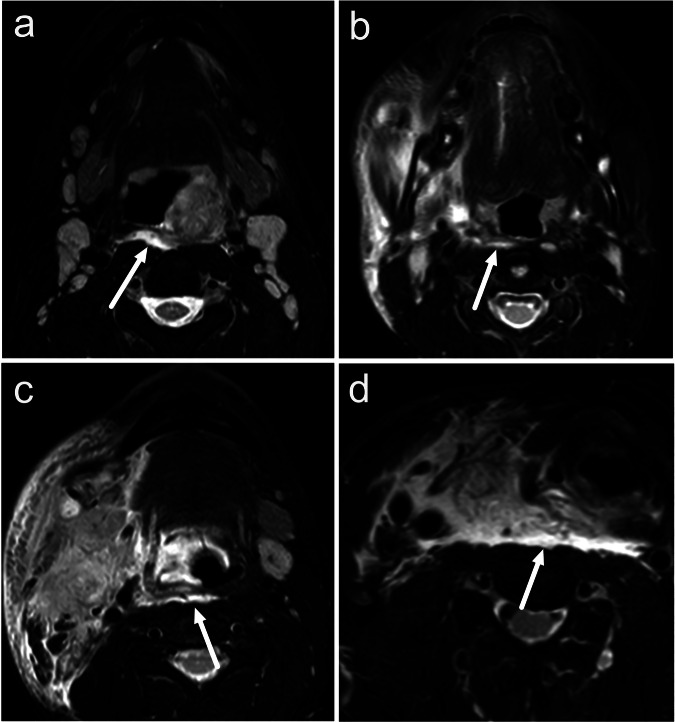
In acute neck infections, magnetic resonance imaging (MRI) shows retropharyngeal edema (RPE), which is a prognostic imaging biomarker for a severe course of illness. This study aimed to develop a deep learning-based algorithm for the automated detection of RPE.
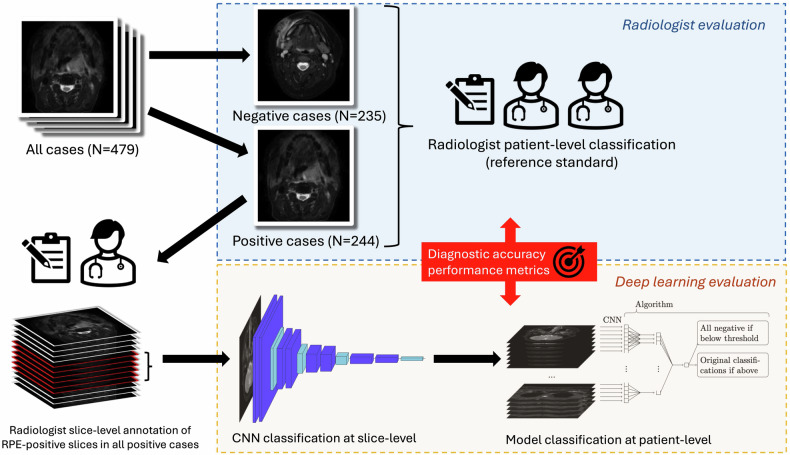
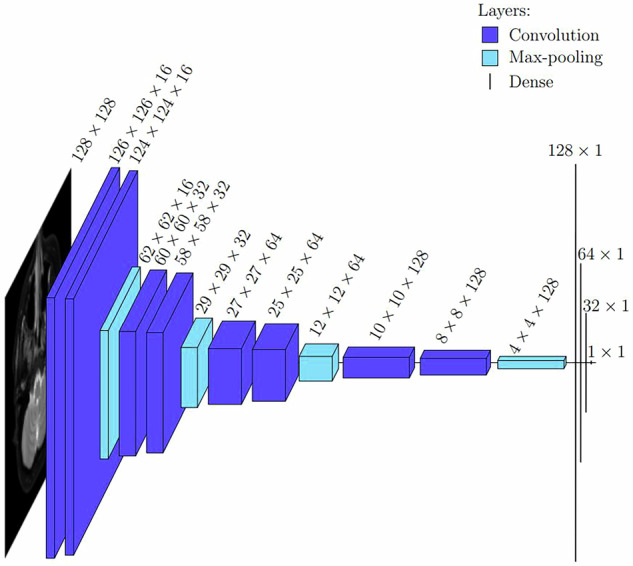
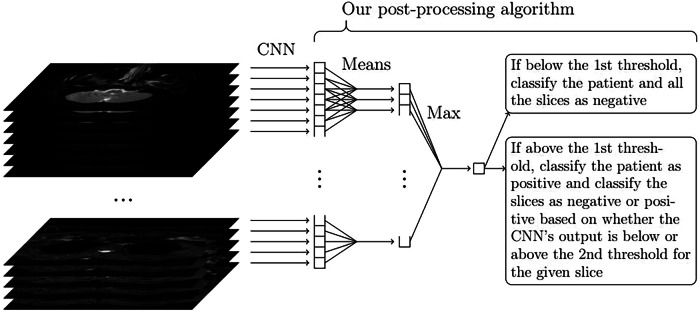
We developed a deep neural network consisting of two parts using axial T2-weighted water-only Dixon MRI images from 479 patients with acute neck infections annotated by radiologists at both slice and patient levels. First, a convolutional neural network (CNN) classified individual slices; second, an algorithm classified patients based on a stack of slices. Model performance was compared with the radiologists' assessment as a reference standard. Accuracy, sensitivity, specificity, and area under receiver operating characteristic curve (AUROC) were calculated. The proposed CNN was compared with InceptionV3, and the patient-level classification algorithm was compared with traditional machine learning models.
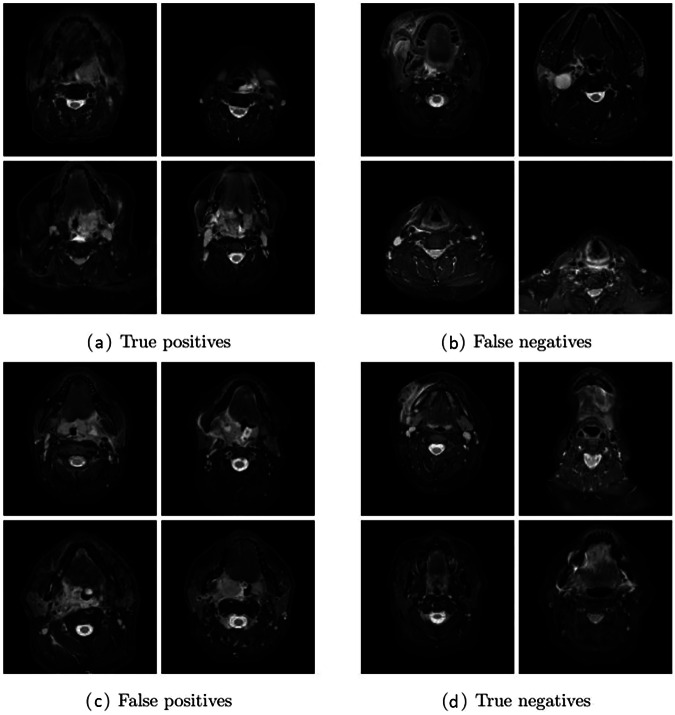
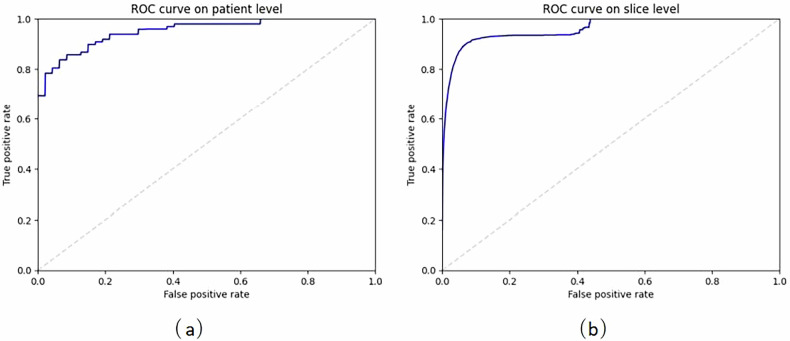
Of the 479 patients, 244 (51%) were positive and 235 (49%) negative for RPE. Our model achieved accuracy, sensitivity, specificity, and AUROC of 94.6%, 83.3%, 96.2%, and 94.1% at the slice level, and 87.4%, 86.5%, 88.2%, and 94.8% at the patient level, respectively. The proposed CNN was faster than InceptionV3 but equally accurate. Our patient classification algorithm outperformed traditional machine learning models.
A deep learning model, based on weakly annotated data and computationally manageable training, achieved high accuracy for automatically detecting RPE on MRI in patients with acute neck infections.
Our automated method for detecting relevant MRI findings was efficiently trained and might be easily deployed in practice to study clinical applicability. This approach might improve early detection of patients at high risk for a severe course of acute neck infections.
Deep learning automatically detected retropharyngeal edema on MRI in acute neck infections. Areas under the receiver operating characteristic curve were 94.1% at the slice level and 94.8% at the patient level. The proposed convolutional neural network was lightweight and required only weakly annotated data.
在急性颈部感染中,磁共振成像(MRI)显示咽后水肿(RPE),这是疾病严重病程的一种预后影像生物标志物。本研究旨在开发一种基于深度学习的算法,用于自动检测RPE。
我们使用479例急性颈部感染患者的轴向T2加权仅水相Dixon MRI图像,开发了一个由两部分组成的深度神经网络,这些图像由放射科医生在切片和患者层面进行标注。首先,一个卷积神经网络(CNN)对单个切片进行分类;其次,一种算法基于一叠切片对患者进行分类。将模型性能与放射科医生的评估作为参考标准进行比较。计算准确性、敏感性、特异性和受试者操作特征曲线下面积(AUROC)。将所提出的CNN与InceptionV3进行比较,并将患者层面的分类算法与传统机器学习模型进行比较。
在479例患者中,244例(51%)RPE呈阳性,235例(49%)呈阴性。我们的模型在切片层面的准确性、敏感性、特异性和AUROC分别为94.6%、83.3%、96.2%和94.1%,在患者层面分别为87.4%、86.5%、88.2%和94.8%。所提出的CNN比InceptionV3速度更快,但准确性相同。我们的患者分类算法优于传统机器学习模型。
一个基于弱标注数据且计算可管理的深度学习模型,在自动检测急性颈部感染患者MRI上的RPE方面取得了高精度。
我们用于检测相关MRI结果的自动化方法经过了有效训练,可能很容易在实践中部署以研究临床适用性。这种方法可能会改善对急性颈部感染严重病程高风险患者的早期检测。
深度学习在急性颈部感染的MRI上自动检测到咽后水肿。受试者操作特征曲线下面积在切片层面为94.1%,在患者层面为94.8%。所提出的卷积神经网络轻量级,仅需要弱标注数据。