Kunming Key Laboratory of Children Infection and Immunity, Yunnan Key Laboratory of Children's Major Disease Research, Yunnan Medical Center for Pediatric Diseases, Yunnan Institute of Pediatrics, Kunming Children's Hospital, Kunming, Yunnan, China.
Department of Endocrinology, Kunming Children's Hospital, Kunming, Yunnan, China.
Mol Genet Genomic Med. 2021 Sep;9(9):e1761. doi: 10.1002/mgg3.1761. Epub 2021 Jul 31.
Microcephalic osteodysplastic primordial dwarfism type II (MOPD II) is a rare autosomal recessive disorder characterized by severe pre- and postnatal growth restrictions, microcephaly, skeletal dysplasia, severe teeth deformities, and typical facial features. Previous studies have shown that MOPD II is associated with mutations in the pericentrin (PCNT) gene.
We evaluated the clinical features of a 10-year and 7-month-old Chinese girl with MOPD II. Subsequently, next-generation sequencing and flow cytometry were performed to investigate genetic characteristics and the expression of PCNT protein respectively.
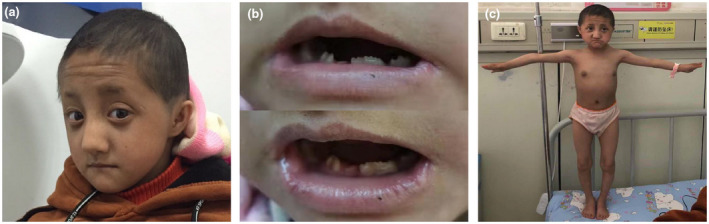
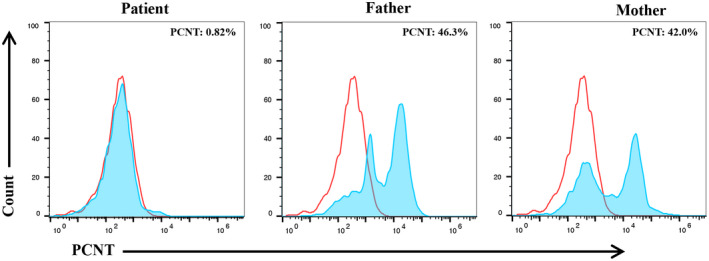
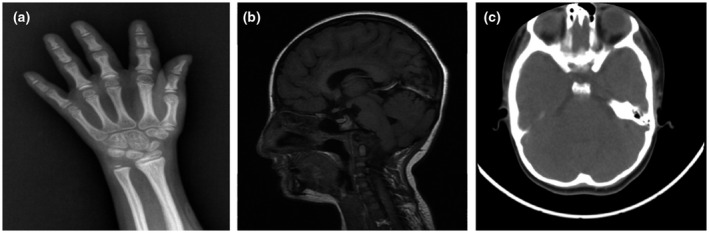
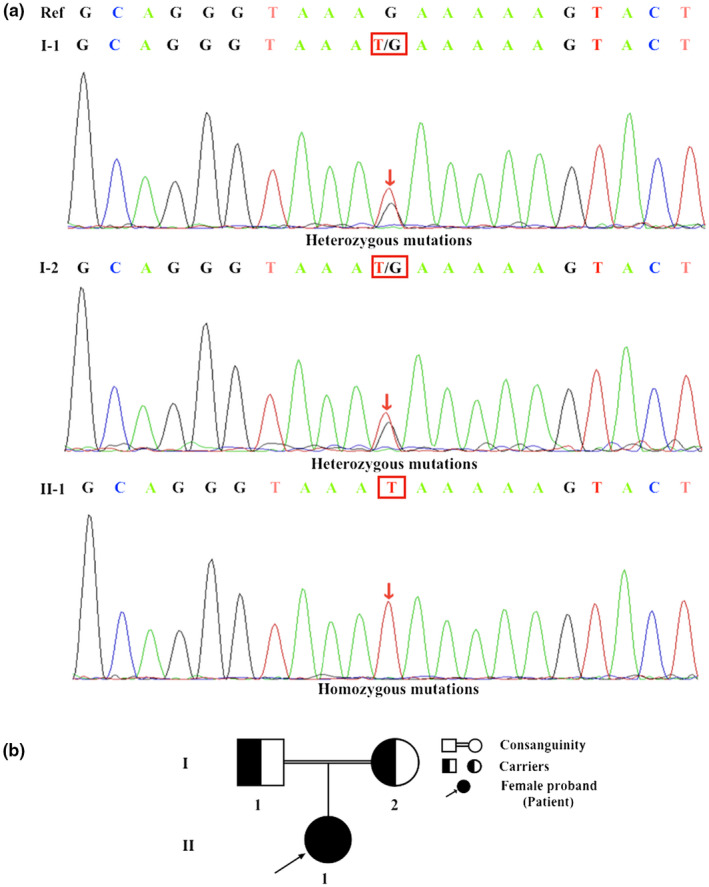
The patient presented with short stature, microcephaly, typical craniofacial features, teeth deformity, thrombocytosis, and a delayed bone age (approximately 7 years). No abnormality in growth hormone or insulin-like growth factor 1 was detected. Notably, the patient was found to carry a novel homozygous PCNT mutation (c.6157G>T, p.Glu2053Ter), which was inherited from her healthy heterozygous parents. Meanwhile, significant deficiency of PCNT expression was identified in the patient.
Our study identified a novel PCNT mutation associated with MOPD II, expanded the mutation spectrum of the PCNT gene and improved our understanding of the molecular basis of MOPD II.
小头骨-牙-软骨发育不全综合征 II 型(MOPD II)是一种罕见的常染色体隐性遗传病,其特征为严重的产前和产后生长受限、小头畸形、骨骼发育不良、严重的牙齿畸形和典型的面部特征。先前的研究表明,MOPD II 与中心体蛋白(PCNT)基因的突变有关。
我们评估了一名 10 岁 7 个月大的中国女孩的 MOPD II 临床特征。随后,进行了下一代测序和流式细胞术分别对遗传特征和 PCNT 蛋白的表达进行了研究。
该患者表现为身材矮小、小头畸形、典型的颅面特征、牙齿畸形、血小板增多症和骨龄延迟(约 7 岁)。生长激素或胰岛素样生长因子 1 检测未见异常。值得注意的是,该患者携带一种新的纯合 PCNT 突变(c.6157G>T,p.Glu2053Ter),该突变是从其健康的杂合父母遗传而来的。同时,该患者的 PCNT 表达明显缺乏。
本研究发现了一种与 MOPD II 相关的新型 PCNT 突变,扩展了 PCNT 基因突变谱,加深了对 MOPD II 分子基础的认识。