College of Medicine, Korea University, Seoul, Republic of Korea.
Samsung Advanced Institute for Health Sciences & Technology (SAIHST), Sungkyunkwan University, Samsung Medical Center, Irwon-ro 81, Gangnam-gu, Seoul 06351, Republic of Korea.
Eur Heart J. 2021 Sep 7;42(34):3388-3403. doi: 10.1093/eurheartj/ehab454.
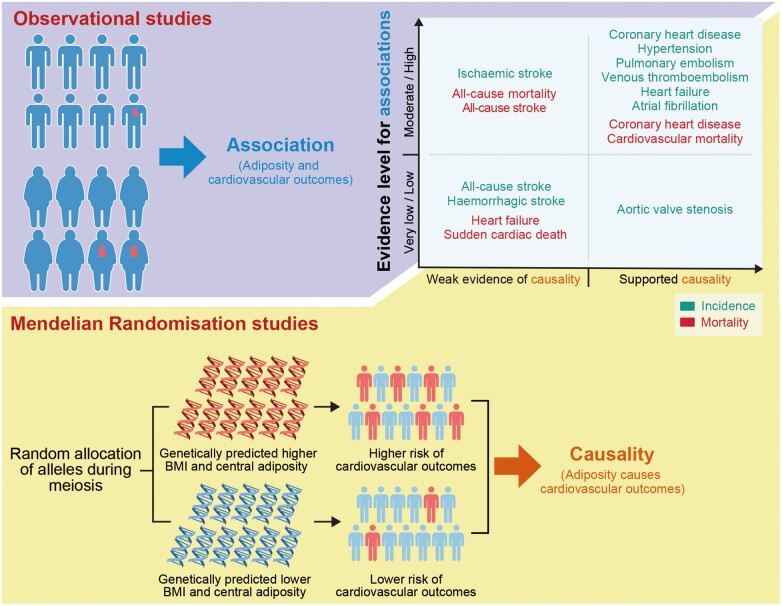
The aim of this study was to investigate the causal relationship and evidence of an association between increased adiposity and the risk of incident cardiovascular disease (CVD) events or mortality.
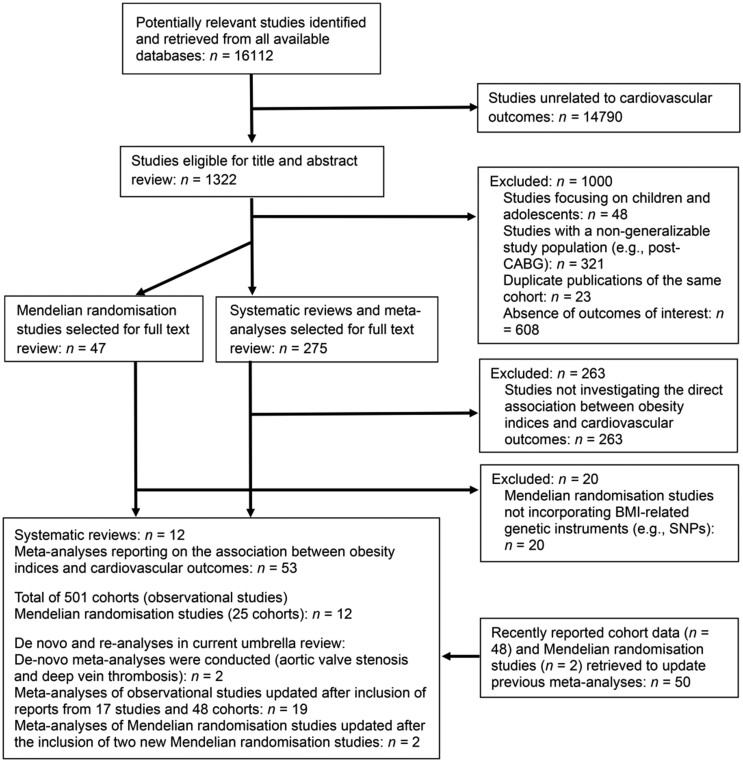
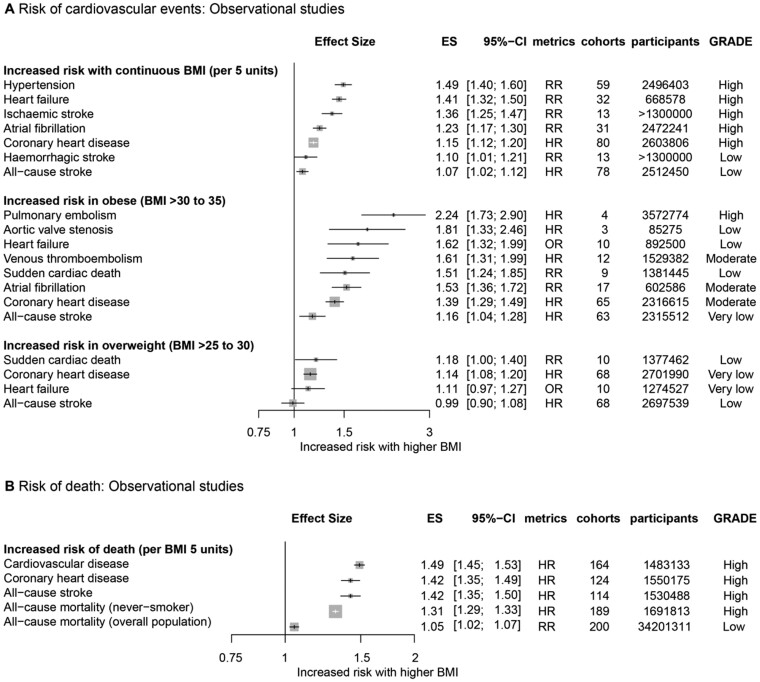
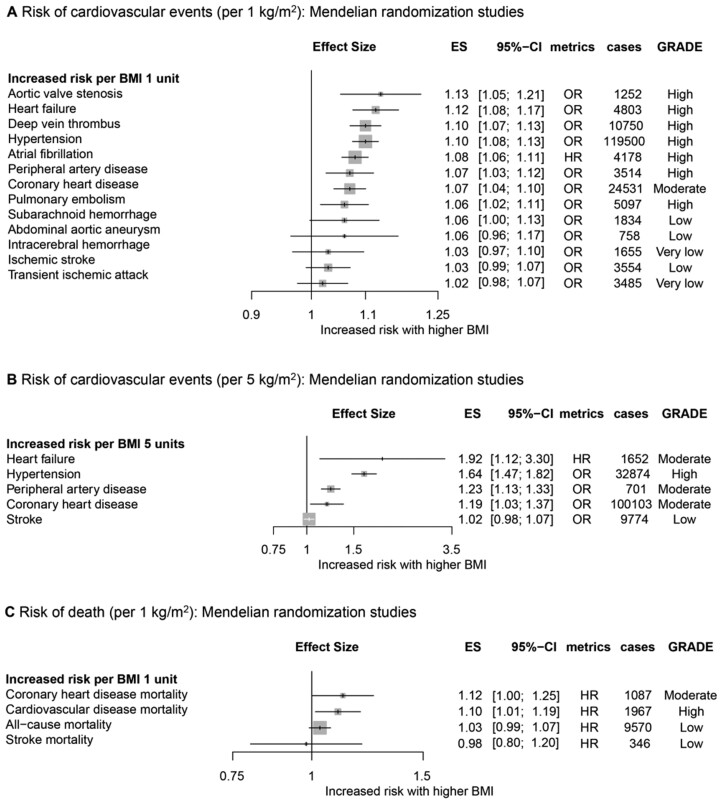
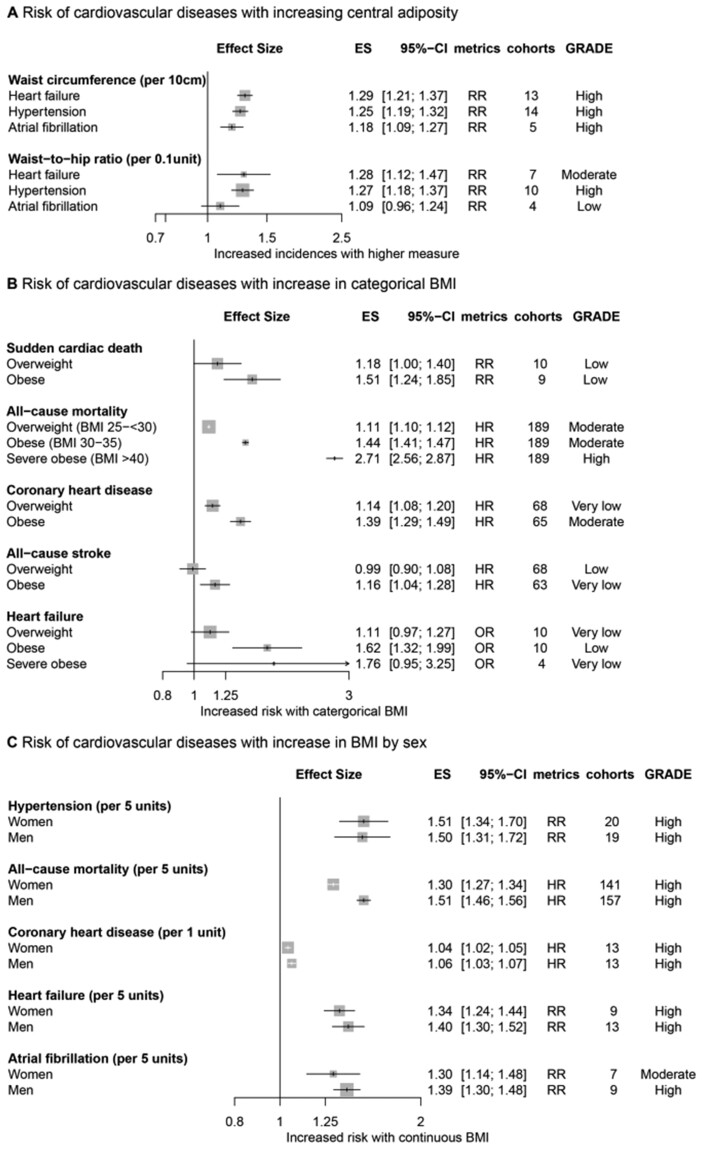
Observational (informing association) and Mendelian randomization (MR) (informing causality) studies were assessed to gather mutually complementary insights and elucidate perplexing epidemiological relationships. Systematic reviews and meta-analyses of observational and MR studies that were published until January 2021 and evaluated the association between obesity-related indices and CVD risk were searched. Twelve systematic reviews with 53 meta-analyses results (including over 501 cohort studies) and 12 MR studies were included in the analysis. A body mass index (BMI) increase was associated with higher risks of coronary heart disease, heart failure, atrial fibrillation, all-cause stroke, haemorrhagic stroke, ischaemic stroke, hypertension, aortic valve stenosis, pulmonary embolism, and venous thrombo-embolism. The MR study results demonstrated a causal effect of obesity on all indices but stroke. The CVD risk increase for every 5 kg/m2 increase in BMI varied from 10% [relative risk (RR) 1.10; 95% confidence interval (CI) 1.01-1.21; certainty of evidence, low] for haemorrhagic stroke to 49% (RR 1.49; 95% CI 1.40-1.60; certainty of evidence, high) for hypertension. The all-cause and CVD-specific mortality risks increased with adiposity in cohorts, but the MR studies demonstrated no causal effect of adiposity on all-cause mortality.
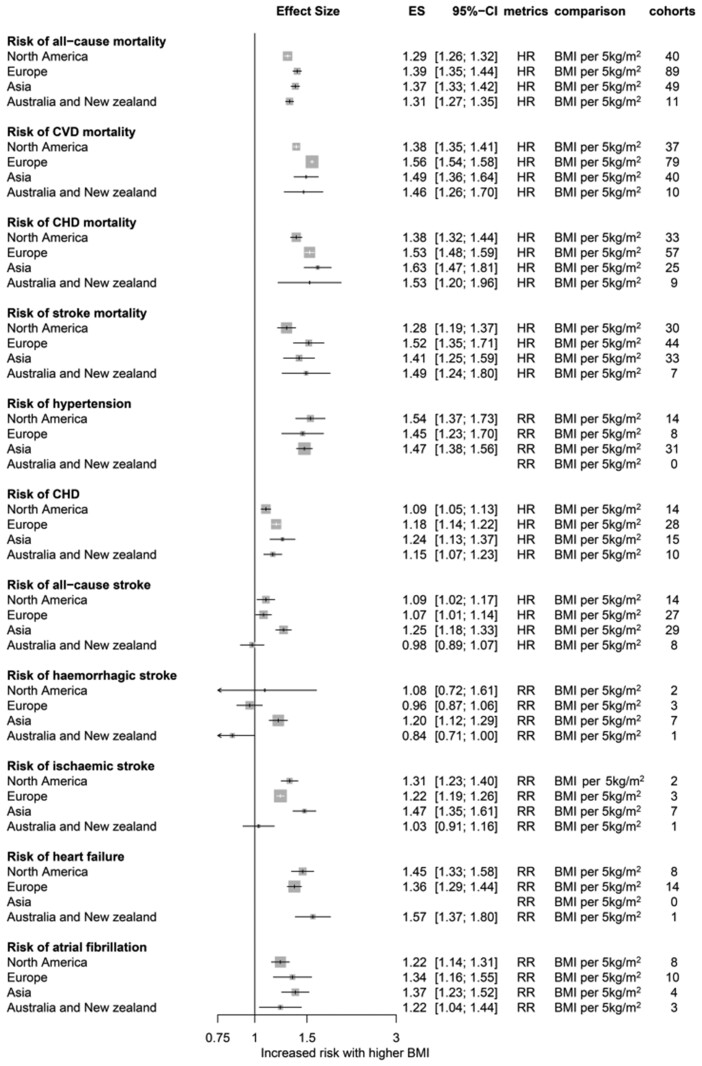
High adiposity is associated with increased CVD risk despite divergent evidence gradients. Adiposity was a causal risk factor for CVD except all-cause mortality and stroke. Half (49%; 26/53) of the associations were supported by high-level evidence. The associations were consistent between sexes and across global regions. This study provides guidance on how to integrate evidence from observational (association) and genetics-driven (causation) studies accumulated to date, to enable a more reliable interpretation of epidemiological relationships.
本研究旨在探讨肥胖与心血管疾病(CVD)事件或死亡率风险增加之间的因果关系和关联证据。
评估观察性(关联)和孟德尔随机化(MR)(因果关系)研究,以收集相互补充的见解并阐明复杂的流行病学关系。系统检索了截至 2021 年 1 月评估肥胖相关指标与 CVD 风险之间关联的观察性和 MR 研究的综述和荟萃分析。共纳入 12 项系统综述和 53 项荟萃分析结果(包括 501 项队列研究)和 12 项 MR 研究。结果显示,体重指数(BMI)增加与冠心病、心力衰竭、心房颤动、全因卒中、出血性卒中、缺血性卒、高血压、主动脉瓣狭窄、肺栓塞和静脉血栓栓塞的风险增加相关。MR 研究结果表明肥胖对所有指标(除卒中外)均有因果作用。BMI 每增加 5kg/m2,CVD 风险增加 10%(相对风险[RR]1.10;95%置信区间[CI]1.01-1.21;证据确定性,低),出血性卒中增加 49%(RR 1.49;95% CI 1.40-1.60;证据确定性,高)。队列研究中,全因和 CVD 特异性死亡率随肥胖程度增加而增加,但 MR 研究表明肥胖对全因死亡率无因果影响。
尽管证据梯度存在差异,但肥胖与 CVD 风险增加有关。肥胖是 CVD 的一个因果危险因素,但不是全因死亡的危险因素。有一半(49%;26/53)的关联得到了高级别证据的支持。这些关联在性别间和全球各地区均一致。本研究为如何整合迄今为止积累的观察性(关联)和遗传学驱动(因果)研究证据提供了指导,以便更可靠地解释流行病学关系。