
比较毒性和非毒性剂量的生物银纳米粒子与化学银纳米粒子对大鼠新生小脑可能引起的组织病理学变化。
Comparison of the possible histopathological changes of the rat neonatal cerebellum induced by toxic and nontoxic doses of biological silver nanoparticles with chemical silver nanoparticles.
机构信息
Department of Medical Sciences, Shahrood Branch, Islamic Azad University, Shahrood, Iran.
Department of Medical Sciences, Mashhad Branch, Islamic Azad University, Mashhad, Iran.
出版信息
Brain Behav. 2021 Aug;11(8):e2319. doi: 10.1002/brb3.2319. Epub 2021 Aug 1.
INTRODUCTION
Today, due to the increasing application of silver nanoparticles in medical products, it is necessary to pay attention to the user's safety. There are three methods, namely, chemical, physical, and biological, used for the production of nanoparticles. Although the first two methods might introduce health hazards, the latter is hypothetically safe. In this study, we examined the histopathological changes in the cerebellum of neonatal Wistar rats induced by injection of toxic and nontoxic doses of silver nanoparticles, which were produced by green synthetic method and were compared with chemical silver nanoparticles.
METHODS
This study was a laboratory interventional study performed on 25 Wistar rats in the Animal Laboratory of Islamic Azad University of Shahrood. These rats were divided into five groups of the control group, the group with nonpoisonous injection of chemical nanoparticles, the group with nonpoisonous injection of biological nanoparticles, the group with injection of poisonous chemical nanoparticles, and the group with injection of poisonous biological nanoparticles. The rats were impregnated by the males of the same race and the cerebellum of their offspring was studied after birth.
RESULTS
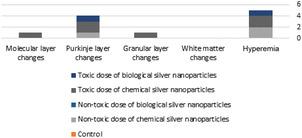
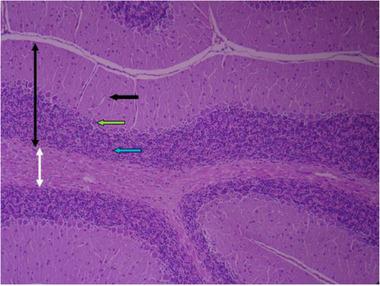
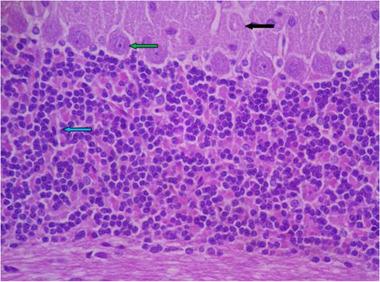
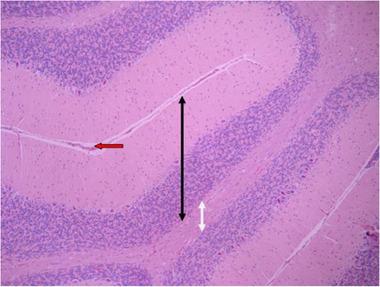
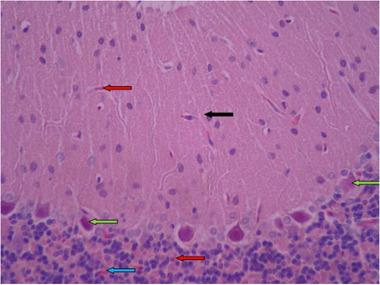
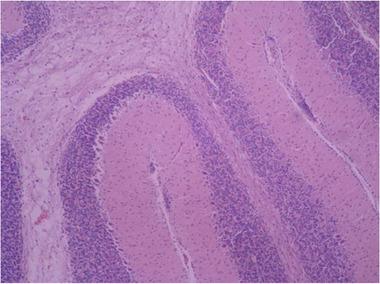
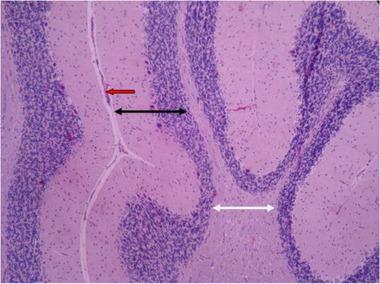
We found that the injection of nonpoisonous chemical nanoparticles caused hyperemia, inappropriate size, and dark cytoplasm in some Purkinje cells. Also, injection of poisonous chemical nanoparticles caused hyperemia and cellular dispersion in the molecular layer, caused abnormal shapes, and reduced the number of cells in Purkinje cells. However, injection of poisonous and nonpoisonous biological nanoparticles did not alter cerebellum cells nor did it cause any inflammation or hyperemia.
CONCLUSION
In contrast with chemical nanoparticles, biological nanoparticles have less significant effect on the cerebellum cells.
简介
如今,由于银纳米粒子在医疗产品中的应用日益广泛,人们必须关注使用者的安全问题。生产纳米粒子的方法有三种,分别是化学法、物理法和生物法。虽然前两种方法可能会带来健康风险,但后一种方法理论上是安全的。在这项研究中,我们研究了通过注射有毒和无毒剂量的银纳米粒子对新生 Wistar 大鼠小脑组织引起的组织病理学变化,这些纳米粒子是通过绿色合成方法制备的,并与化学银纳米粒子进行了比较。
方法
这是在伊斯兰阿扎德大学沙赫罗德动物实验室进行的一项实验室干预研究,共有 25 只 Wistar 大鼠参与。这些大鼠被分为五组:对照组、无毒化学纳米粒子注射组、无毒生物纳米粒子注射组、有毒化学纳米粒子注射组和有毒生物纳米粒子注射组。雄性大鼠与雌性大鼠交配,其后代出生后研究其小脑组织。
结果
我们发现,注射无毒化学纳米粒子会导致部分浦肯野细胞出现充血、大小不当和细胞质变暗。此外,注射有毒化学纳米粒子会导致分子层充血和细胞弥散,使浦肯野细胞形状异常,细胞数量减少。然而,注射有毒和无毒生物纳米粒子均未改变小脑细胞,也未引起任何炎症或充血。
结论
与化学纳米粒子相比,生物纳米粒子对小脑细胞的影响较小。




 Zotero 插件