Nacher-Soler German, Lenglet Sébastien, Coelho Marta, Thomas Aurélien, Voruz François, Krause Karl-Heinz, Senn Pascal, Rousset Francis
The Inner Ear and Olfaction Lab, Department of Pathology and Immunology, Faculty of Medicine, University of Geneva, Geneva, Switzerland.
Forensic Toxicology and Chemistry Unit, University Centre for Legal Medicine, Geneva University Hospital, Geneva, Switzerland.
Front Cell Neurosci. 2021 Jul 14;15:701783. doi: 10.3389/fncel.2021.701783. eCollection 2021.
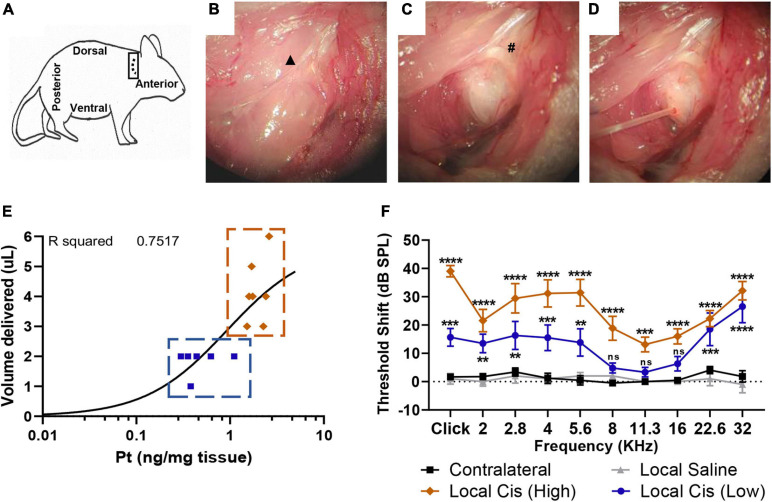
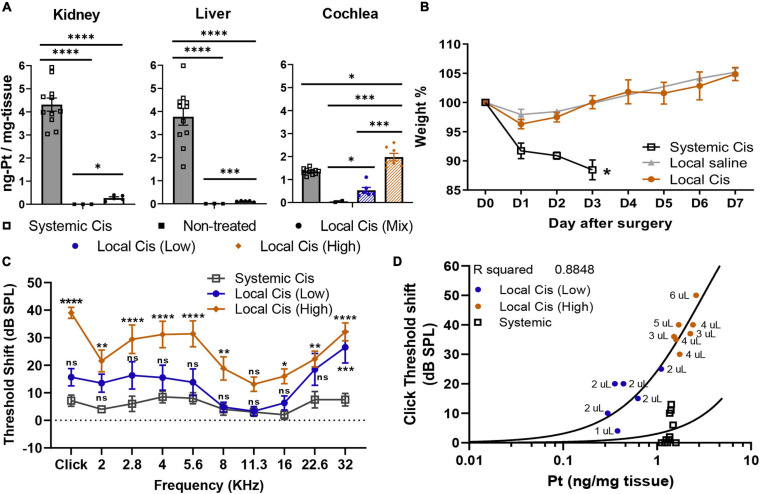
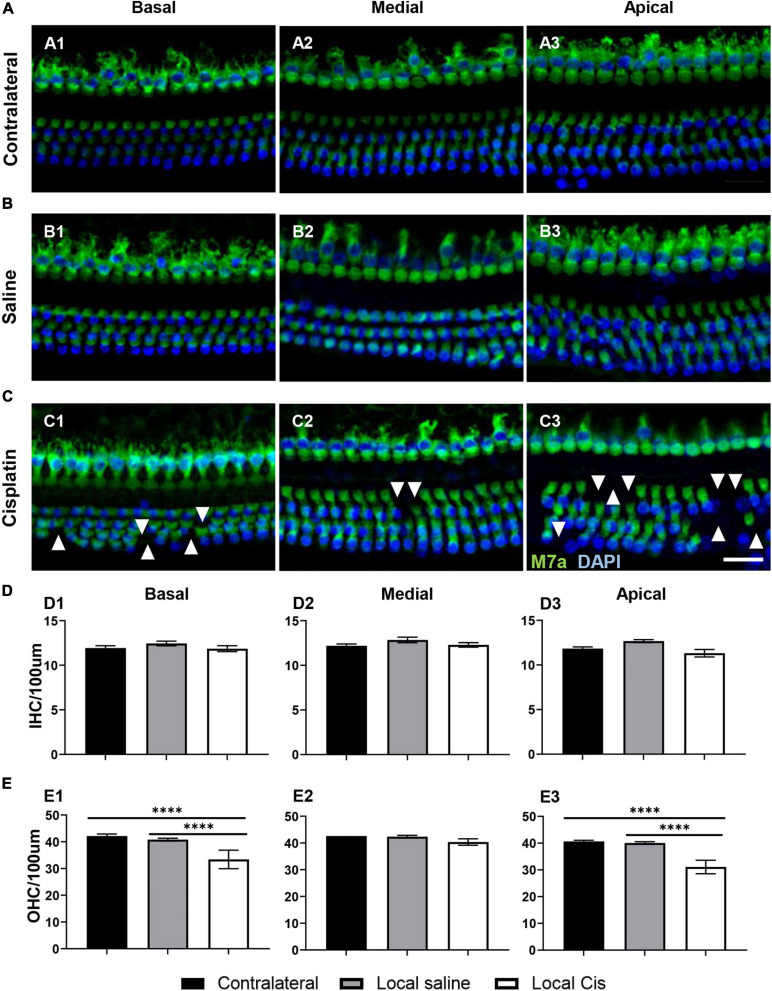
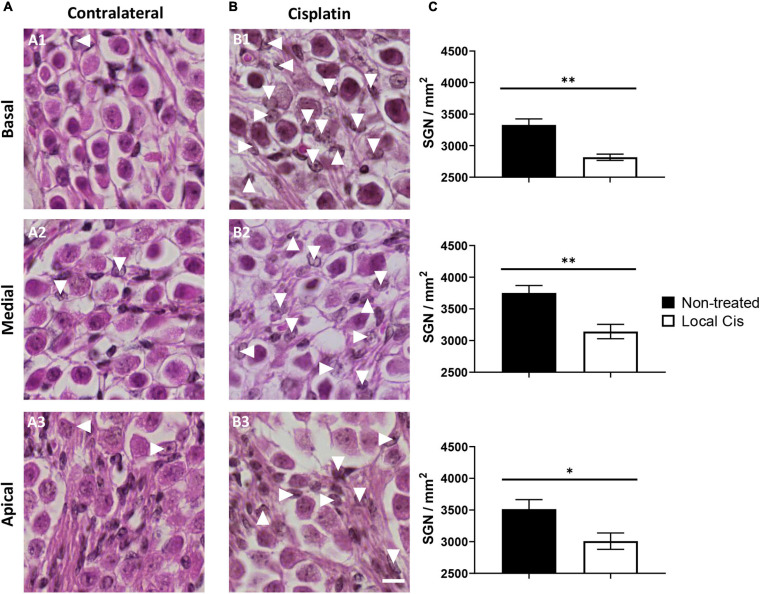
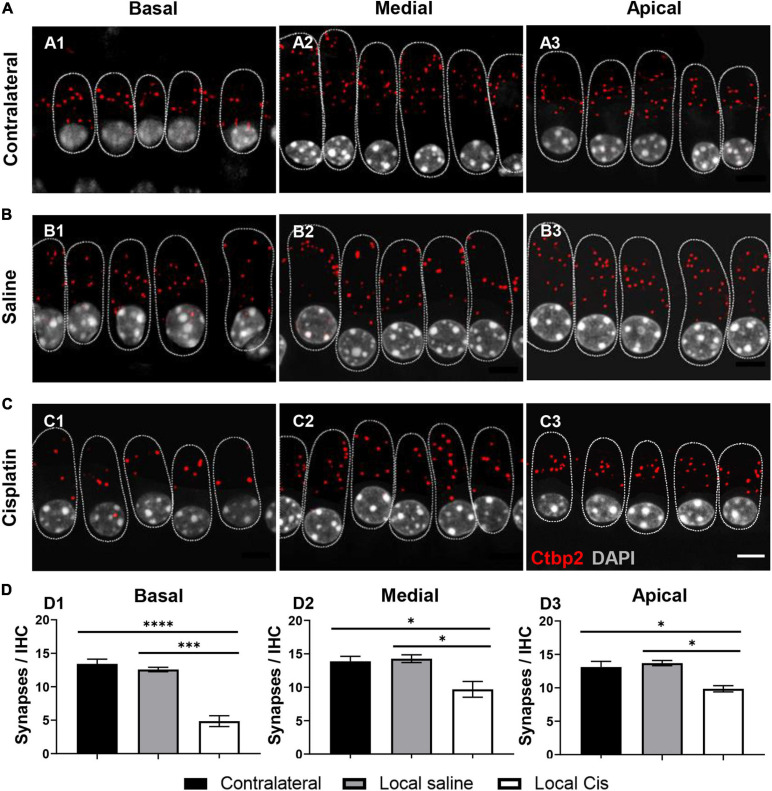
Cisplatin is a lifesaving chemotherapeutic drug with marked ototoxic adverse effects. Cisplatin-induced hearing loss affects a significant part of cancer-surviving patients and is an unmet clinical need with important socioeconomic consequences. Unfortunately, in current preclinical animal models of cisplatin ototoxicity, which are mainly based on systemic delivery, important morbidity is observed, leading to premature death. This methodology not only raises obvious animal welfare concerns but also increases the number of animals used in ototoxicity studies to compensate for dropouts related to early death. To overcome these important limitations, we developed a local delivery model based on the application of a cisplatin solution directly into the otic bulla through a retroauricular approach. The local delivery model reliably induced significant hearing loss with a mean threshold shift ranging from 10 to 30 dB, strongly affecting the high frequencies (22 and 32 kHz). Importantly, mice did not show visible stress or distress indicators and no significant morbidity in comparison with a traditional systemic delivery control group of mice injected intraperitoneally with 10 mg/kg cisplatin, where significant weight loss >10% in all treated animals (without any recovery) led to premature abortion of experiments on day 3. Mass spectrometry confirmed the absence of relevant systemic uptake after local delivery, with platinum accumulation restricted to the cochlea, whereas important platinum concentrations were detected in the liver and kidney of the systemic cisplatin group. A clear correlation between the cochlear platinum concentration and the auditory threshold shift was observed. Immunohistochemistry revealed statistically significant loss of outer hair cells in the basal and apical turns of the cochlea and an important and statistically significant loss of auditory neurons and synapses in all cochlear regions. In conclusion, local cisplatin delivery induces robust hearing loss with minimal morbidity, thereby offering a reliable rodent model for human cisplatin ototoxicity, reducing the number of animals required and showing improved animal welfare compared with traditional systemic models.
顺铂是一种挽救生命的化疗药物,但具有明显的耳毒性副作用。顺铂诱导的听力损失影响了相当一部分癌症存活患者,是一个尚未满足的临床需求,具有重要的社会经济后果。不幸的是,在目前主要基于全身给药的顺铂耳毒性临床前动物模型中,观察到严重的发病率,导致过早死亡。这种方法不仅引发了明显的动物福利问题,还增加了耳毒性研究中使用的动物数量,以补偿与早期死亡相关的实验失败。为了克服这些重要限制,我们开发了一种局部给药模型,该模型基于通过耳后途径将顺铂溶液直接注入中耳泡。局部给药模型可靠地诱导了显著的听力损失,平均阈值偏移范围为10至30 dB,强烈影响高频(22和32 kHz)。重要的是,与传统的全身给药对照组小鼠相比,小鼠未表现出明显的应激或痛苦指标,也没有明显的发病率。传统全身给药对照组小鼠腹腔注射10 mg/kg顺铂,所有治疗动物体重显著减轻>10%(无任何恢复),导致在第3天实验提前终止。质谱分析证实局部给药后没有相关的全身吸收,铂的积累仅限于耳蜗,而在全身顺铂组的肝脏和肾脏中检测到重要的铂浓度。观察到耳蜗铂浓度与听觉阈值偏移之间存在明显的相关性。免疫组织化学显示,耳蜗基底和顶转中外毛细胞有统计学意义的损失,所有耳蜗区域的听觉神经元和突触有重要且统计学意义的损失。总之,局部顺铂给药诱导了强烈且发病率最小的听力损失,从而为人类顺铂耳毒性提供了一种可靠的啮齿动物模型,与传统的全身模型相比,减少了所需动物数量,并显示出改善的动物福利。