
前交叉韧带重建术后六周患者中与姿势控制相关的功能性皮质连接
Functional Cortical Connectivity Related to Postural Control in Patients Six Weeks After Anterior Cruciate Ligament Reconstruction.
作者信息
Lehmann Tim, Büchel Daniel, Mouton Caroline, Gokeler Alli, Seil Romain, Baumeister Jochen
机构信息
Exercise Science and Neuroscience Unit, Department of Exercise & Health, Faculty of Science, Paderborn University, Paderborn, Germany.
Department of Orthopaedic Surgery, Clinique D'Eich, Centre Hospitalier de Luxembourg, Luxembourg, Luxembourg.
出版信息
Front Hum Neurosci. 2021 Jul 15;15:655116. doi: 10.3389/fnhum.2021.655116. eCollection 2021.
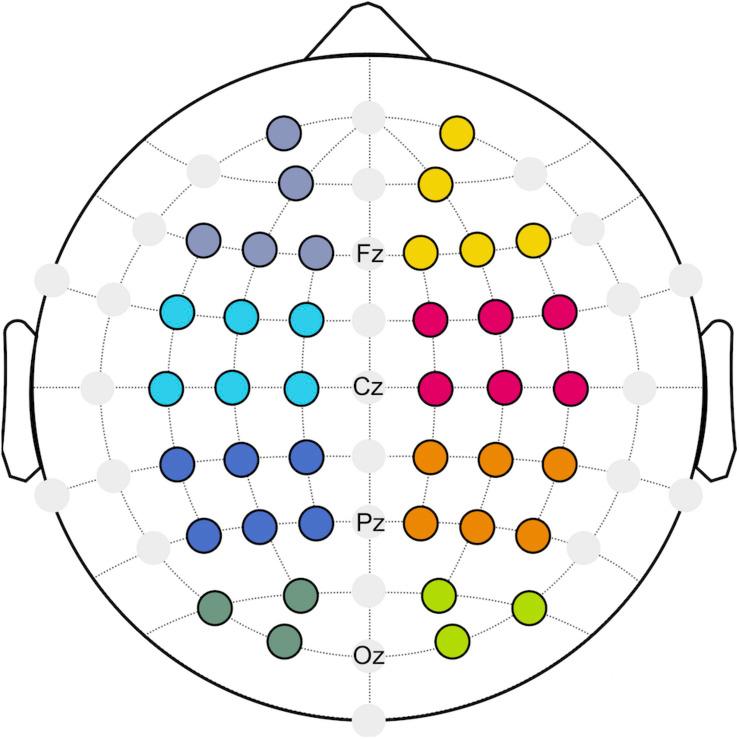
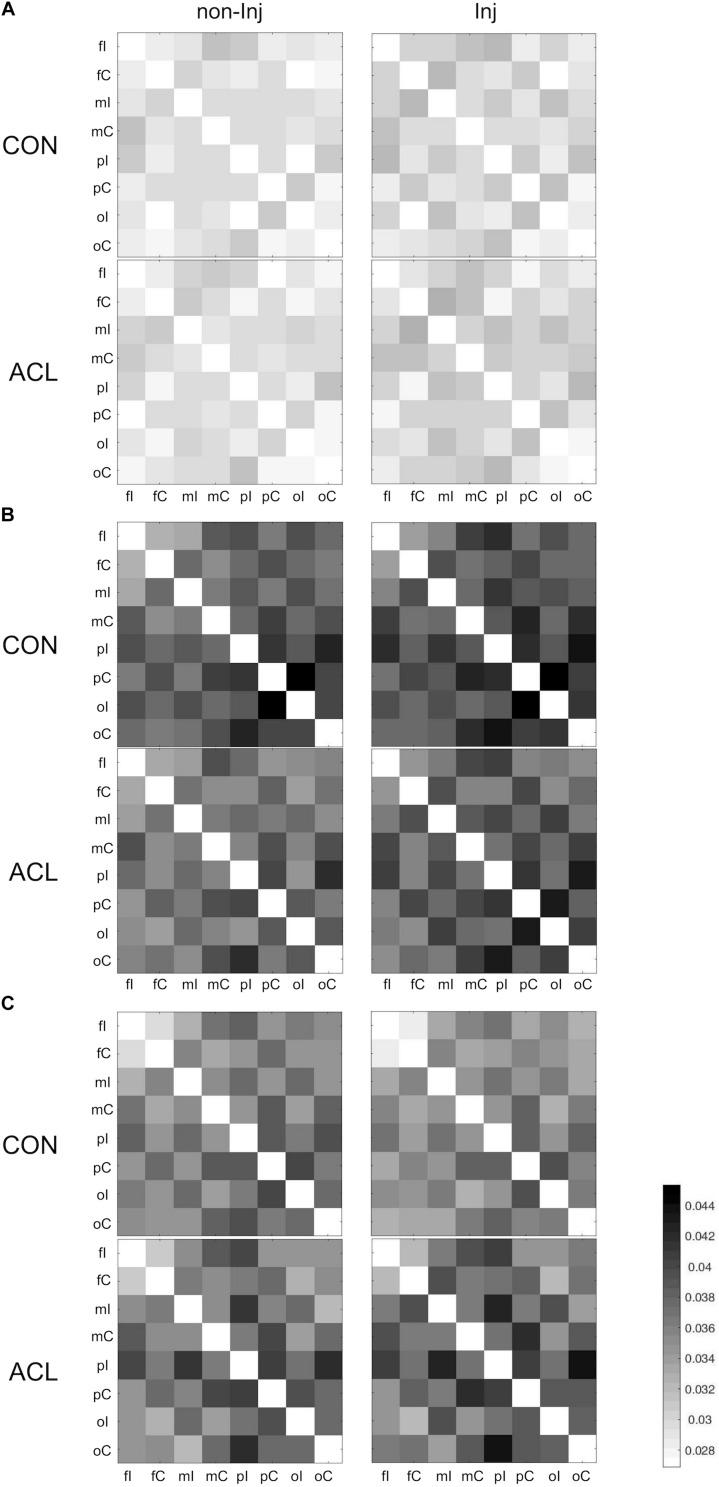
Whereas initial findings have already identified cortical patterns accompanying proprioceptive deficiencies in patients after anterior cruciate ligament reconstruction (ACLR), little is known about compensatory sensorimotor mechanisms for re-establishing postural control. Therefore, the aim of the present study was to explore leg dependent patterns of cortical contributions to postural control in patients 6 weeks following ACLR. A total of 12 patients after ACLR (25.1 ± 3.2 years, 178.1 ± 9.7 cm, 77.5 ± 14.4 kg) and another 12 gender, age, and activity matched healthy controls participated in this study. All subjects performed 10 × 30 s. single leg stances on each leg, equipped with 64-channel mobile electroencephalography (EEG). Postural stability was quantified by area of sway and sway velocity. Estimations of the weighted phase lag index were conducted as a cortical measure of functional connectivity. The findings showed significant group × leg interactions for increased functional connectivity in the anterior cruciate ligament (ACL) injured leg, predominantly including fronto-parietal [ = 8.41, ≤ 0.008, η = 0.28], fronto-occipital [ = 4.43, ≤ 0.047, η = 0.17], parieto-motor [ = 10.30, ≤ 0.004, η = 0.32], occipito-motor [ = 5.21, ≤ 0.032, η = 0.19], and occipito-parietal [ = 4.60, ≤ 0.043, η = 0.17] intra-hemispherical connections in the contralateral hemisphere and occipito-motor [ = 7.33, ≤ 0.013, η = 0.25] on the ipsilateral hemisphere to the injured leg. Higher functional connectivity in patients after ACLR, attained by increased emphasis of functional connections incorporating the somatosensory and visual areas, may serve as a compensatory mechanism to control postural stability of the injured leg in the early phase of rehabilitation. These preliminary results may help to develop new neurophysiological assessments for detecting functional deficiencies after ACLR in the future.
虽然初步研究结果已经确定了前交叉韧带重建(ACLR)术后患者本体感觉缺陷所伴随的皮质模式,但对于重新建立姿势控制的代偿性感觉运动机制却知之甚少。因此,本研究的目的是探讨ACLR术后6周患者中皮质对姿势控制的腿部依赖性贡献模式。共有12例ACLR术后患者(25.1±3.2岁,178.1±9.7厘米,77.5±14.4千克)和另外12名性别、年龄和活动量相匹配的健康对照者参与了本研究。所有受试者在每条腿上进行10次×30秒的单腿站立,同时配备64通道移动脑电图(EEG)。姿势稳定性通过摆动面积和摆动速度进行量化。加权相位滞后指数的估计作为功能连接性的皮质测量指标。研究结果显示,在受伤的前交叉韧带(ACL)腿中,功能连接性增加存在显著的组×腿交互作用,主要包括对侧半球的额顶叶[F = 8.41,p≤0.008,η = 0.28]、额枕叶[F = 4.43,p≤0.047,η = 0.17]、顶叶-运动区[F = 10.30,p≤0.004,η = 0.32]、枕叶-运动区[F = 5.21,p≤0.032,η = 0.19]和枕顶叶[F = 4.60,p≤0.043,η = 0.17]半球内连接,以及受伤腿同侧半球的枕叶-运动区[F = 7.33,p≤0.013,η = 0.25]。ACLR术后患者中更高的功能连接性,通过增加对包含体感和视觉区域的功能连接的强调来实现,可能作为一种代偿机制,在康复早期控制受伤腿的姿势稳定性。这些初步结果可能有助于未来开发新的神经生理学评估方法,以检测ACLR后的功能缺陷。



 Zotero 插件