Aix Marseille Univ, CNRS, INSERM, CIML, Marseille, France.
Department of Hematology, Institut Paoli-Calmettes, Marseille, France.
Front Immunol. 2021 Jul 16;12:683597. doi: 10.3389/fimmu.2021.683597. eCollection 2021.
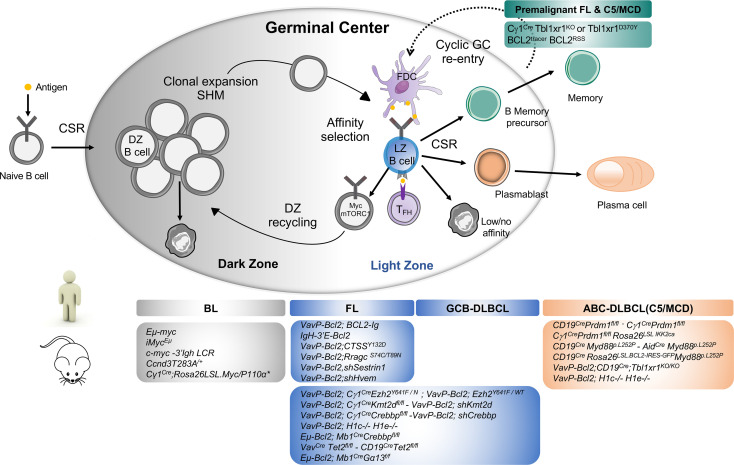
Lymphomas are cancers deriving from lymphocytes, arising preferentially in secondary lymphoid organs, and represent the 6th cancer worldwide and the most frequent blood cancer. The majority of B cell Non-Hodgkin lymphomas (B-NHL) develop from germinal center (GC) experienced mature B cells. GCs are transient structures that form in lymphoid organs in response to antigen exposure of naive B cells, and where B cell receptor (BCR) affinity maturation occurs to promote B cell differentiation into memory B and plasma cells producing high-affinity antibodies. Genomic instability associated with the somatic hypermutation (SHM) and class-switch recombination (CSR) processes during GC transit enhance susceptibility to malignant transformation. Most B cell differentiation steps in the GC are at the origin of frequent B cell malignant entities, namely Follicular Lymphoma (FL) and GCB diffuse large B cell lymphomas (GCB-DLBCL). Over the past decade, large sequencing efforts have provided a great boost in the identification of candidate oncogenes and tumor suppressors involved in FL and DLBCL oncogenesis. Mouse models have been instrumental to accurately mimic lymphoma-specific mutations and interrogate their normal function in the GC context and their oncogenic function leading to lymphoma onset. The limited access of biopsies during the initiating steps of the disease, the cellular and (epi)genetic heterogeneity of individual tumors across and within patients linked to perturbed dynamics of GC ecosystems make the development of genetically engineered mouse models crucial to decipher lymphomagenesis and disease progression and eventually to test the effects of novel targeted therapies. In this review, we provide an overview of some of the important genetically engineered mouse models that have been developed to recapitulate lymphoma-associated (epi)genetic alterations of two frequent GC-derived lymphoma entities: FL and GCB-DLCBL and describe how those mouse models have improved our knowledge of the molecular processes supporting GC B cell transformation.
淋巴瘤是起源于淋巴细胞的癌症,主要发生在次级淋巴器官,是全球第六大癌症,也是最常见的血液癌。大多数 B 细胞非霍奇金淋巴瘤(B-NHL)源自生发中心(GC)经历过的成熟 B 细胞。GC 是在抗原暴露于幼稚 B 细胞时在淋巴器官中形成的短暂结构,在那里 B 细胞受体(BCR)亲和力成熟发生以促进 B 细胞分化为产生高亲和力抗体的记忆 B 细胞和浆细胞。与体细胞超突变(SHM)和类别转换重组(CSR)过程相关的基因组不稳定性增强了恶性转化的易感性。GC 中转录的大多数 B 细胞分化步骤是经常发生 B 细胞恶性实体的起源,即滤泡性淋巴瘤(FL)和生发中心 B 细胞弥漫性大 B 细胞淋巴瘤(GCB-DLBCL)。在过去的十年中,大规模测序工作极大地促进了鉴定参与 FL 和 DLBCL 发生的候选癌基因和肿瘤抑制因子。小鼠模型对于准确模拟淋巴瘤特异性突变以及在 GC 背景下检测其正常功能及其导致淋巴瘤发生的致癌功能非常重要。在疾病的起始步骤中,活检的获取有限,个体肿瘤之间和内部的细胞和(表观)遗传异质性与 GC 生态系统的动态失调相关,这使得基因工程小鼠模型的发展对于解析淋巴瘤发生和疾病进展并最终测试新型靶向治疗的效果至关重要。在这篇综述中,我们概述了一些已开发的重要基因工程小鼠模型,这些模型可再现两种常见 GC 衍生淋巴瘤实体:FL 和 GCB-DLCBL 相关的(表观)遗传改变,并描述了这些小鼠模型如何提高我们对支持 GC B 细胞转化的分子过程的认识。