Grave-Capistrán Mario Alberto, Prieto-Vázquez Arturo Yishai, Torres-SanMiguel Christopher René
Instituto Politécnico Nacional, Escuela Superior de Ingeniería Mecánica y Eléctrica, Sección de Estudios de Posgrado e Investigación Unidad Zacatenco, 07738, Mexico.
Appl Bionics Biomech. 2021 Jul 19;2021:5555218. doi: 10.1155/2021/5555218. eCollection 2021.
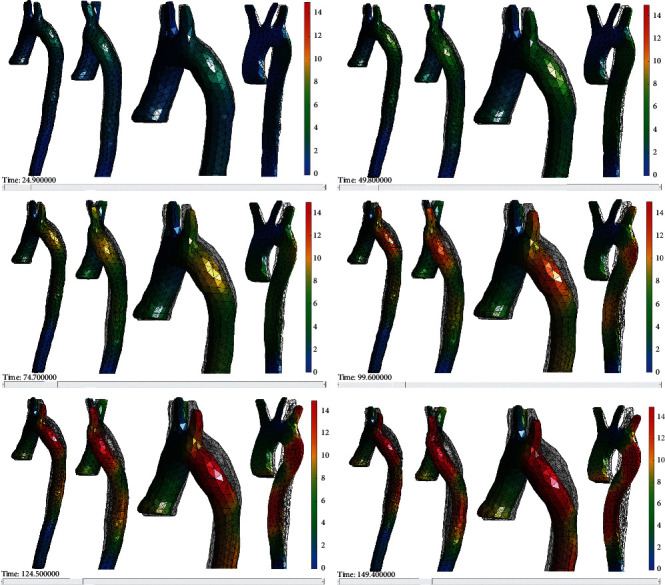
The aorta is the largest artery of the human body, and it is considered in the continuous medium mechanics as a hyperelastic material for its biological properties. The thoracic aorta is directly affected in vehicular collision events by compression generated between the ribcage and the three-point seatbelt tension producing injuries in the artery wall. A three-dimensional model of the thoracic aorta was constructed from digital tomographic images considering the ascending aorta, the aortic arch, and the descending aorta. The model obtained presents acceptable characteristics such as a length of 222.8 mm and an ascending aortic diameter of 22.7 mm, 22.7 mm in the aortic arch, and 16.09 mm in the descending aorta. A 150 ms time numerical simulation was developed through the finite element method (MEF), and the model was analyzed simulating a compression load on the artery at its front location. Boundary conditions were considered by selecting specific nodes in the model, such as the points where the artery is held in the thorax with other elements. In addition, displacement nodes were considered to establish a natural behavior of the artery. The outcomes show significant displacements in the artery wall. The most affected areas are the aortic arch and descending aorta, whose displacements reach 14 mm from their original position. Based on the abbreviated injury scale (AIS), the degree of injury to the aorta in this collision event is estimated, an AIS 2 with a moderate severity index and required medical attention.
主动脉是人体最大的动脉,由于其生物学特性,在连续介质力学中被视为一种超弹性材料。在车辆碰撞事故中,胸主动脉会受到肋骨笼和三点式安全带张力之间产生的压缩直接影响,从而导致动脉壁受伤。利用数字断层图像构建了胸主动脉的三维模型,该模型包括升主动脉、主动脉弓和降主动脉。所得到的模型具有可接受的特征,如长度为222.8毫米,升主动脉直径为22.7毫米,主动脉弓处为22.7毫米,降主动脉处为16.09毫米。通过有限元方法(MEF)进行了150毫秒的时间数值模拟,并对模型进行了分析,模拟了动脉前部位置的压缩载荷。通过选择模型中的特定节点来考虑边界条件,例如动脉在胸腔中与其他元件固定的点。此外,还考虑了位移节点以建立动脉的自然行为。结果显示动脉壁有明显位移。受影响最严重的区域是主动脉弓和降主动脉,其位移距原始位置达到14毫米。根据简明损伤定级标准(AIS),估计了此次碰撞事件中主动脉的损伤程度,为AIS 2级,严重程度指数中等,需要医疗护理。