Veselka Josef, Hajek Petr, Štěchovský Cyril, Horváth Martin, Adlová Radka, Roland Robert, Homolová Ingrid, Hansvenclová Eva, Zimolová Petra
Department of Cardiology, 2 Medical School, Charles University, University Hospital Motol, Prague, Czech Republic.
Arch Med Sci. 2020 Aug 17;17(4):849-855. doi: 10.5114/aoms.2020.98167. eCollection 2021.
There is lack of long-term data outside of controlled clinical trials in carotid artery stenting (CAS). In this study, we compared the short-term outcome, long-term survival, and rate of re-interventions for restenosis in patients after CAS, related to the extent of carotid atherosclerosis classified as single-vessel (unilateral) or double-vessel (bilateral) carotid artery disease.
We retrospectively evaluated 599 patients with significant carotid artery stenosis, who underwent 763 CAS procedures, and used the propensity score to match 226 pairs (452 patients) in the single- or double-vessel carotid disease.
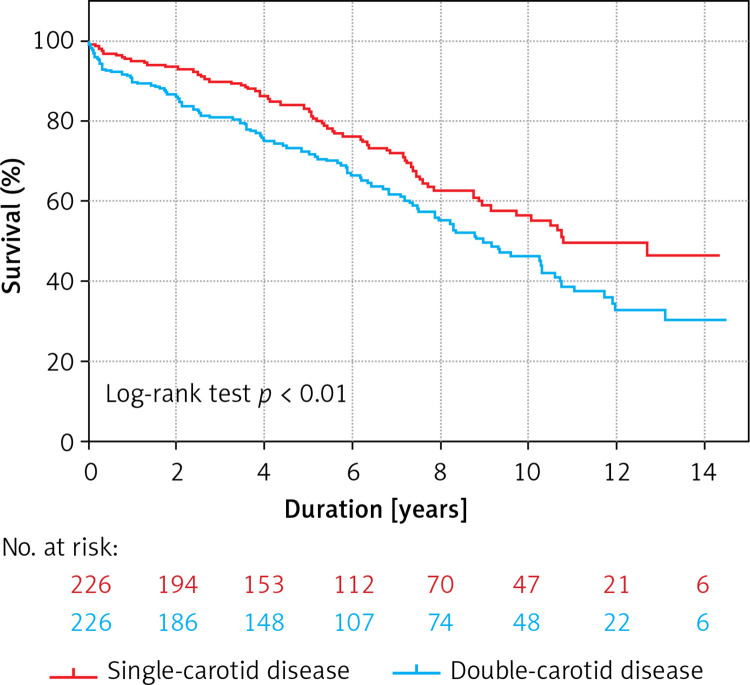
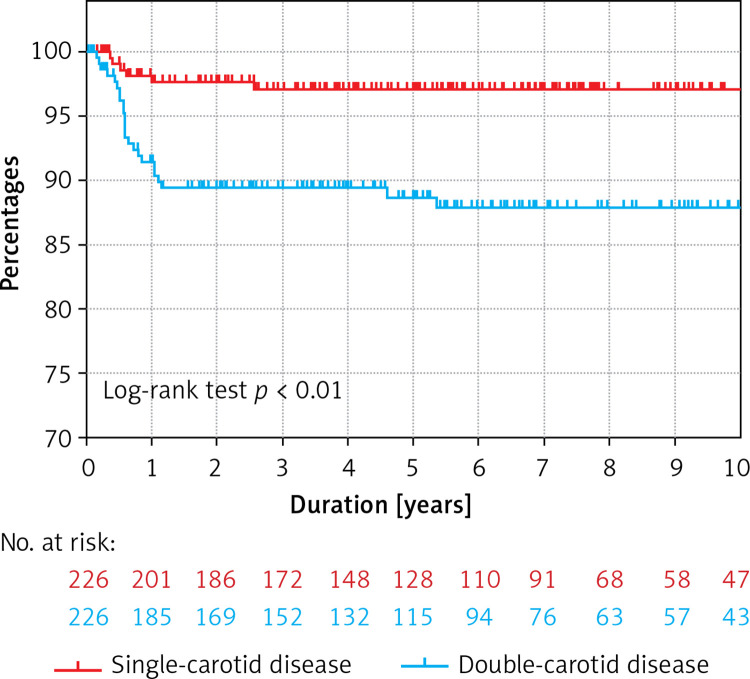
There was no significant difference in the occurrence of in-hospital major adverse events (3.5% vs. 3.1% of patients in the double-vessel carotid group vs. the single-vessel carotid group; = 1) The mean follow-up was 6.1 ±4.0 years, and a total of 181 (40%) deaths occurred during 2759 patient-years, which translates into 7.8 and 5.3 deaths per 100 patient-years in the double-vessel carotid group and the single-vessel carotid group, respectively ( < 0.01). The survival in the double-vessel carotid group vs. the single-vessel carotid group at 10 years was 46% (95% CI: 38-54%) vs. 55% (95% CI: 47-63%) ( < 0.01). Twenty-four (11%) patients and 6 (3%) patients underwent re-interventions for restenosis in the double-vessel and the single-vessel carotid disease group, respectively ( < 0.01).
Patients with CAS and significant double-vessel carotid artery disease had similar peri-procedural risk, but had a worse long-term survival, and a higher rate of re-interventions for restenosis compared to the single-vessel carotid artery disease patients.
在颈动脉支架置入术(CAS)中,缺乏对照临床试验之外的长期数据。在本研究中,我们比较了CAS术后患者的短期结局、长期生存率以及再狭窄的再次干预率,这些与颈动脉粥样硬化程度相关,分为单支血管(单侧)或双支血管(双侧)颈动脉疾病。
我们回顾性评估了599例患有严重颈动脉狭窄且接受了763例CAS手术的患者,并使用倾向评分在单支或双支颈动脉疾病中匹配了226对(452例患者)。
住院期间主要不良事件的发生率无显著差异(双支颈动脉组患者为3.5%,单支颈动脉组患者为3.1%;P = 1)。平均随访时间为6.1±4.0年,在2759患者年期间共发生181例(40%)死亡,双支颈动脉组和单支颈动脉组分别为每100患者年7.8例和5.3例死亡(P < 0.01)。双支颈动脉组与单支颈动脉组在10年时的生存率分别为46%(95%CI:38 - 54%)和55%(95%CI:47 - 63%)(P < 0.01)。双支和单支颈动脉疾病组分别有24例(11%)和6例(3%)患者因再狭窄接受了再次干预(P < 0.01)。
患有CAS且有显著双支颈动脉疾病的患者围手术期风险相似,但与单支颈动脉疾病患者相比,长期生存率较差,再狭窄的再次干预率较高。