Cooney Martin
Center for Applied Intelligent Systems Research (CAISR), Department of Intelligent Systems and Digital Design, Halmstad University, Halmstad, Sweden.
Front Robot AI. 2021 Jul 15;8:668986. doi: 10.3389/frobt.2021.668986. eCollection 2021.
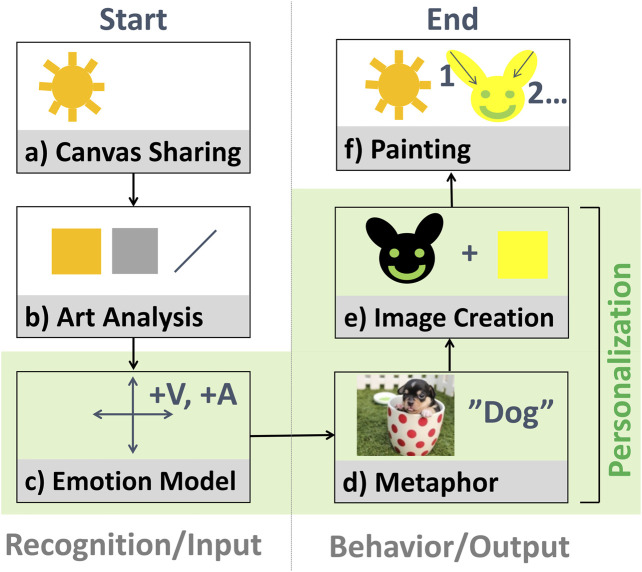
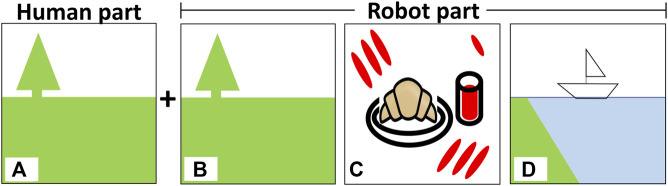
Socially assistive robots are being designed to support people's well-being in contexts such as art therapy where human therapists are scarce, by making art together with people in an appropriate way. A challenge is that various complex and idiosyncratic concepts relating to art, like emotions and creativity, are not yet well understood. Guided by the principles of speculative design, the current article describes the use of a collaborative prototyping approach involving artists and engineers to explore this design space, especially in regard to general and personalized art-making strategies. This led to identifying a goal: to generate representational or abstract art that connects emotionally with people's art and shows creativity. For this, an approach involving personalized "visual metaphors" was proposed, which balances the degree to which a robot's art is influenced by interacting persons. The results of a small user study via a survey provided further insight into people's perceptions: the general design was perceived as intended and appealed; as well, personalization via representational symbols appeared to lead to easier and clearer communication of emotions than via abstract symbols. In closing, the article describes a simplified demo, and discusses future challenges. Thus, the contribution of the current work lies in suggesting how a robot can seek to interact with people in an emotional and creative way through personalized art; thereby, the aim is to stimulate ideation in this promising area and facilitate acceptance of such robots in everyday human environments.
社交辅助机器人旨在通过以适当方式与人们一起创作艺术,在诸如艺术治疗等人类治疗师稀缺的情境中支持人们的幸福感。一个挑战是,与艺术相关的各种复杂且独特的概念,如情感和创造力,尚未得到很好的理解。在推测性设计原则的指导下,本文描述了一种涉及艺术家和工程师的协作式原型制作方法的应用,以探索这个设计空间,特别是在一般和个性化的艺术创作策略方面。这导致确定了一个目标:创作与人们的艺术在情感上产生联系并展现创造力的具象或抽象艺术。为此,提出了一种涉及个性化“视觉隐喻”的方法,该方法平衡了机器人艺术受互动者影响的程度。通过一项小型用户调查得出的结果进一步深入了解了人们的看法:总体设计被认为符合预期且具有吸引力;此外,通过具象符号进行个性化似乎比通过抽象符号更容易、更清晰地传达情感。最后,本文描述了一个简化的演示,并讨论了未来的挑战。因此,当前工作的贡献在于提出机器人如何通过个性化艺术寻求以情感和创造性的方式与人们互动;从而,目的是激发这个有前景领域的创意,并促进此类机器人在日常人类环境中的接受度。