Department of Orthodontic, School of Dentistry, Kermanshah University of Medical Sciences, Kermanshah, Iran.
Students Research Committee, School of Dentistry, Kermanshah University of Medical Sciences, Kermanshah, Iran.
Prog Orthod. 2021 Aug 2;22(1):22. doi: 10.1186/s40510-021-00370-8.
This study sought to assess the effect of miniscrew insertion angle (vertical and oblique) on its clinical survival under shearing forces in orthodontic patients undergoing canine retraction.
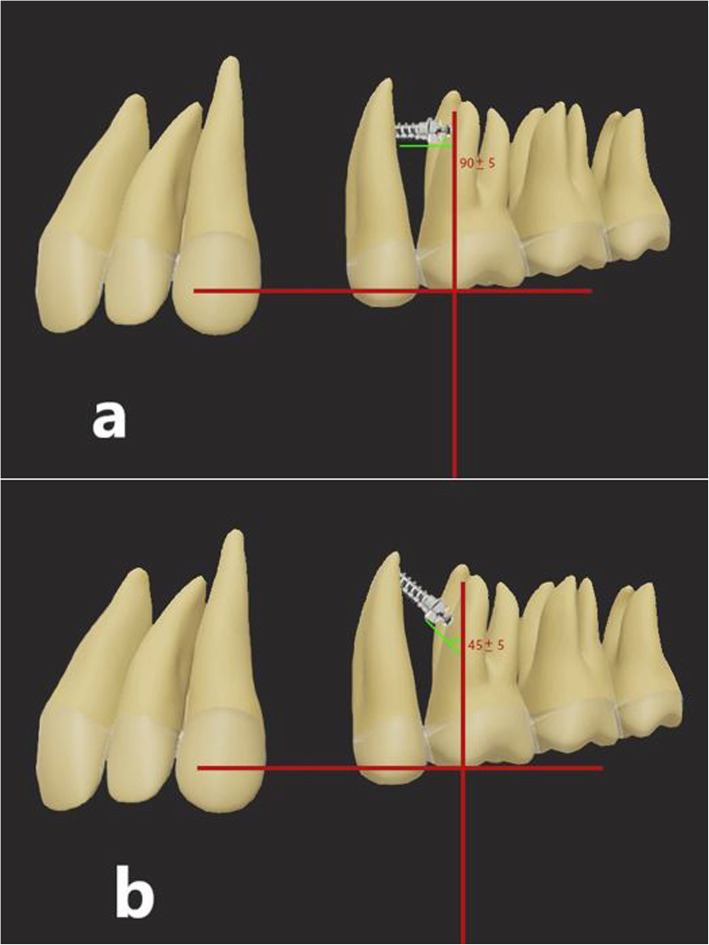
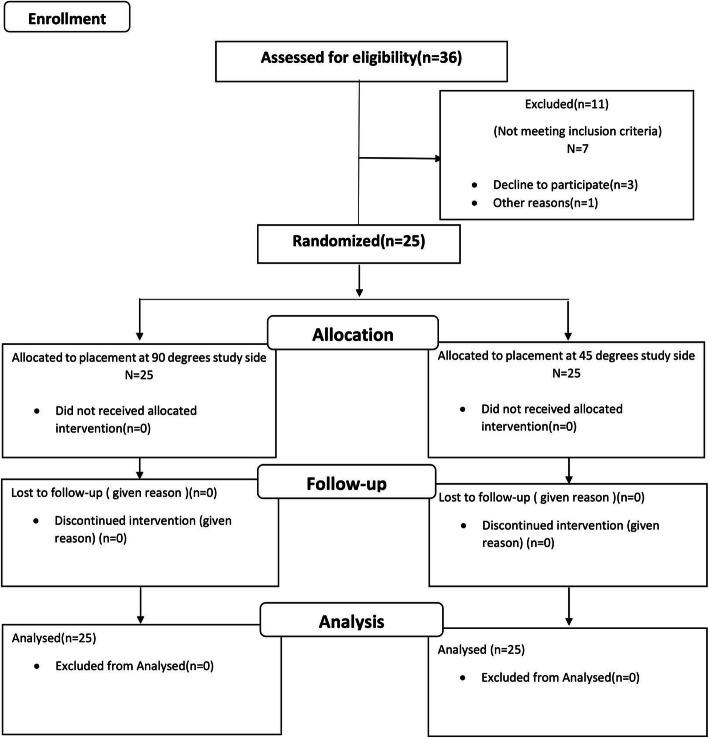
In this split-mouth randomized controlled clinical trial, 50 miniscrews were placed bilaterally in 25 patients with 45° and 90° insertion angles relative to a line perpendicular to the occlusal plane distal to the maxillary first premolar extraction site. Allocation of insertion angles to the right/left side was random using the Random Allocation Software. The patients, clinician, and statistician were blinded to the allocation of miniscrews to the side of jaw. The patients were followed-up monthly for 6 months. The primary outcome was the clinical survival of miniscrews, which was evaluated at each follow-up session. The secondary outcomes were the miniscrew stability based on the Periotest value (PTV) and the level of pain experienced by patients at 1, 12, and 24 h, and 7 days after miniscrew placement using a visual analog scale (VAS). Data were analyzed using paired t-test, repeated measures ANOVA, and McNemar's test.
The clinical survival rate of miniscrews placed at 90° and 45° angles was 76% and 88%, respectively. This difference was not statistically significant (P = 0.375). No significant difference was noted between the two groups regarding the PTV or the pain score either (P > 0.05).
Clinically, the insertion angle of miniscrews (90° versus 45° relative to a line perpendicular to the occlusal plane) has no significant effect on the miniscrew survival rate or stability during orthodontic treatment.
This trial was registered at www.irct.ir ( IRCT20190901044659N1 ).
The protocol was published after trial commencement.
本研究旨在评估在正畸患者尖牙后移中,承受剪切力时,颊舌向倾斜种植钉植入角度(垂直和倾斜)对其临床存活率的影响。
在这项随机对照的分侧临床研究中,将 50 颗种植钉以 45°和 90°的颊舌向倾斜角植入 25 名患者双侧,以第一磨牙远中颊侧拔牙间隙处垂直于牙合平面的线为参照。使用随机分配软件对左右侧植入角度进行随机分配。患者、临床医生和统计人员对种植钉分配到颌侧均不知情。患者每月随访 6 个月。主要结局为种植钉的临床存活率,在每次随访时进行评估。次要结局为基于 Periotest 值(PTV)的种植钉稳定性和患者在种植钉植入后 1、12、24 小时和 7 天时的疼痛程度,采用视觉模拟评分(VAS)进行评估。使用配对 t 检验、重复测量方差分析和 McNemar 检验对数据进行分析。
以 90°和 45°角植入的种植钉的临床存活率分别为 76%和 88%。差异无统计学意义(P = 0.375)。两组间 PTV 或疼痛评分也无显著差异(P > 0.05)。
临床结果表明,正畸治疗中,种植钉颊舌向倾斜角度(与垂直于牙合平面的线相比,90°和 45°)对种植钉存活率或稳定性无显著影响。
本试验在 www.irct.ir 注册(IRCT20190901044659N1)。
方案在试验开始后公布。