Language and Computation in Neural Systems group, Max Planck Institute for Psycholinguistics, Nijmegen, Netherlands.
Donders Centre for Cognitive Neuroimaging, Radboud University, Nijmegen, Netherlands.
Elife. 2021 Aug 2;10:e68066. doi: 10.7554/eLife.68066.
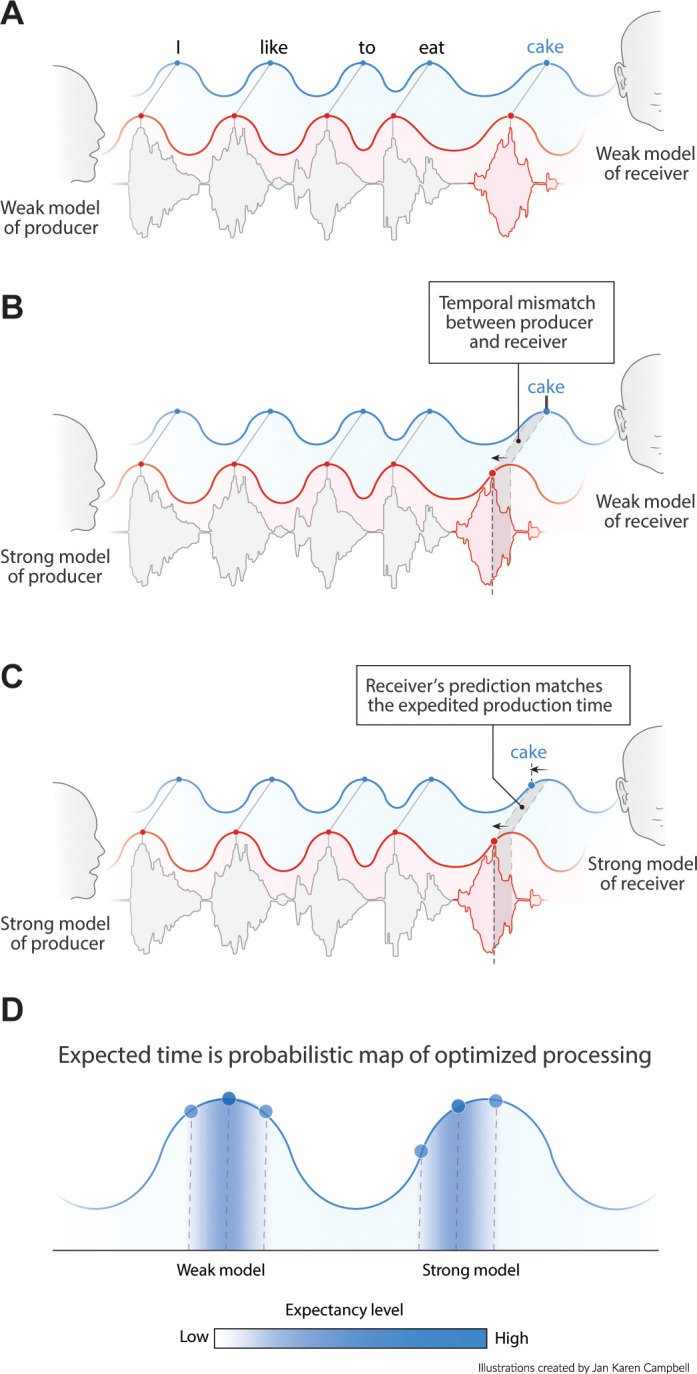
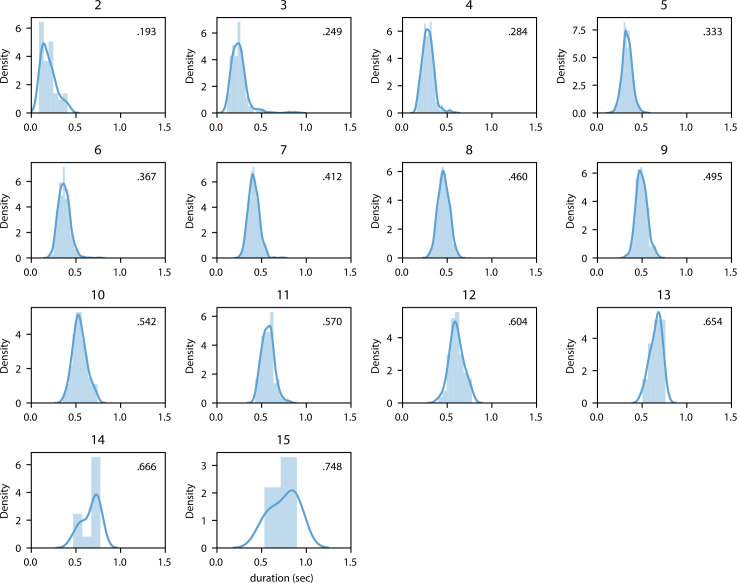
Neuronal oscillations putatively track speech in order to optimize sensory processing. However, it is unclear how isochronous brain oscillations can track pseudo-rhythmic speech input. Here we propose that oscillations can track pseudo-rhythmic speech when considering that speech time is dependent on content-based predictions flowing from internal language models. We show that temporal dynamics of speech are dependent on the predictability of words in a sentence. A computational model including oscillations, feedback, and inhibition is able to track pseudo-rhythmic speech input. As the model processes, it generates temporal phase codes, which are a candidate mechanism for carrying information forward in time. The model is optimally sensitive to the natural temporal speech dynamics and can explain empirical data on temporal speech illusions. Our results suggest that speech tracking does not have to rely only on the acoustics but could also exploit ongoing interactions between oscillations and constraints flowing from internal language models.
神经元振荡据称是为了优化感觉处理而跟踪言语的。然而,目前尚不清楚等时的脑振荡如何能跟踪伪节奏的言语输入。在这里,我们提出,当考虑到言语时间取决于从内部语言模型中流动的基于内容的预测时,振荡可以跟踪伪节奏的言语。我们表明,言语的时间动态取决于句子中单词的可预测性。一个包括振荡、反馈和抑制的计算模型能够跟踪伪节奏的言语输入。随着模型的处理,它生成时间相位码,这是一个候选机制,可以在时间上向前传递信息。该模型对自然的时间言语动态具有最佳的敏感性,并且可以解释时间言语错觉的经验数据。我们的结果表明,言语跟踪不必仅依赖于声学,也可以利用来自内部语言模型的振荡和约束之间的持续相互作用。