Koltai Jonathan, Raifman Julia, Bor Jacob, McKee Martin, Stuckler David
Department of Sociology, University of New Hampshire, Durham, US.
Department of Health Law, Policy, and Management, Boston University School of Public Health, Boston, Massachusetts.
medRxiv. 2021 Jul 28:2021.07.19.21260782. doi: 10.1101/2021.07.19.21260782.
Mental health problems increased during the COVID-19 pandemic. Knowledge that one is less at risk after being vaccinated may alleviate distress, but this hypothesis remains unexplored. Here we test whether psychological distress declined in those vaccinated against COVID-19 in the US and whether changes in perceived risk mediated any association.
A nationally-representative cohort of U.S. adults (N=5,792) in the Understanding America Study were interviewed every two weeks from March 2020 to June 2021 (28 waves). Difference-in-difference regression tested whether getting vaccinated reduced distress (PHQ-4 scores), with mediation analysis used to identify potential mechanisms, including perceived risks of infection, hospitalization, and death.
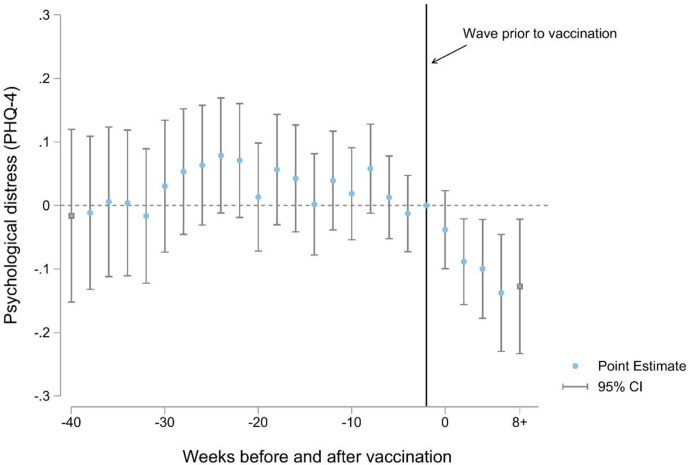
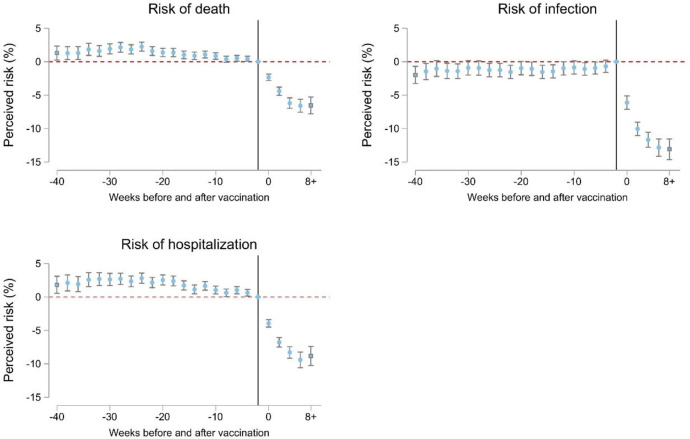
Vaccination was associated with a 0.09 decline in distress scores (95% CI:-0.15 to -0.04) (0-12 scale), a 5.7% relative decrease compared to mean scores in the wave prior to vaccination. Vaccination was also associated with an 8.44 percentage point reduction in perceived risk of infection (95% CI:-9.15% to -7.73%), a 7.44-point reduction in perceived risk of hospitalization (95% CI:-8.07% to -6.82%), and a 5.03-point reduction in perceived risk of death (95% CI:-5.57% to -4.49%). Adjusting for risk perceptions decreased the vaccination-distress association by two-thirds. Event study models suggest vaccinated and never vaccinated respondents followed similar PHQ-4 trends pre-vaccination, diverging significantly post-vaccination. Analyses were robust to individual and wave fixed effects, time-varying controls, and several alternative modelling strategies. Results were similar across sociodemographic groups.
Receiving a COVID-19 vaccination was associated with declines in distress and perceived risks of infection, hospitalization, and death. Vaccination campaigns could promote these additional benefits of being vaccinated.
在新冠疫情期间,心理健康问题有所增加。知道接种疫苗后自身风险降低可能会减轻痛苦,但这一假设仍未得到探讨。在此,我们测试美国接种新冠疫苗者的心理痛苦是否有所减轻,以及感知风险的变化是否介导了任何关联。
在“理解美国研究”中,对一个具有全国代表性的美国成年人队列(N = 5792)进行了研究,从2020年3月至2021年6月每两周访谈一次(共28轮)。采用差分回归测试接种疫苗是否能减轻痛苦(PHQ - 4评分),并通过中介分析来确定潜在机制,包括感染、住院和死亡的感知风险。
接种疫苗与痛苦评分下降0.09相关(95%置信区间:-0.15至-0.04)(0 - 12分制),相较于接种疫苗前一轮的平均评分,相对下降了5.7%。接种疫苗还与感染感知风险降低8.44个百分点相关(95%置信区间:-9.15%至-7.73%),住院感知风险降低7.44个百分点(95%置信区间:-8.07%至-6.82%),死亡感知风险降低5.03个百分点(95%置信区间:-5.57%至-4.49%)。对风险感知进行调整后,接种疫苗与痛苦之间的关联降低了三分之二。事件研究模型表明,接种疫苗者和未接种疫苗者在接种前的PHQ - 4趋势相似,接种后出现显著差异。分析对个体和轮次固定效应、随时间变化的控制以及几种替代建模策略具有稳健性。不同社会人口群体的结果相似。
接种新冠疫苗与痛苦减轻以及感染、住院和死亡的感知风险降低相关。疫苗接种运动可以宣传接种疫苗的这些额外益处。