Department of Surgery, Radboud University Medical Centre, Nijmegen, the Netherlands.
Department of Surgery, ZGT Hospital Almelo, Almelo, the Netherlands.
Ann Surg. 2021 Nov 1;274(5):698-704. doi: 10.1097/SLA.0000000000005130.
The aim of this study was to compare chronic postoperative inguinal pain (CPIP) in patients with an inguinal hernia after the TransREctus Sheath PrePeritoneal (TREPP) and the TransInguinal PrePeritoneal Technique (TIPP).
The preperitoneal mesh position for inguinal hernia repair showed beneficial results regarding CPIP with low recurrence rates. Two open preperitoneal techniques, TREPP and TIPP, were compared in a randomized clinical trial with the hypothesis of fewer patients with CPIP after TREPP due to complete avoidance of nerve contact.
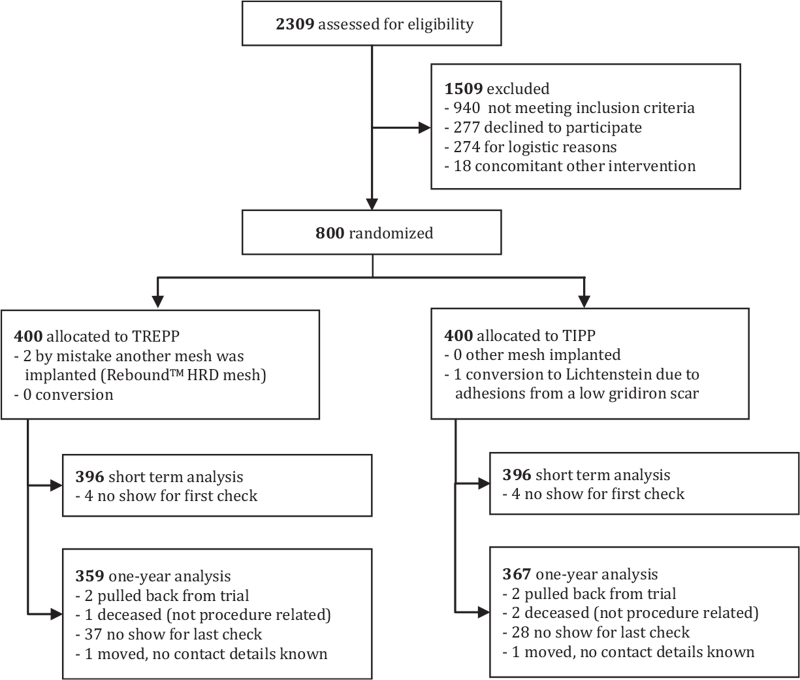
Adult patients with a primary unilateral inguinal hernia were randomized to either TREPP or TIPP in four hospitals. Before the trial's start the study protocol was ethically approved and published. Outcomes included CPIP after 1 year (primary outcome) and recurrence rates, adverse events, and health-related quality of life (secondary outcomes). Follow-up was performed at 2 weeks, 6 months, and 1 year.
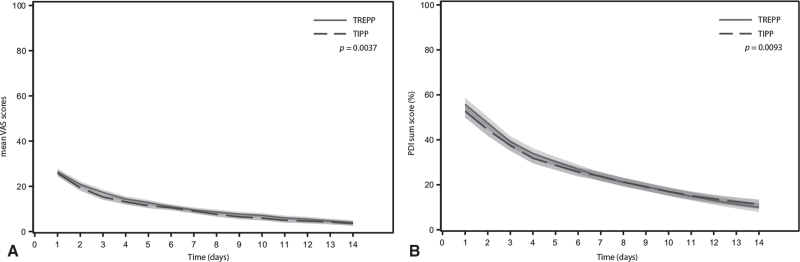
Baseline characteristics were comparable in both groups. Pain was less often present after TREPP at 2 weeks and 6 months, but CPIP at rest at 1 year was comparable: 1.9% after TREPP vs 1.4% after TIPP, P = 0.535). The overall recurrence rate was higher in the TREPP group, 8.9% vs 4.6%, P = 0.022). Corrected for a learning curve for TREPP, no significant difference could be assessed (TREPP 5.7% and TIPP 4.8%, P = 0.591).
Both the TREPP and TIPP technique resulted in a low incidence of CPIP after 1-year follow-up. The TREPP method can be considered a solid method for inguinal hernia repair if expertise is present. The learning curve of the TREPP techniques needs further evaluation.
ISRCTN18591339.
本研究旨在比较经腹横纹肌鞘前腹膜(TREPP)与经腹股沟前腹膜技术(TIPP)治疗腹股沟疝后慢性术后腹股沟痛(CPIP)。
经腹膜前补片在腹股沟疝修补术中的位置显示出有利于 CPIP 的结果,复发率低。本随机临床试验比较了两种开放式腹膜前技术,TREPP 和 TIPP,假设 TREPP 由于完全避免神经接触,CPIP 患者更少。
4 家医院将成年单侧腹股沟疝患者随机分为 TREPP 或 TIPP 组。试验开始前,研究方案经伦理批准并公布。主要结局为术后 1 年 CPIP,次要结局为复发率、不良事件和健康相关生活质量。随访时间为 2 周、6 个月和 1 年。
两组患者的基线特征无差异。术后 2 周和 6 个月时 TREPP 后疼痛发生频率较低,但术后 1 年时休息时 CPIP 无差异:TREPP 组为 1.9%,TIPP 组为 1.4%,P = 0.535)。TREPP 组总体复发率较高,为 8.9%,TIPP 组为 4.6%,P = 0.022)。校正 TREPP 的学习曲线后,无显著差异(TREPP 组为 5.7%,TIPP 组为 4.8%,P = 0.591)。
TREPP 和 TIPP 技术在术后 1 年随访时 CPIP 的发生率均较低。如果有专业知识,TREPP 方法可被认为是一种可靠的腹股沟疝修补方法。TREPP 技术的学习曲线需要进一步评估。
ISRCTN86445353。