Department of Physiological Sciences, University of Florida, Gainesville, Florida, USA.
Grupo de Investigación en Agrociencias, Biodiversidad y Territorio - GAMMA, Facultad de Ciencias Agrarias, Universidad de Antioquia UdeA, Medellín, Colombia.
Biol Reprod. 2021 Nov 15;105(5):1126-1139. doi: 10.1093/biolre/ioab147.
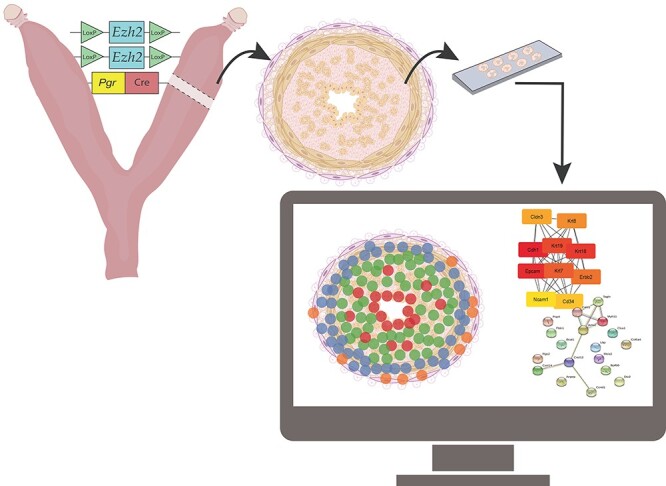
Histone proteins undergo various modifications that alter chromatin structure, including addition of methyl groups. Enhancer of zeste homolog 2 (EZH2) is a histone methyltransferase that methylates lysine residue 27, and thereby suppresses gene expression. EZH2 plays integral roles in the uterus and other reproductive organs. We have previously shown that conditional deletion of uterine EZH2 results in increased proliferation of luminal and glandular epithelial cells, and RNA-seq analyses reveal several uterine transcriptomic changes in Ezh2 conditional (c) knockout (KO) mice that can affect estrogen signaling pathways. To pinpoint the origin of such gene expression changes, we used the recently developed spatial transcriptomics (ST) method with the hypotheses that Ezh2cKO mice would predominantly demonstrate changes in epithelial cells and/or ablation of this gene would disrupt normal epithelial/stromal gene expression patterns. Uteri were collected from ovariectomized adult WT and Ezh2cKO mice and analyzed by ST. Asb4, Cxcl14, Dio2, and Igfbp5 were increased, Sult1d1, Mt3, and Lcn2 were reduced in Ezh2cKO uterine epithelium vs. WT epithelium. For Ezh2cKO uterine stroma, differentially expressed key hub genes included Cald1, Fbln1, Myh11, Acta2, and Tagln. Conditional loss of uterine Ezh2 also appears to shift the balance of gene expression profiles in epithelial vs. stromal tissue toward uterine epithelial cell and gland development and proliferation, consistent with uterine gland hyperplasia in these mice. Current findings provide further insight into how EZH2 may selectively affect uterine epithelial and stromal compartments. Additionally, these transcriptome data might provide mechanistic understanding and valuable biomarkers for human endometrial disorders with epigenetic underpinnings.
组蛋白蛋白经历各种修饰,改变染色质结构,包括添加甲基。EZH2 是一种组蛋白甲基转移酶,可甲基化赖氨酸残基 27,从而抑制基因表达。EZH2 在子宫和其他生殖器官中发挥重要作用。我们之前已经表明,子宫 EZH2 的条件性缺失会导致腔上皮细胞和腺上皮细胞的增殖增加,并且 RNA-seq 分析显示 Ezh2 条件性(c)敲除(KO)小鼠的子宫转录组有几个变化,可能影响雌激素信号通路。为了确定这些基因表达变化的起源,我们使用了最近开发的空间转录组学(ST)方法,并提出了以下假设:Ezh2cKO 小鼠主要表现出上皮细胞的变化,或者该基因的缺失会破坏正常的上皮/基质基因表达模式。从去卵巢成年 WT 和 Ezh2cKO 小鼠中收集子宫,并通过 ST 进行分析。与 WT 上皮相比,Ezh2cKO 子宫上皮中 Asb4、Cxcl14、Dio2 和 Igfbp5 增加,Sult1d1、Mt3 和 Lcn2 减少。对于 Ezh2cKO 子宫基质,差异表达的关键基因包括 Cald1、Fbln1、Myh11、Acta2 和 Tagln。子宫 Ezh2 的条件性缺失似乎也会使上皮与基质组织中的基因表达谱平衡向子宫上皮细胞和腺发育和增殖倾斜,与这些小鼠中的子宫腺增生一致。目前的发现为 EZH2 如何选择性地影响子宫上皮和基质细胞提供了进一步的认识。此外,这些转录组数据可能为具有表观遗传基础的人类子宫内膜疾病提供机制理解和有价值的生物标志物。