Department of Microbiology, SMS Medical College, Jaipur, Rajasthan, India.
Deparment of Neonatology, Neoclinic, Jaipur, Rajasthan, India
BMJ Open Qual. 2021 Jul;10(Suppl 1). doi: 10.1136/bmjoq-2021-001470.
The overuse of antibiotics in newborns leads to increased mortality and morbidities. Implementation of a successful antibiotic stewardship programme (ASP) is necessary to decrease inappropriate use of antibiotics and its adverse effects.
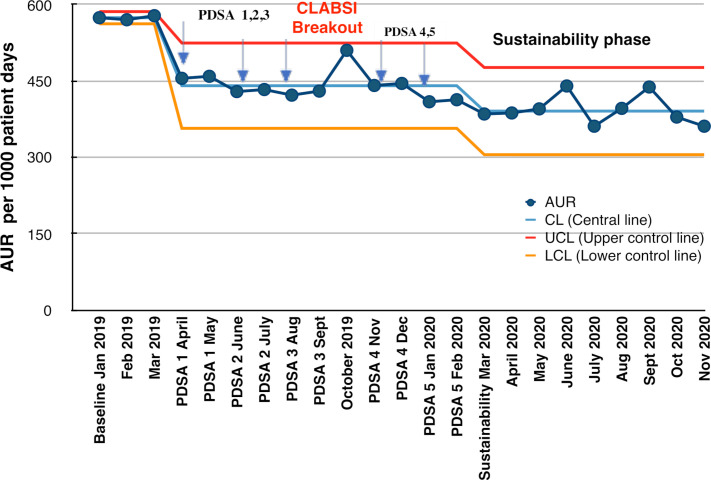
Our neonatal intensive care unit (NICU) is a tertiary referral centre of north India, consisting of all outborn babies mostly with sepsis caused by high rate of multidrug-resistant organisms (MDROs). So antibiotics are not only life-saving but also used excessively with a high antibiotic usage rate (AUR) of 574 per 1000 patient days.
A quality improvement (QI) study was conducted using the Plan-Do-Study-Act (PDSA) approach to reduce AUR by at least 20% from January 2019 to December 2020. Various strategies were made : such as making a unit protocol, education and awareness of NICU nurses and doctors, making check points for both starting and early stoppage of antibiotics, making specific protocol to start vancomycin, and reviewing yearly antibiotic policy as per antibiogram.
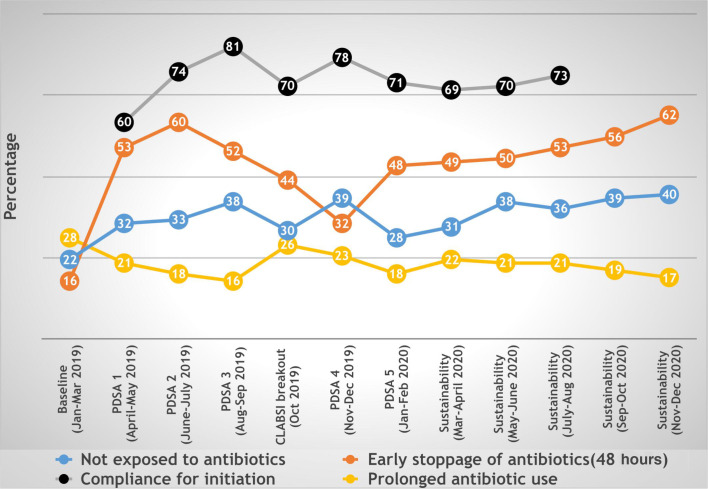
The total AUR, AUR (culture negative) and AUR (vancomycin) was reduced by 32%, 20% and 29%, respectively, (p<0.01). The proportion of newborns who never received antibiotics increased from 22% to 37% (p<0.045) and the proportion of culture-negative/screen-negative newborns where antibiotics were stopped within 48 hours increased from 16% to 54% (p<0.001). The compliance with the unit protocol in starting and upgrading antibiotic was 75% and 82%, respectively. In early 2020, there was a sudden upsurge in AUR due to central line-related bloodstream infection breakout. However, we were able to control it, and all the PDSA cycles were reinforced. Finally, we could reattain our goals, and also able to sustain it until next 1 year. There was no significant difference in overall necrotising enterocolitis and mortality rates.
In a centre such as ours, where sepsis is a leading cause of neonatal deaths, restricting antibiotic use is a huge challenge. However, we have demonstrated implementation of an efficient ASP with the help of a dedicated team and effective PDSA cycles. Also, we have emphasised the importance of sustainability in success of any QI study.
新生儿抗生素过度使用会导致死亡率和发病率增加。实施成功的抗生素管理计划(ASP)对于减少抗生素的不合理使用及其不良影响是必要的。
我们的新生儿重症监护病房(NICU)是印度北部的一个三级转诊中心,由所有外出的婴儿组成,大多数患有败血症,由高比率的多药耐药菌(MDROs)引起。因此,抗生素不仅是救命的,而且还被过度使用,抗生素使用率(AUR)高达每 1000 个患者天 574 次。
从 2019 年 1 月至 2020 年 12 月,使用计划-执行-研究-行动(PDSA)方法进行了一项质量改进(QI)研究,以将 AUR 至少降低 20%。采取了各种策略:制定单位方案、教育和提高 NICU 护士和医生的意识、为开始和早期停止使用抗生素制定检查点、制定特定的万古霉素启动方案、并根据药敏试验结果每年审查抗生素政策。
总 AUR、AUR(无培养物)和 AUR(万古霉素)分别降低了 32%、20%和 29%(p<0.01)。从未接受过抗生素的新生儿比例从 22%增加到 37%(p<0.045),在 48 小时内停止使用抗生素的无培养物/无筛查物新生儿比例从 16%增加到 54%(p<0.001)。开始和升级抗生素时遵守单位方案的比例分别为 75%和 82%。在 2020 年初,由于中心静脉相关血流感染爆发,AUR 突然上升。然而,我们能够控制它,并加强了所有的 PDSA 循环。最后,我们能够重新实现我们的目标,并在接下来的 1 年内维持它。总的坏死性小肠结肠炎和死亡率没有显著差异。
在我们这样的中心,败血症是新生儿死亡的主要原因,限制抗生素的使用是一个巨大的挑战。然而,在一个专门的团队和有效的 PDSA 循环的帮助下,我们已经证明了有效的 ASP 的实施。此外,我们还强调了在任何 QI 研究中可持续性对成功的重要性。