Ophthalmology Unit, Clinica San Francesco, Verona, Italy.
ESASO, European School of Advanced Studies in Ophthalmology, Lugano, Switzerland.
Eye (Lond). 2022 Aug;36(8):1687-1693. doi: 10.1038/s41433-021-01718-4. Epub 2021 Aug 3.
The prospective DIabetes and CATaract Study II (DICAT II) was performed to characterise the risks of cataract surgery to the retinae of patients with early diabetic macular oedema (E-DMO).
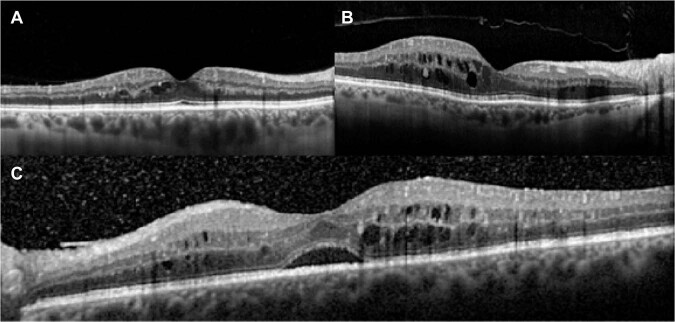
DICAT II was a prospective, comparative, multicentre, observational study involving six Italian clinics. Patients were aged ≥55 years, had type 1 or 2 diabetes with spectral-domain optical coherence tomography evidence of ESASO classification Early DMO. Group 1 eyes (78 eyes, 78 patients) underwent phacoemulsification-based cataract surgery. Group 2 eyes (65 eyes, 65 patients) had E-DMO and either clear media or had undergone uncomplicated cataract surgery ≥1 year previously. Central subfield thickness (CST) and best-corrected visual acuity (BCVA) were assessed in both groups.
The negative impact of surgery on CST was evident after the first postoperative week; CST peaked during the first month, then rapidly decreased. CST worsening ≥10 µm was observed in 63/78 eyes (80.7%) and 29/65 eyes (44.6%) in Groups 1 and 2, respectively (p < 0.0001). CST worsening of ≥50 µm was observed in 51 eyes (65.4%) and 10 eyes (15.4%) in Groups 1 and 2, respectively (p < 0.0001). Mean CST worsening was lower in Group 2 than in Group 1 (38.6 ± 30.4 µm vs 85.5 ± 55.3 µm, p < 0.0001) with a lower BCVA loss (-2.6 ± 3.5 letters vs -8.2 ± 6.2 letters, p < 0.0001). Higher glycaemic levels and HBA1c levels were significantly associated with the risk of >50 μm CST worsening in eyes from both groups.
Early DMO is associated with poorer outcomes after cataract surgery and requires close pre- and postoperative monitoring.
前瞻性糖尿病与白内障研究 II(DICAT II)旨在描述早期糖尿病性黄斑水肿(E-DMO)患者白内障手术对视网膜的风险。
DICAT II 是一项前瞻性、比较性、多中心、观察性研究,涉及意大利的 6 家诊所。患者年龄≥55 岁,患有 1 型或 2 型糖尿病,经频域光相干断层扫描(SD-OCT)证实为 ESASO 分类的早期 DMO。第 1 组(78 只眼,78 例患者)行白内障超声乳化吸除术。第 2 组(65 只眼,65 例患者)E-DMO 患者,晶状体透明或在 1 年前已行单纯白内障手术。在两组中均评估中央视网膜厚度(CST)和最佳矫正视力(BCVA)。
术后第 1 周,手术对 CST 的负面影响明显;CST 在术后第 1 个月达到峰值,然后迅速下降。第 1 组和第 2 组中分别有 63/78 只眼(80.7%)和 29/65 只眼(44.6%)出现 CST 恶化≥10μm(p<0.0001)。第 1 组和第 2 组中分别有 51 只眼(65.4%)和 10 只眼(15.4%)出现 CST 恶化≥50μm(p<0.0001)。第 2 组 CST 恶化的平均值低于第 1 组(38.6±30.4μm 比 85.5±55.3μm,p<0.0001),BCVA 损失也较小(-2.6±3.5 行比-8.2±6.2 行,p<0.0001)。两组中血糖水平和糖化血红蛋白(HbA1c)水平升高均与 CST 恶化>50μm 的风险显著相关。
E-DMO 与白内障术后视力下降有关,需要密切的术前和术后监测。