Kim Jongdoo, Lee Jihyun, Kim Ukjin, Park Jong-Kuk, Um Hong-Duck
Division of Radiation Biomedical Research, Korea Institute of Radiological and Medical Sciences, Seoul 01812, Republic of Korea.
Oncol Lett. 2021 Sep;22(3):681. doi: 10.3892/ol.2021.12942. Epub 2021 Jul 23.
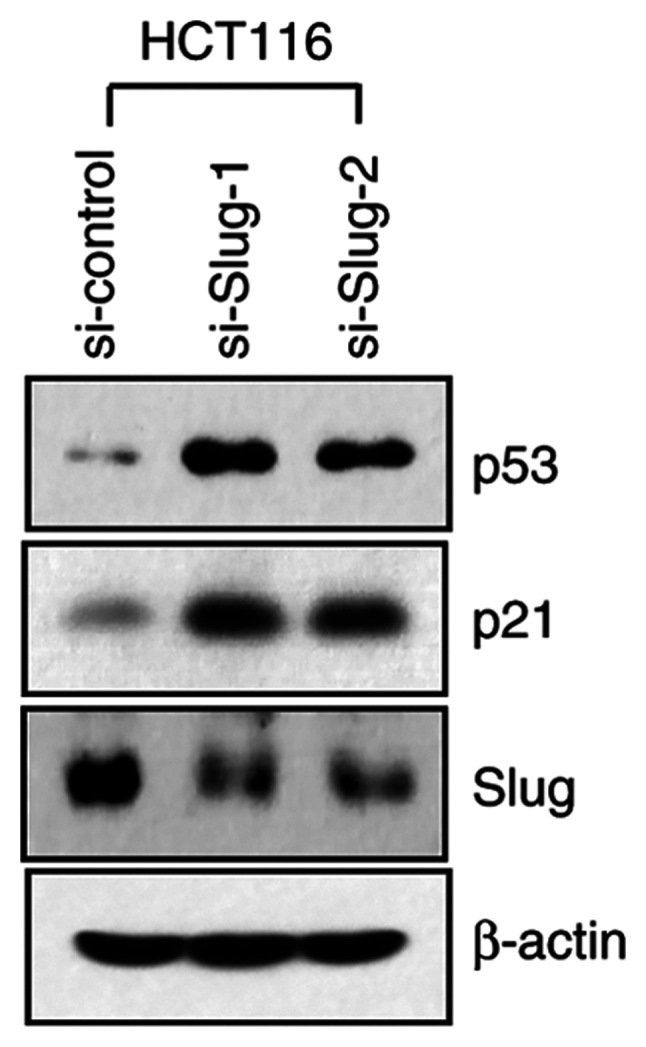
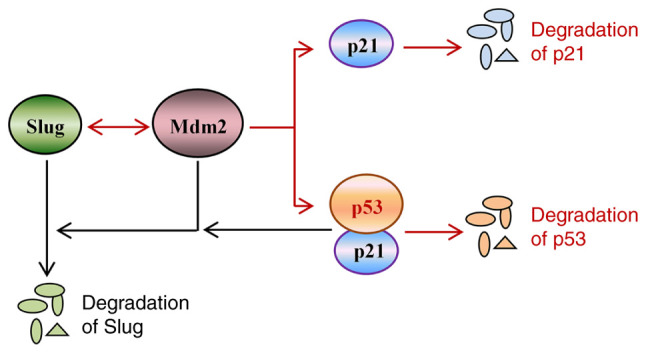
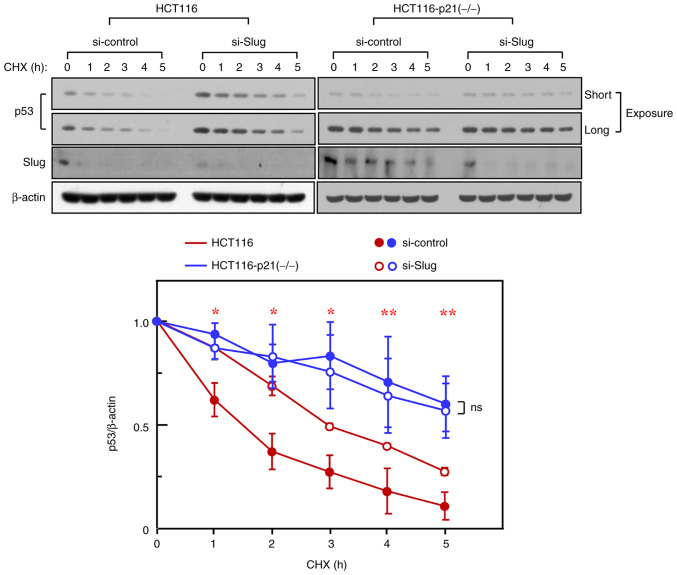
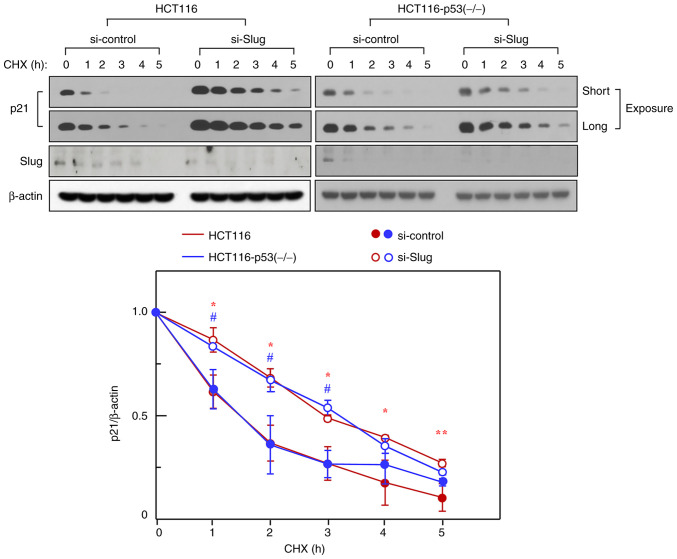
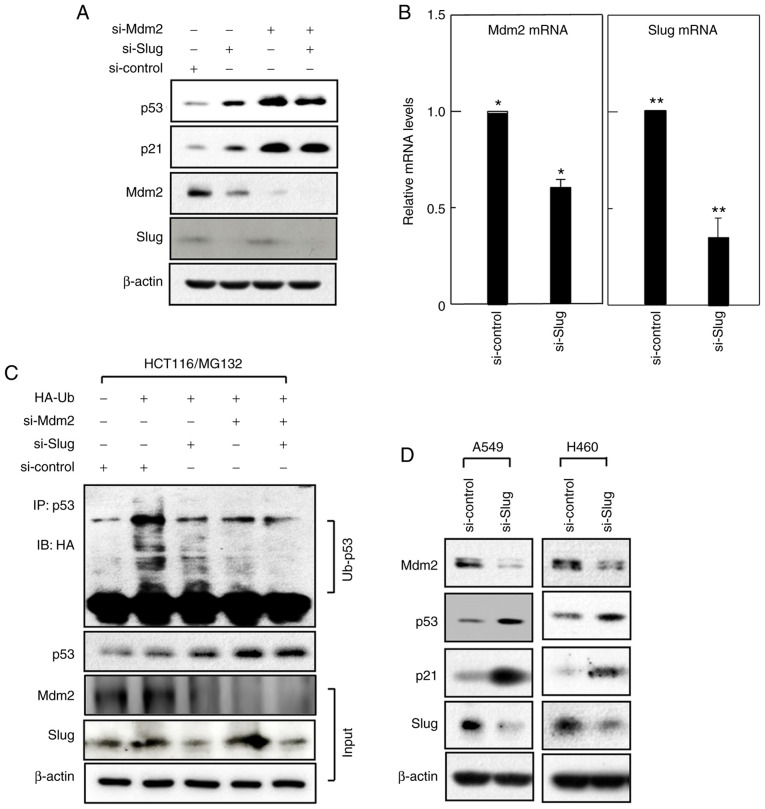
Our previous study revealed that the tumor suppressor/transcription factor p53 directly binds to its transcriptional target, p21, and that the p53/p21 complex binds to zinc finger protein SNAI2 (Slug), a tumor promoter/transcription factor; thereby promoting the degradation of Slug by Mdm2, an E3 ligase. The present study demonstrated that Slug reduced the cellular expression levels of p53 and p21 in HCT116 colon cancer by decreasing their protein stability. In parallel, Slug increased the mRNA and protein expression levels of Mdm2 in these cells. Moreover, knockdown of Mdm2 using specific small interfering RNAs abolished the ability of Slug to induce the degradation of p53 and p21. Considering the well-known function of Mdm2 in facilitating p53 and p21 degradation, these data suggested that Slug promoted p53 and p21 degradation by inducing Mdm2 expression. Moreover, Slug increased ubiquitination levels of p53 in HCT116 cells. This is consistent with the fact that Mdm2 induces p53 degradation by ubiquitinating p53, and further confirmed that Mdm2 acted downstream of Slug. Comparative studies using HCT116 cells and their p53- or p21-knockout variants have revealed that Slug requires p21 to induce p53 degradation. This result is consistent with our previous study, which revealed that Mdm2 acts more efficiently on p53 in the p53/p21 complex compared with on p53 alone. By contrast, Slug did not require p53 to induce p21 degradation, suggesting that p53 was dispensable in Mdm2-mediated p21 degradation. Notably, the ability of Slug to increase/decrease Mdm2/p53 and p21 levels, respectively, was not confined to HCT116 cells alone, but was also confirmed in A549 and H460 lung cancer cells. Collectively, the results of the present study suggested that Slug could counter p53 and p21. The balance between these two opposing groups (Slug vs. p53/p21) may depend on environmental stresses and the internal physiology of cells.
我们之前的研究表明,肿瘤抑制因子/转录因子p53直接与其转录靶点p21结合,并且p53/p21复合物与肿瘤促进因子/转录因子锌指蛋白SNAI2(Slug)结合;从而通过E3连接酶Mdm2促进Slug的降解。本研究表明,Slug通过降低p53和p21的蛋白质稳定性,降低了HCT116结肠癌细胞中它们的细胞表达水平。与此同时,Slug增加了这些细胞中Mdm2的mRNA和蛋白质表达水平。此外,使用特异性小干扰RNA敲低Mdm2消除了Slug诱导p53和p21降解的能力。考虑到Mdm2在促进p53和p21降解方面的已知功能,这些数据表明Slug通过诱导Mdm2表达促进p53和p21的降解。此外,Slug增加了HCT116细胞中p53的泛素化水平。这与Mdm2通过使p53泛素化诱导p53降解的事实一致,并进一步证实Mdm2在Slug的下游发挥作用。使用HCT116细胞及其p53或p21基因敲除变体的比较研究表明,Slug需要p21来诱导p53降解。这一结果与我们之前的研究一致,该研究表明,与单独的p53相比,Mdm2对p53/p21复合物中的p53作用更有效。相比之下,Slug诱导p21降解不需要p53,这表明p53在Mdm2介导的p21降解中是可有可无的。值得注意的是,Slug分别增加/降低Mdm2/p53和p21水平的能力不仅限于HCT116细胞,在A549和H460肺癌细胞中也得到了证实。总的来说,本研究结果表明Slug可以对抗p53和p21。这两个对立组(Slug与p53/p21)之间的平衡可能取决于环境压力和细胞的内部生理状态。