Nadella Pranay, Subramanian S V, Roman-Urrestarazu Andres
Centre for Global Health, Perelman School of Medicine, University of Pennsylvania, Philadelphia, USA.
Department of Social and Behavioural Sciences, Harvard T. H. Chan School of Public Health, Harvard University, Boston, USA.
SSM Popul Health. 2021 Jul 15;15:100872. doi: 10.1016/j.ssmph.2021.100872. eCollection 2021 Sep.
Community health workers (CHWs) are central to India's strategy for reaching the Sustainable Development Goals around maternal and child health. Despite India's significant investment in these programs, few studies have analyzed the effect of CHWs across India.
This study aims to analyze multiple types of CHWs and their impact on a broad range of antenatal and infant health outcomes across India.
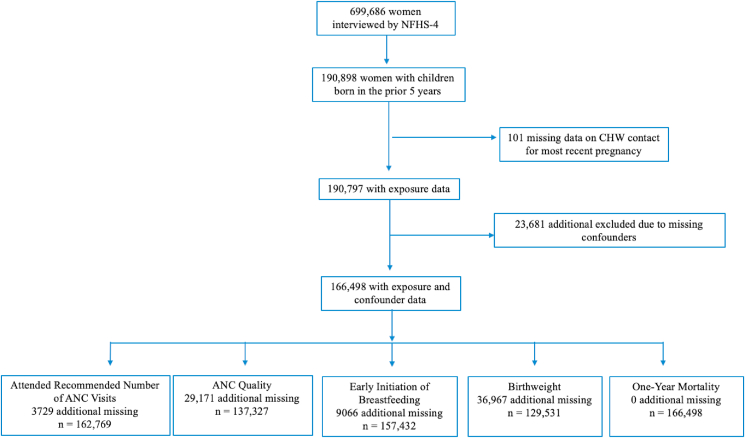
In this population-based cross-sectional study, we analyzed data of women interviewed by the most recent 2015-2016 National Family Health Survey-4 (NFHS-4) in India. This study performed multiple variable regressions to examine the effect of receiving ANC during pregnancy from 1) any CHW and 2) by specific type of CHW - Accredited Social Health Activist (ASHA), Anganwadi Worker (AWW), and Community/Village Health Worker (defined in Table 1) on antenatal and infant health outcomes.
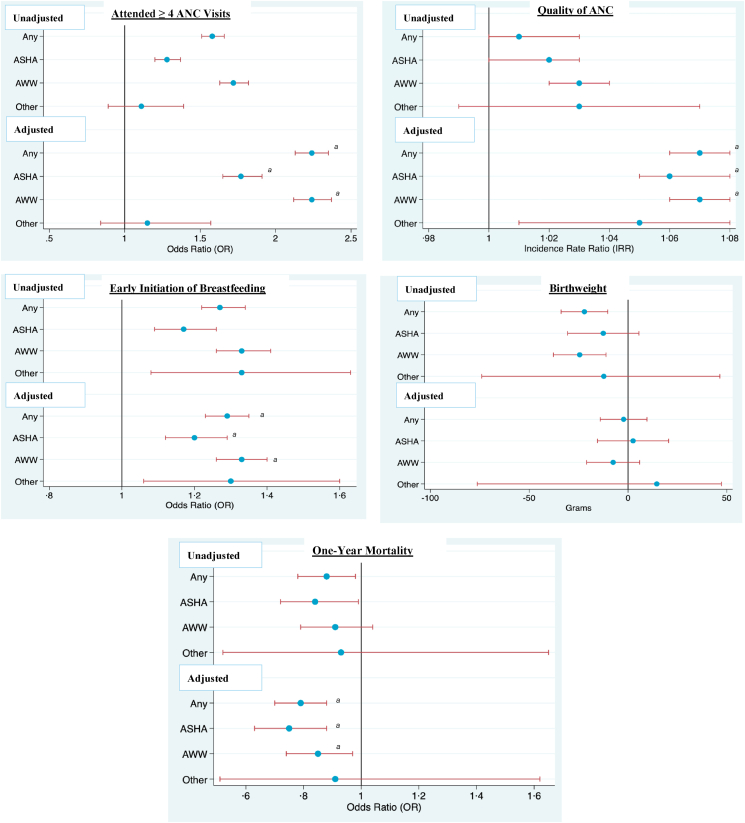
Of 166,498 women, 14.2% received ANC from any CHW with specifically 5.9% receiving from ASHAs, 10.2% receiving from AWWs, and 0.5% receiving from Community/Village Health Workers. Women who received ANC from an ASHA had increased ANC utilization (OR 1.77; 95% CI 1.65, 1.91) as well as quality (IRR 1.06; 95% CI 1.05, 1.08), increased early initiation of breast feeding (OR 1.20; 95% CI 1.12, 1.29), and decreased one-year mortality (OR 0.75; 95% CI 0.63, 0.88). Women who received ANC from an AWW had increased ANC utilization (OR 2.24; 95% CI 2.12, 2.37) as well as quality (IRR 1.07, 95% CI 1.06, 1.08) and increased early initiation of breast feeding (OR 1.30; 95% CI 1.26, 1.40).
Receiving ANC from ASHAs and AWWs is associated with improved ANC utilization, ANC quality, early initiation of breastfeeding and the key outcome of reduced infant mortality.
社区卫生工作者是印度实现围绕孕产妇和儿童健康的可持续发展目标战略的核心。尽管印度在这些项目上投入巨大,但很少有研究分析社区卫生工作者在印度全国范围内的影响。
本研究旨在分析印度多种类型的社区卫生工作者及其对广泛的产前和婴儿健康结局的影响。
在这项基于人群的横断面研究中,我们分析了印度2015 - 2016年最新的第四次全国家庭健康调查(NFHS - 4)中接受访谈的女性的数据。本研究进行了多项变量回归分析,以检验孕期接受以下两类人员的产前护理(ANC)对产前和婴儿健康结局的影响:1)任何社区卫生工作者;2)特定类型的社区卫生工作者——经认证的社会健康活动家(ASHA)、安格班迪工作人员(AWW)以及社区/乡村卫生工作者(定义见表1)。
在166,498名女性中,14.2%的人接受了任何社区卫生工作者提供的产前护理,其中5.9%的人接受了ASHA提供的护理,10.2%的人接受了AWW提供的护理,0.5%的人接受了社区/乡村卫生工作者提供的护理。接受ASHA提供产前护理的女性,其产前护理利用率提高(比值比[OR] 1.77;95%置信区间[CI] 1.65,1.91),护理质量也提高(发病率比值比[IRR] 1.06;95% CI 1.05,1.08),母乳喂养早期开始率提高(OR 1.20;95% CI 1.12,1.29),一岁时死亡率降低(OR 0.75;95% CI 0.63,0.88)。接受AWW提供产前护理的女性,其产前护理利用率提高(OR 2.24;95% CI 2.12,2.37),护理质量提高(IRR 1.07,95% CI 1.06,1.08),母乳喂养早期开始率提高(OR 1.30;95% CI 1.26,1.40)。
接受ASHA和AWW提供的产前护理与提高产前护理利用率、护理质量、母乳喂养早期开始率以及降低婴儿死亡率这一关键结局相关。