Devasenapathy Niveditha, Neogi Sutapa B, Soundararajan Srinivasan, Ahmad Danish, Hazra Avishek, Ahmad Jaleel, Mann Neelakshi, Mavalankar Dileep
Indian Institute of Public Health-Delhi, Plot No. 47, Sector 44, Institutional Area, Gurgaon, 122002, India.
Uttar Pradesh Community Mobilization Project, Public Health Foundation of India, Gurgaon, 122002, India.
J Health Popul Nutr. 2017 Jun 21;36(1):30. doi: 10.1186/s41043-017-0107-z.
Appropriate immediate newborn care is vital for neonatal survival. Antenatal period is a crucial time to impart knowledge and awareness to mothers regarding newborn care, either during facility visits or during home visits by community health workers (CHWs) especially in the rural context. In this paper, we report newborn care practices in rural Uttar Pradesh (UP) and have explored association between newborn care practices with antenatal care, contact with community health workers during pregnancy and place of childbirth.
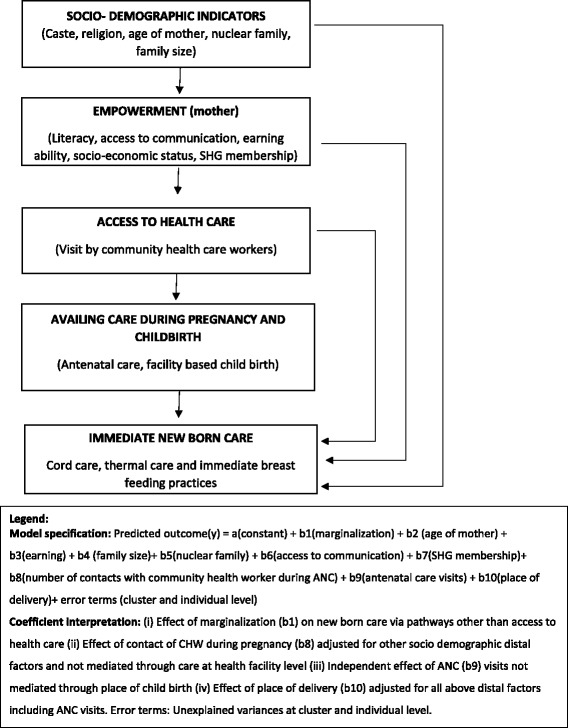
We use cross-sectional baseline data (which is part of a larger intervention project) collected from 129 gram panchayats (GPs) from 15 administrative blocks spread over five districts of UP in 2013. From currently married women (n = 2208) of 15-49 years, who delivered 15 months prior to the survey, we collected information on women's demographic and socio-economic characteristics, knowledge and practice of reproductive, maternal, newborn, child health and nutrition behaviours. Association of newborn practices with antenatal care, contacts by community health worker during pregnancy and place of childbirth were tested using random intercept logistic regression, adjusting for socio-economic and demographic factors and accounting for clustering at the GP and block levels.
Eighty-three percent of 2208 mothers received ANC, but only half of the respondents received a minimum of three ANC visits. More than two thirds of respondents delivered at a health facility. Practice of newborn care was poor: merely one fourth of women practised clean cord care, one third of women followed good breastfeeding practices (initiation with an hour of birth, fed colostrum and did not give pre-lacteal feeds) and one third provided adequate thermal care (kept baby warm and delayed bathing). Only 5% followed all above practices with evidence of clustering of newborn care practices at the block and GP levels. While facility-based childbirth was strongly associated with appropriate newborn care practices, ANC visits and contacts with CHWs was not associated with all newborn care practices.
The quality of ANC care provided needs to be improved to have an impact on newborn care practices. Our finding emphasizes the importance of facility-based birthing. There is a need for training CHWs to strengthen their counselling skills on newborn care. Variation of newborn care practices between communities should be taken into consideration while implementing any intervention to optimize benefits.
恰当的新生儿即时护理对新生儿存活至关重要。孕期是向母亲传授新生儿护理知识和提高意识的关键时期,无论是在医疗机构就诊时,还是社区卫生工作者(CHW)进行家访时,尤其是在农村地区。在本文中,我们报告了印度北方邦(UP)农村地区的新生儿护理情况,并探讨了新生儿护理行为与产前护理、孕期与社区卫生工作者的接触以及分娩地点之间的关联。
我们使用了2013年从北方邦五个区的15个行政街区的129个村潘查亚特(GP)收集的横断面基线数据(这是一个更大干预项目的一部分)。从调查前15个月分娩的15 - 49岁已婚妇女(n = 2208)中,我们收集了有关妇女的人口统计学和社会经济特征、生殖、孕产妇、新生儿、儿童健康及营养行为的知识和实践方面的信息。使用随机截距逻辑回归对新生儿护理行为与产前护理、孕期社区卫生工作者的接触以及分娩地点之间的关联进行了测试,同时对社会经济和人口统计学因素进行了调整,并考虑了在村潘查亚特和街区层面的聚类情况。
2208名母亲中有83%接受了产前护理,但只有一半的受访者至少接受了三次产前检查。超过三分之二的受访者在医疗机构分娩。新生儿护理实践情况较差:仅有四分之一的妇女进行了脐带清洁护理,三分之一的妇女遵循了良好的母乳喂养习惯(出生后一小时内开始喂奶、喂初乳且未喂哺初乳前食物),三分之一的妇女提供了适当的保暖护理(让婴儿保持温暖并延迟洗澡)。只有5%的妇女遵循了上述所有做法,且在街区和村潘查亚特层面存在新生儿护理行为的聚类现象。虽然在医疗机构分娩与适当的新生儿护理行为密切相关,但产前检查次数和与社区卫生工作者的接触与所有新生儿护理行为并无关联。
需要提高所提供的产前护理质量,以对新生儿护理实践产生影响。我们的研究结果强调了在医疗机构分娩的重要性。有必要培训社区卫生工作者,以加强他们在新生儿护理方面的咨询技能。在实施任何干预措施以优化效益时,应考虑到不同社区之间新生儿护理实践的差异。