Division of Gastroenterology, Hepatology and Nutrition, Virginia Commonwealth University and Richmond VA Medical Center, Richmond, Virginia, USA.
Microbiome Analysis Center, George Mason University, Manassas, Virginia.
Gut Microbes. 2021 Jan-Dec;13(1):1953247. doi: 10.1080/19490976.2021.1953247.
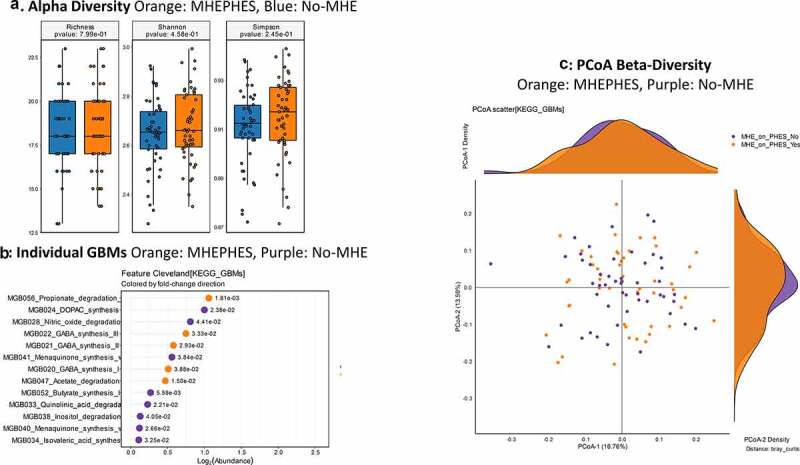
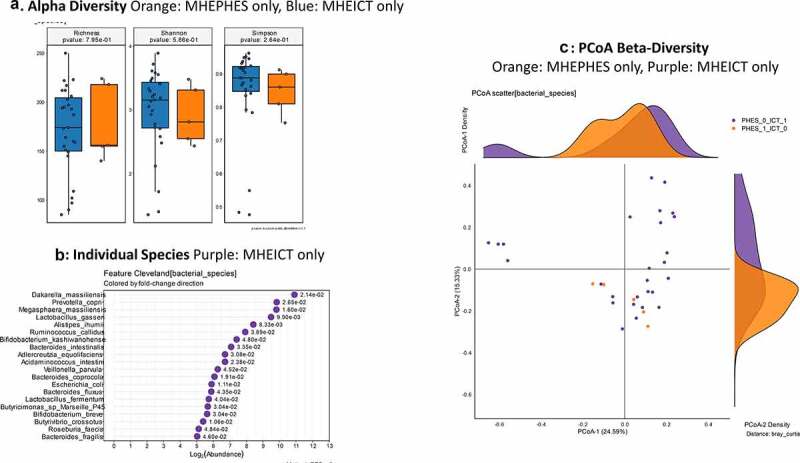
Most cirrhosis etiologies, such as alcohol, hepatitis C, and obesity, involve behavior that require the loss of inhibitory control. Once cirrhosis develops, patients can also develop cognitive impairment due to minimal hepatic encephalopathy (MHE). Both processes could have distinct imprints on the gut-liver-brain axis. Determine the impact of inhibitory control versus traditional cirrhosis-related cognitive performance on gut microbial composition and function. Outpatients with cirrhosis underwent two tests for MHE: inhibitory control test (MHEICT, computerized associated with response inhibition) and psychometric hepatic encephalopathy score (MHEPHES, paper-pencil HE-specific associated with subcortical impairment) along with stool collection for metagenomics. MHEICT/not, MHEPHES/not, and discordant (positive on one test but negative on the other) were analyzed for demographics, bacterial species, and gut-brain modules (GBM) using multi-variable analyses. Ninety-seven patients [47 (49%) MHEPHES, 76 (78%) MHEICT, 41 discordant] were enrolled. : Cirrhosis severity was worse in MHEPHES without differences in alpha/beta diversity on bacterial species or GBMs. Pathobionts (Enterobacteriaceae) and γ-amino-butryic acid (GABA) synthesis GBM were higher in MHEPHES. : We found similar cirrhosis severity and metagenomic alpha/beta diversity in MHEICT versus not. However, alpha/beta diversity of GBMs were different in MHEICT versus No-MHE patients. , spp. were higher, while spp. were uniquely lower in MHEICT versus no-MHE and discordant comparisons. GBMs belonging to tryptophan, menaquinone, GABA, glutamate, and short-chain fatty acid synthesis were also unique to MHEICT. Gut microbial signature of impaired inhibitory control, which is associated with addictive disorders that can lead to cirrhosis, is distinct from cirrhosis-related cognitive impairment.
大多数肝硬化病因,如酒精、丙型肝炎和肥胖,都涉及需要丧失抑制控制的行为。一旦发生肝硬化,患者还可能因轻微肝性脑病(MHE)而出现认知障碍。这两个过程都可能对肠-肝-脑轴产生不同的影响。确定抑制控制与传统肝硬化相关认知表现对肠道微生物组成和功能的影响。对肝硬化门诊患者进行了两项 MHE 测试:抑制控制测试(MHEICT,计算机关联的反应抑制)和精神肝脏脑病评分(MHEPHES,纸笔 HE 特异性关联的皮质下损害),以及进行宏基因组学的粪便收集。分析 MHEICT/否、MHEPHES/否和不一致(一项测试阳性而另一项测试阴性)的人口统计学数据、细菌种类和肠-脑模块(GBM),采用多变量分析。共纳入 97 例患者[47 例(49%)MHEPHES、76 例(78%)MHEICT、41 例不一致]。结果:MHEPHES 无差异,但细菌种类或 GBM 无差异的情况下,肝硬化严重程度更差。条件致病菌(肠杆菌科)和γ-氨基丁酸(GABA)合成 GBM 在 MHEPHES 中更高。结果:我们发现 MHEICT 与不 MHE 患者的肝硬化严重程度和宏基因组 alpha/beta 多样性相似。然而,MHEICT 与无 MHE 患者相比,GBM 的 alpha/beta 多样性不同。在 MHEICT 中, spp.更高,而 spp.在 MHEICT 中比无 MHE 和不一致的比较中独特地更低。属于色氨酸、甲萘醌、GABA、谷氨酸和短链脂肪酸合成的 GBM 也仅存在于 MHEICT 中。与可导致肝硬化的成瘾障碍相关的受损抑制控制的肠道微生物特征与肝硬化相关的认知障碍不同。