
血清白细胞介素-10 水平升高与成人噬血细胞性淋巴组织细胞增生症患者的不良预后相关。
Increased levels of serum interleukin-10 are associated with poor outcome in adult hemophagocytic lymphohistiocytosis patients.
机构信息
Center of Hematology, The First Affiliated Hospital of Nanchang University, Nanchang, 330006, Jiangxi, China.
Institute of Hematology, Academy of Clinical Medicine of Jiangxi Province, Nanchang, 330006, Jiangxi, China.
出版信息
Orphanet J Rare Dis. 2021 Aug 4;16(1):347. doi: 10.1186/s13023-021-01973-4.
BACKGROUND
Interleukin-10 (IL-10) is an independent factor for predicting adverse outcomes in pediatric patients with hemophagocytic lymphohistiocytosis (HLH). However, little is known about its prognostic value in adult patients.
METHODS
This single center retrospective study was conducted to explore the prognostic value of IL-10 in 101 adults newly diagnosed with HLH. The serum interleukin levels were quantitatively determined by chemiluminescence using cytokine profiling kits.
RESULTS
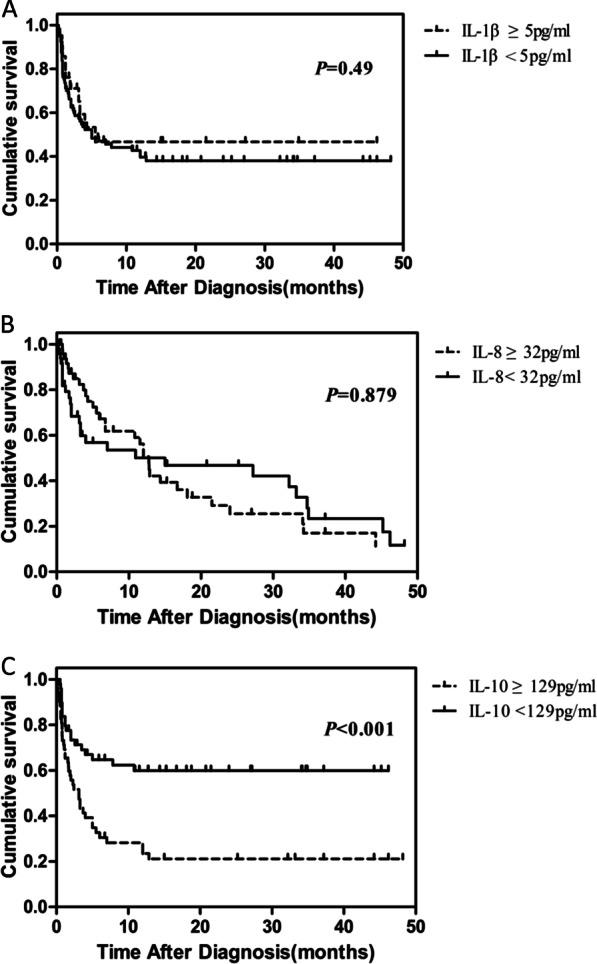
Serum IL-10 levels were significantly increased in adult HLH patients. Elevated IL-10 levels was correlated with lower concentrations of hemoglobin (r = - 0.279, P = 0.005). IL-10 levels were significantly lower in patients with macrophage activation syndrome (MAS) than in those with infection-associated HLH (IAHS) and malignancy-associated HLH (MAHS) (P = 0.033, P = 0.012). Patients with MAS had relatively longer survival than those with IAHS and MAHS (P < 0.001). Univariate analysis indicated that hemoglobin < 8.2 g/dL, platelets < 40 × 10/L, lactate dehydrogenase ≥ 700 IU/L, albumin < 28 g/L, post-treatment ferritin > 1050 µg/L and IL-10 ≥ 129 pg/mL were poor prognostic factors for survival. However, multivariate analysis revealed that only high serum IL-10 levels (≥ 129 pg/mL) at diagnosis and high post-treatment ferritin levels (> 1050 µg/L) were independent risk factors for poor overall survival in adult HLH patients (HR: 4.087, 95% CI 2.064-8.090, P < 0.001; HR 3.814, 95% CI 2.042-7.126, P < 0.001, respectively).
CONCLUSIONS
Our results suggest that higher serum IL-10 levels might be a prognostic marker in adult HLH patients.
背景
白细胞介素-10(IL-10)是预测儿童噬血细胞性淋巴组织细胞增生症(HLH)患者不良预后的独立因素。然而,其在成年患者中的预后价值知之甚少。
方法
本单中心回顾性研究旨在探讨 101 例新诊断为 HLH 的成年患者中 IL-10 的预后价值。通过使用细胞因子分析试剂盒进行化学发光法定量测定血清白细胞介素水平。
结果
成人 HLH 患者的血清 IL-10 水平显著升高。升高的 IL-10 水平与血红蛋白浓度降低相关(r = -0.279,P = 0.005)。巨噬细胞活化综合征(MAS)患者的 IL-10 水平明显低于感染相关性 HLH(IAHS)和恶性肿瘤相关性 HLH(MAHS)患者(P = 0.033,P = 0.012)。MAS 患者的生存时间明显长于 IAHS 和 MAHS 患者(P < 0.001)。单因素分析表明,血红蛋白 < 8.2 g/dL、血小板 < 40×10/L、乳酸脱氢酶≥700 IU/L、白蛋白 < 28 g/L、治疗后铁蛋白 > 1050 µg/L 和 IL-10 ≥ 129 pg/mL 是生存的不良预后因素。然而,多因素分析显示,只有初诊时血清 IL-10 水平升高(≥ 129 pg/mL)和治疗后铁蛋白水平升高(> 1050 µg/L)是成年 HLH 患者总生存不良的独立危险因素(HR:4.087,95%CI 2.064-8.090,P < 0.001;HR 3.814,95%CI 2.042-7.126,P < 0.001)。
结论
我们的研究结果表明,较高的血清 IL-10 水平可能是成年 HLH 患者的预后标志物。


 Zotero 插件