Altulaihi Bader A, Alharbi Khalid G, Alhassan Abdulrahman M, Altamimi Abdullah M, Al Akeel Mouneera A
Family and Community Medicine, King Abdulaziz Medical City, Riyadh, SAU.
Family Medicine, King Saud bin Abdulaziz University for Health Sciences, Riyadh, SAU.
Cureus. 2021 Jul 2;13(7):e16107. doi: 10.7759/cureus.16107. eCollection 2021 Jul.
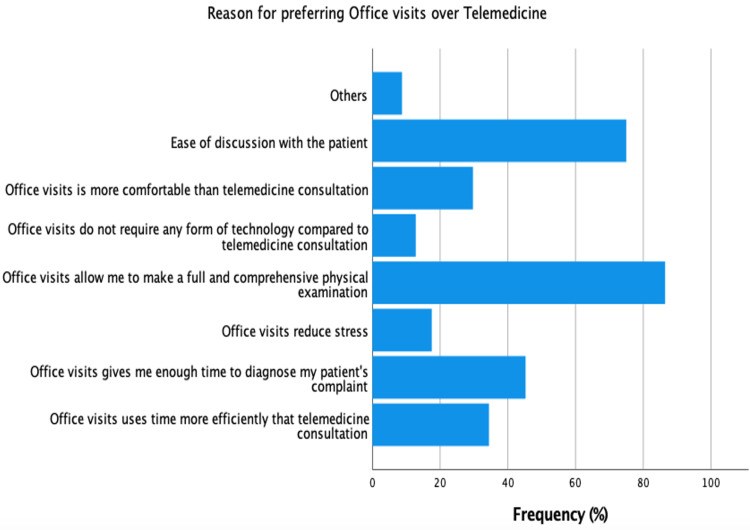
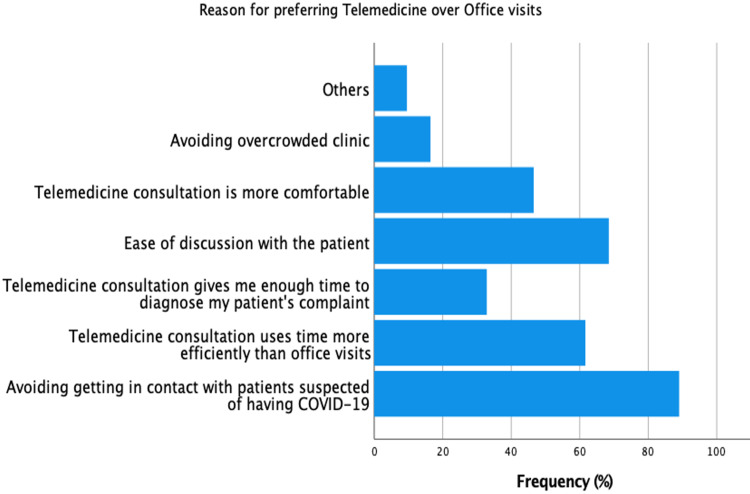
Introduction The novel coronavirus, officially known as COVID-19, was first reported in Wuhan, China, in December of 2019. Since that time, medical services in Saudi Arabia have adapted to the situation by delivering medical care via virtual clinics. Therefore, the aim of the study is to assess physicians' perception and the level of satisfaction with telemedicine during the COVID-19 pandemic in Riyadh, Saudi Arabia. Methods This was a cross-sectional study that included family medicine consultants and fellows who had used telemedicine in primary health care centers in Riyadh, Saudi Arabia. It was conducted using an online validated questionnaire. The questionnaire was completed by 219 family medicine consultants and fellows, after obtaining their informed consent. The data that were extracted from the questionnaire included demographics, level of satisfaction, and questions related to their experience with telemedicine. Results Two hundred and nineteen participants enrolled in this study with 50.6% males and 49.4% females. The overall level of physicians' satisfaction with telemedicine was 64.3%. However, only one-third preferred telemedicine over office visits. Of these, 60% were males and 40% were females. The only factor that had a statistically significant effect on the preference of office visits or telemedicine was time efficiency (p-value < 0.001). Of those who preferred office visits over telemedicine, 52% of them cited ease of discussion and the ability to make a comprehensive physical examination as the most important reasons for choosing office visits. Technologic issues were the least important factor for choosing either clinic (4.1%). Of those who preferred telemedicine, avoiding contact with patients suspected of COVID-19 was the most commonly cited factor (27.4%). Family medicine physicians face multiple barriers while using telemedicine during the COVID-19 pandemic. The most commonly cited barrier was the inability to make a full and comprehensive assessment of the patient. Conclusions In the setting of highly transmissible disease epidemics, telemedicine has a lot of potential for providing quick and safe care that is appropriate for screening and management. Based on our findings, using telemedicine should be encouraged by improving physicians' skills in this field since telemedicine is a crucial step to reduce the risk of COVID-19 transmission and provide community-wide treatment.
引言 新型冠状病毒,官方名称为COVID-19,于2019年12月在中国武汉首次报告。自那时以来,沙特阿拉伯的医疗服务通过虚拟诊所提供医疗护理来适应这种情况。因此,本研究的目的是评估沙特阿拉伯利雅得在COVID-19大流行期间医生对远程医疗的认知和满意度水平。方法 这是一项横断面研究,纳入了在沙特阿拉伯利雅得的初级卫生保健中心使用过远程医疗的家庭医学顾问和研究员。研究通过在线验证问卷进行。在获得219名家庭医学顾问和研究员的知情同意后,他们完成了问卷。从问卷中提取的数据包括人口统计学信息、满意度水平以及与他们远程医疗经历相关的问题。结果 219名参与者参与了本研究,其中男性占50.6%,女性占49.4%。医生对远程医疗的总体满意度为64.3%。然而,只有三分之一的人更喜欢远程医疗而不是门诊就诊。其中,60%为男性,40%为女性。对选择门诊就诊或远程医疗有统计学显著影响的唯一因素是时间效率(p值<0.001)。在那些更喜欢门诊就诊而非远程医疗的人中,52%的人认为讨论方便以及能够进行全面体格检查是选择门诊就诊的最重要原因。技术问题是选择任何一种诊所的最不重要因素(4.1%)。在那些更喜欢远程医疗的人中,避免与疑似COVID-19患者接触是最常提到的因素(27.4%)。在COVID-19大流行期间,家庭医学医生在使用远程医疗时面临多重障碍。最常提到的障碍是无法对患者进行全面和综合评估。结论 在高传播性疾病流行的背景下,远程医疗在提供适合筛查和管理的快速、安全护理方面有很大潜力。根据我们的研究结果,应通过提高医生在该领域的技能来鼓励使用远程医疗,因为远程医疗是降低COVID-19传播风险并提供社区范围内治疗的关键一步。