Telemedicine Department, Hospital Israelita Albert Einstein, Brazil.
J Telemed Telecare. 2021 Apr;27(3):166-173. doi: 10.1177/1357633X19864829. Epub 2019 Aug 14.
Few studies have assessed the perception of teledermatologists about the utility and limitations of teledermatology, especially to diagnose a broad range of skin diseases. This study aimed to evaluate dermatologists' confidence in teledermatology, its utility and limitations for dermatological conditions in primary care.
An analytical study that used a survey for dermatologists who diagnosed 30,916 patients with 55,012 lesions through teledermatology during a 1-year project in São Paulo, Brazil.
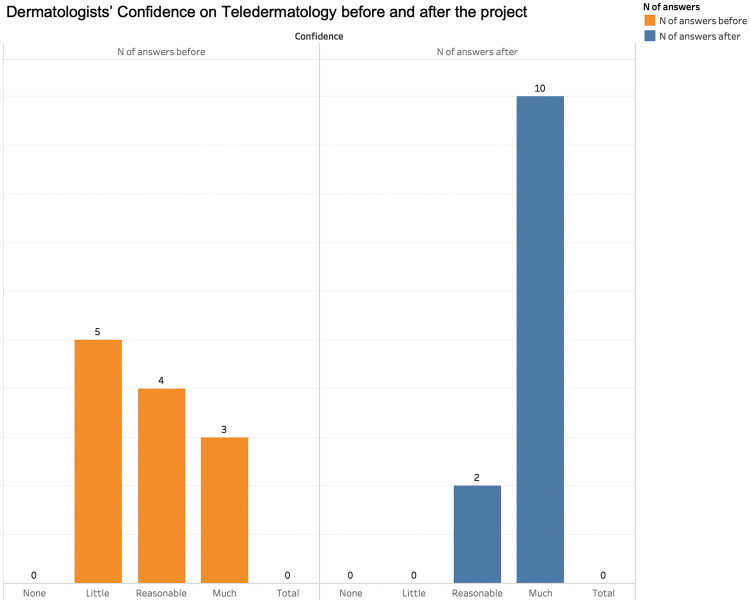
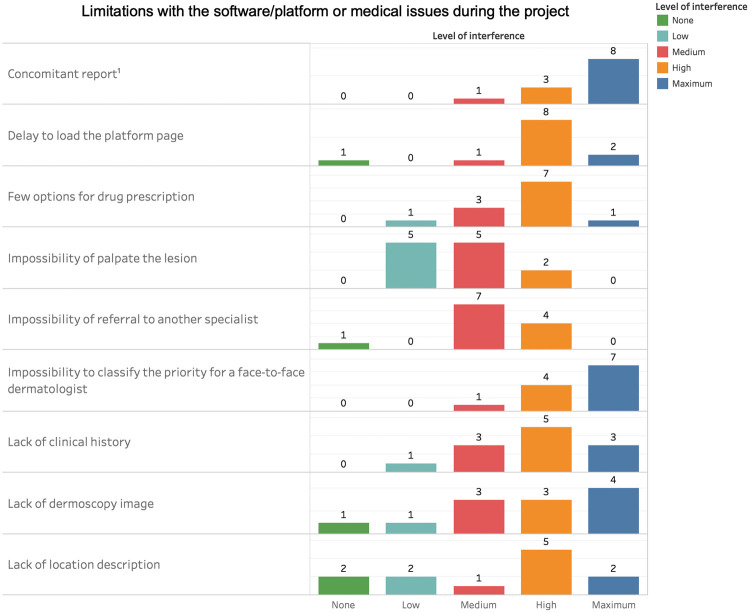
Dermatologists found teledermatology useful for triage and diagnosis, especially for xerotic eczema, pigmentary disorders and superficial infections. Their confidence in teledermatology was statistically higher by the end of the project ( = 0.0012). Limitations included some technical issues and the impossibility to suggest how soon the patient should be assisted face-to-face by a dermatologist. The most treatable group of diseases by teledermatology was superficial infections (92%). The use of dermoscopy images would significantly increase the confidence to treat atypical naevi and malignant tumours ( < 0.0001 and = 0.0003 respectively). Follow-ups by teledermatology or feedback from primary-care physicians would be desirable, according to the dermatologists.
We found it interesting that dermatologists became increasingly confident in teledermatology after the project and how they classified teledermatology as useful for triage, diagnosis and even treatment of most types of skin conditions followed at primary care. Dermoscopy should definitely be added to the photographs, especially for malignant tumours and atypical naevi. Most of the technical limitations found could be solved with a few improvements in the software/platform.
很少有研究评估远程皮肤学家对远程皮肤病学的实用性和局限性的看法,尤其是对诊断广泛的皮肤病。本研究旨在评估皮肤科医生对远程皮肤病学的信心,以及其在初级保健中对皮肤科疾病的实用性和局限性。
这是一项分析性研究,使用问卷调查了在巴西圣保罗进行的为期一年的项目中通过远程皮肤病学诊断了 30916 名患者的 55012 处病变的皮肤科医生。
皮肤科医生发现远程皮肤病学在分诊和诊断方面非常有用,特别是对干性湿疹、色素障碍和浅表感染。他们对远程皮肤病学的信心在项目结束时呈统计学上的显著提高(=0.0012)。局限性包括一些技术问题和无法建议患者应多快由皮肤科医生进行面对面就诊。通过远程皮肤病学治疗最可行的疾病组是浅表感染(92%)。使用皮肤镜图像将显著增加治疗非典型痣和恶性肿瘤的信心(分别为<0.0001 和=0.0003)。根据皮肤科医生的意见,希望通过远程皮肤病学进行随访或从初级保健医生那里获得反馈。
我们发现有趣的是,皮肤科医生在项目后对远程皮肤病学的信心越来越强,以及他们如何将远程皮肤病学分类为对初级保健中随访的大多数皮肤疾病的分诊、诊断甚至治疗都有用。皮肤镜检查绝对应该添加到照片中,特别是对于恶性肿瘤和非典型痣。发现的大多数技术局限性可以通过对软件/平台进行一些改进来解决。