Menici Valentina, Antonelli Camilla, Beani Elena, Mattiola Alessandra, Giampietri Matteo, Martini Giada, Rizzi Riccardo, Cecchi Alessandra, Cioni Maria Luce, Cioni Giovanni, Sgandurra Giuseppina
Department of Developmental Neuroscience, IRCCS Fondazione Stella Maris, Pisa, Italy.
Tuscan Ph.D. Programme of Neuroscience, University of Florence, Florence, Italy.
Front Pediatr. 2021 Jul 19;9:673956. doi: 10.3389/fped.2021.673956. eCollection 2021.
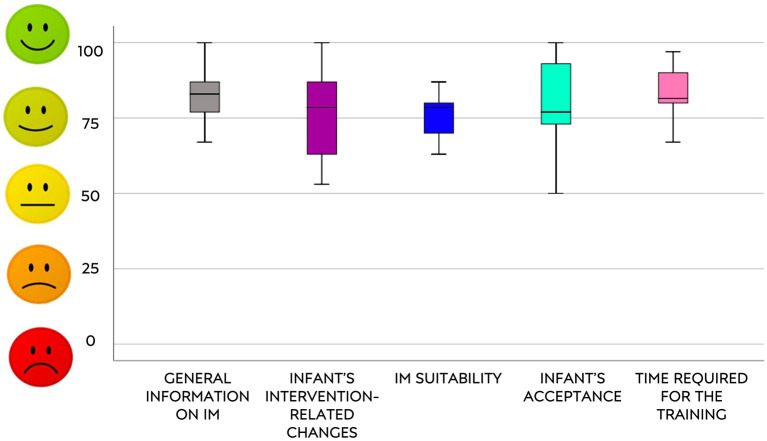
Infant massage (IM) can be considered an early intervention program that leads to the environmental enrichment framework. The effectiveness of IM to promote neurodevelopment in preterm infants has been proved, but studies on infants with early brain damage are still lacking. The main aim of this study was to assess the feasibility, acceptability and usability of IM, carried out by parents at home, on infants at high risk for Cerebral Palsy. An IM daily diary and an questionnaire, called Infant Massage Questionnaire Parent-Infant Experiences (IMQPE), were developed. IMQPE consisted of a total of 30 questions, divided into 5 areas. The parents were trained to carry out the IM with a home-based course, conducted by an expert therapist. The intensive IM program was set according to a defined daily length of at least 20 min, with a frequency of at least 5 days per week for a total of 8 weeks. Data collection consisted in the selection of the variables around the characteristics, both of the infants and the mothers, IM dosage and frequency, different body parts of the infants involved and IMQPE scores. Variable selection was carried out by minimizing the Bayesian Information Criteria (BIC) over all possible variable subsets. Nineteen high-risk infants, aged 4.83 ± 1.22 months, received IM at home for 8 weeks. The massage was given by the infants' mothers with a mean daily session dose of 27.79 ± 7.88 min and a total of 21.04 ± 8.49 h. 89.74% and 100% of mothers performed the IM for the minimum daily dosage and the frequency recommended, respectively. All the families filled in the IMQPE, with a Total mean score of 79.59% and of 82.22% in General Information on IM, 76.30% in Infant's intervention-related changes, 76.85% in IM Suitability, 79.07% in Infant's acceptance and 83.52% in Time required for the training. Different best predictors in mothers and in infants have been found. These data provide evidence of the feasibility of performing IM at home on infants at high risk for CP. Study registration: www.clinicaltrial.com (NCT03211533 and NCT03234959).
婴儿抚触(IM)可被视为一种能纳入环境丰富化框架的早期干预项目。已证实IM对促进早产儿神经发育有效,但针对早期脑损伤婴儿的研究仍很缺乏。本研究的主要目的是评估由家长在家中对脑瘫高危婴儿进行IM的可行性、可接受性和实用性。为此编制了一份IM日常日记和一份名为“婴儿抚触问卷——亲子体验”(IMQPE)的问卷。IMQPE共有30个问题,分为5个领域。由专业治疗师通过家庭课程培训家长进行IM。强化IM项目设定为每天至少20分钟,每周至少5天,共持续8周。数据收集包括选取有关婴儿和母亲的特征、IM剂量和频率、婴儿涉及的不同身体部位以及IMQPE评分等变量。通过在所有可能的变量子集中最小化贝叶斯信息准则(BIC)来进行变量选择。19名年龄为4.83±1.22个月的高危婴儿在家中接受了8周的IM。按摩由婴儿母亲进行,平均每日时长为27.79±7.88分钟,总计21.04±8.49小时。分别有89.74%和100%的母亲按照推荐的最低每日剂量和频率进行IM。所有家庭都填写了IMQPE,在IM一般信息方面的总平均分分别为79.59%和82.22%,婴儿干预相关变化方面为76.30%,IM适宜性方面为76.85%,婴儿接受度方面为79.07%,培训所需时间方面为83.52%。在母亲和婴儿中发现了不同的最佳预测因素。这些数据证明了在家中对脑瘫高危婴儿进行IM的可行性。研究注册:www.clinicaltrial.com(NCT03211533和NCT03234959)。