Division of Oncology, IRCCS Azienda Ospedaliero-Universitaria di Bologna, Bologna, Italy.
Division of Oncology, IRCCS Azienda Ospedaliero-Universitaria di Bologna, Bologna, Italy.
ESMO Open. 2021 Aug;6(4):100222. doi: 10.1016/j.esmoop.2021.100222. Epub 2021 Aug 2.
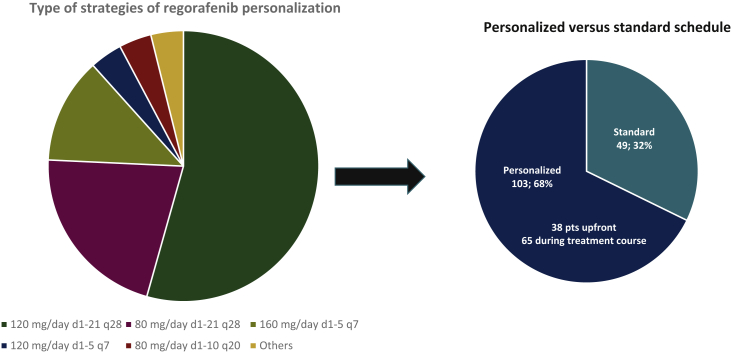
Despite its proven activity as third-line treatment in gastrointestinal stromal tumors (GIST), regorafenib can present a poor tolerability profile which often leads to treatment modifications and transient or permanent discontinuation; thus, in clinical practice physicians usually adopt various dosing and interval schedules to counteract regorafenib-related adverse events and avoid treatment interruption. The aim of this real-world study was to investigate the efficacy and safety of personalized schedules of regorafenib in patients with metastatic GIST, in comparison with the standard schedule (160 mg daily, 3-weeks-on, 1-week-off).
Institutional registries across seven Italian reference centers were retrospectively reviewed and data of interest retrieved to identify patients with GIST who had received regorafenib from February 2013 to January 2021. The Kaplan-Meier method was used to estimate survival and the log-rank test to make comparisons.
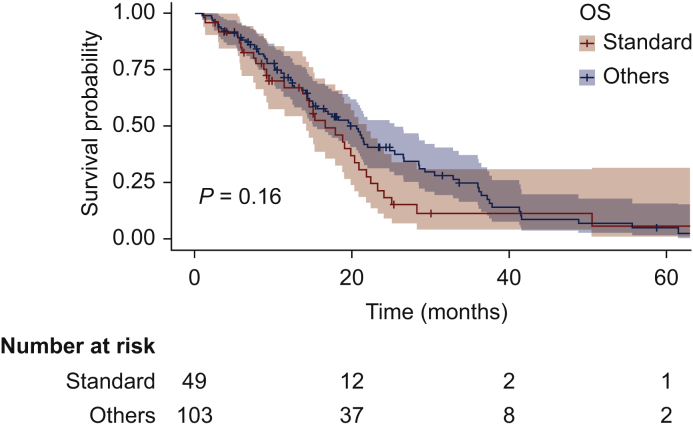
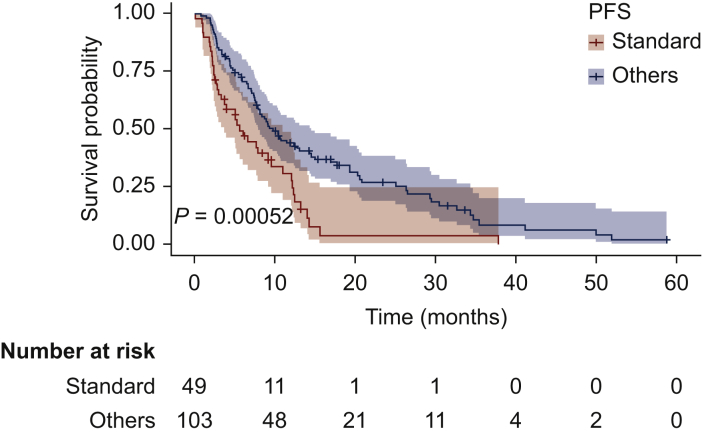
Of a total of 152 patients with GIST, 49 were treated with standard dose, while 103 received personalized schedules. At a median follow-up of 36.5 months, median progression-free survival was 5.6 months [95% confidence interval (CI) 3.73-11.0 months] versus 9.7 months (95% CI 7.9-14.5 months) in the standard-dose and the personalized schedule groups, respectively [hazard ratio (HR) 0.51; 95% CI 0.34-0.75; P = 0.00052]. Median overall survival was 16.6 months (95% CI 14.1-21.8 months) versus 20.5 months (95% CI 15.0-25.4 months), respectively (HR 0.75; 95% CI 0.49-1.22; P = 0.16).
Regorafenib-personalized schedules are commonly adopted in daily clinical practice of high-volume GIST expert centers and correlate with significant improvement of therapeutic outcomes. Therefore, regorafenib treatment optimization in patients with GIST may represent the best strategy to maximize long-term therapy.
尽管regorafenib 已被证实可作为胃肠道间质瘤(GIST)的三线治疗药物,但它的耐受性较差,常导致治疗方案的调整和暂时或永久性停药;因此,在临床实践中,医生通常采用各种剂量和间隔方案来对抗 regorafenib 相关的不良反应,避免治疗中断。本真实世界研究的目的是比较个体化的regorafenib 方案与标准方案(每日 160mg,连续 3 周,停药 1 周)在转移性 GIST 患者中的疗效和安全性。
回顾性分析了意大利 7 个参考中心的机构注册数据,并检索了相关数据,以确定自 2013 年 2 月至 2021 年 1 月接受 regorafenib 治疗的 GIST 患者。采用 Kaplan-Meier 法估计生存情况,并采用对数秩检验进行比较。
在总共 152 例 GIST 患者中,49 例接受标准剂量治疗,103 例接受个体化方案治疗。中位随访 36.5 个月时,标准剂量组和个体化方案组的中位无进展生存期分别为 5.6 个月(95%可信区间 3.73-11.0 个月)和 9.7 个月(95%可信区间 7.9-14.5 个月)[风险比(HR)0.51;95%可信区间 0.34-0.75;P=0.00052]。中位总生存期分别为 16.6 个月(95%可信区间 14.1-21.8 个月)和 20.5 个月(95%可信区间 15.0-25.4 个月)[HR 0.75;95%可信区间 0.49-1.22;P=0.16]。
在高容量 GIST 专家中心的日常临床实践中,常采用 regorafenib 个体化方案,与治疗效果的显著改善相关。因此,优化 GIST 患者的 regorafenib 治疗可能是最大限度延长治疗时间的最佳策略。