Ryser Remo, Hirt Myriam R, Häussler Johanna, Gravel Dominique, Brose Ulrich
German Centre for Integrative Biodiversity Research (iDiv) Halle-Jena-Leipzig, Leipzig, Germany.
Institute of Biodiversity, Friedrich Schiller University Jena, Jena, Germany.
Nat Commun. 2021 Aug 5;12(1):4716. doi: 10.1038/s41467-021-24877-0.
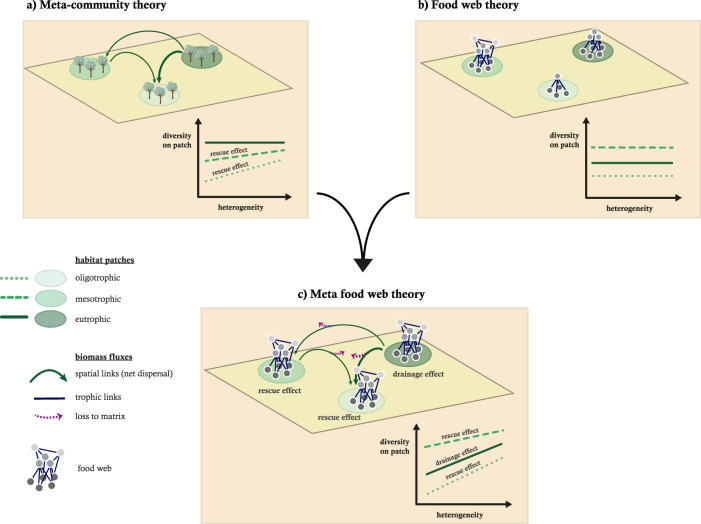
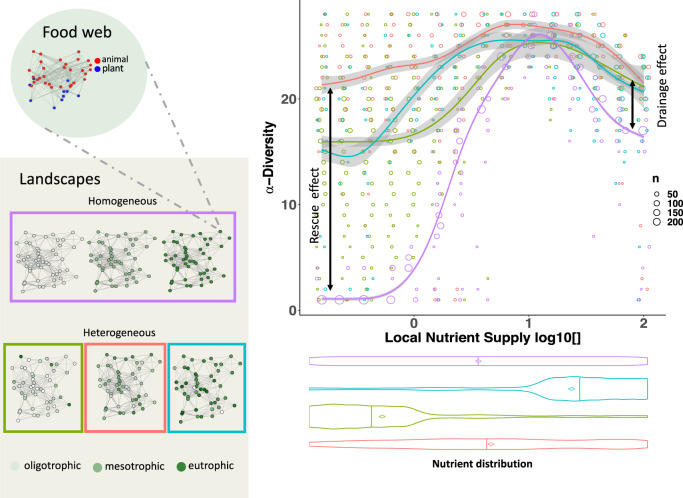
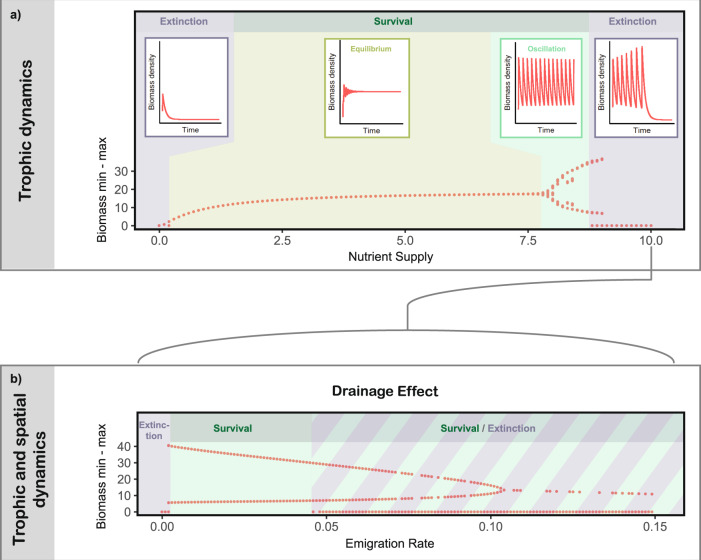
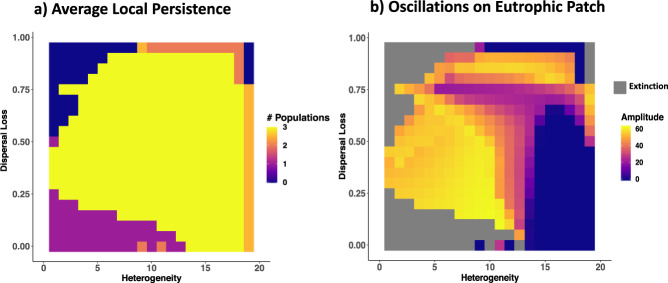
Habitat fragmentation and eutrophication have strong impacts on biodiversity. Metacommunity research demonstrated that reduction in landscape connectivity may cause biodiversity loss in fragmented landscapes. Food-web research addressed how eutrophication can cause local biodiversity declines. However, there is very limited understanding of their cumulative impacts as they could amplify or cancel each other. Our simulations of meta-food-webs show that dispersal and trophic processes interact through two complementary mechanisms. First, the 'rescue effect' maintains local biodiversity by rapid recolonization after a local crash in population densities. Second, the 'drainage effect' stabilizes biodiversity by preventing overshooting of population densities on eutrophic patches. In complex food webs on large spatial networks of habitat patches, these effects yield systematically higher biodiversity in heterogeneous than in homogeneous landscapes. Our meta-food-web approach reveals a strong interaction between habitat fragmentation and eutrophication and provides a mechanistic explanation of how landscape heterogeneity promotes biodiversity.
栖息地破碎化和富营养化对生物多样性有强烈影响。集合群落研究表明,景观连通性的降低可能导致破碎化景观中的生物多样性丧失。食物网研究探讨了富营养化如何导致局部生物多样性下降。然而,对于它们的累积影响,人们的了解非常有限,因为它们可能相互放大或抵消。我们对元食物网的模拟表明,扩散和营养过程通过两种互补机制相互作用。首先,“救援效应”通过在局部种群密度崩溃后迅速重新定殖来维持局部生物多样性。其次,“排水效应”通过防止富营养斑块上的种群密度过度增长来稳定生物多样性。在栖息地斑块的大型空间网络上的复杂食物网中,这些效应在异质景观中产生的生物多样性系统地高于同质景观。我们的元食物网方法揭示了栖息地破碎化和富营养化之间的强烈相互作用,并提供了一个关于景观异质性如何促进生物多样性的机理解释。