Neuropsychiatry, Department of Neurosciences, Leuven Brain Institute, KU Leuven, Leuven, Belgium.
Geriatric Psychiatry, University Psychiatric Center KU Leuven, Leuven, Belgium.
Sci Rep. 2021 Aug 5;11(1):15981. doi: 10.1038/s41598-021-95206-0.
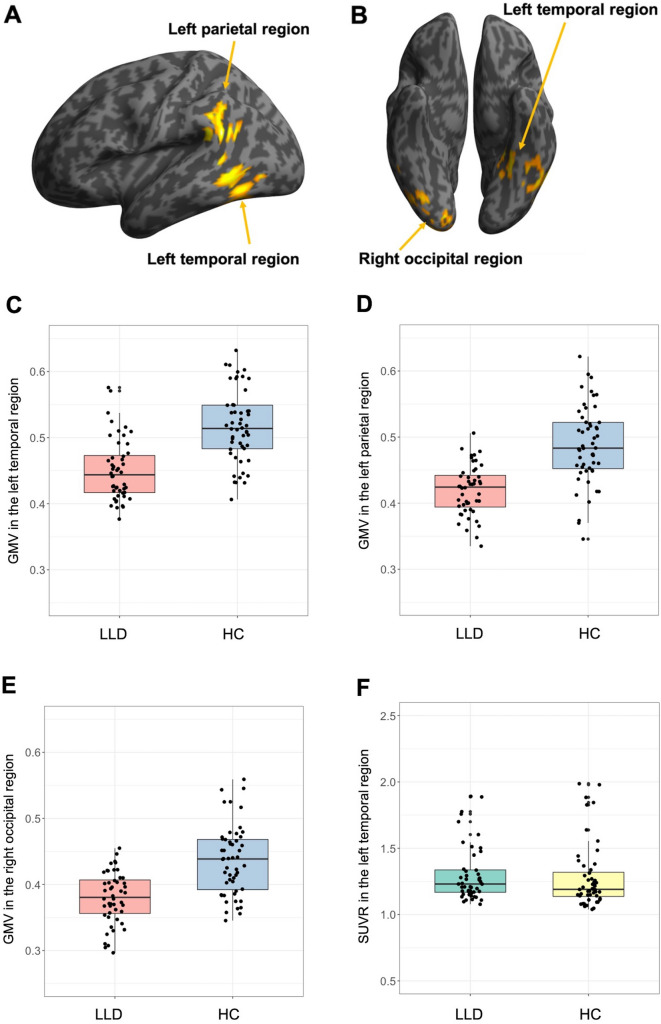
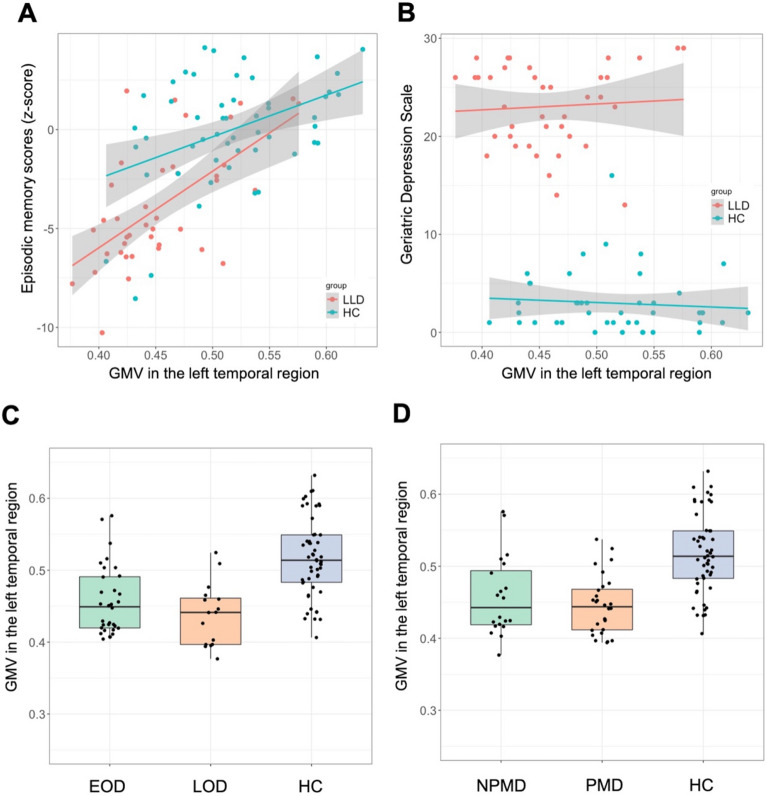
Late-life depression (LLD) is associated with a risk of developing Alzheimer's disease (AD). However, the role of AD-pathophysiology in LLD, and its association with clinical symptoms and cognitive function are elusive. In this study, one hundred subjects underwent amyloid positron emission tomography (PET) imaging with [F]-flutemetamol and structural MRI: 48 severely depressed elderly subjects (age 74.1 ± 7.5 years, 33 female) and 52 age-/gender-matched healthy controls (72.4 ± 6.4 years, 37 female). The Geriatric Depression Scale (GDS) and Rey Auditory Verbal Learning Test (RAVLT) were used to assess the severity of depressive symptoms and episodic memory function respectively. Amyloid deposition was quantified using the standardized uptake value ratio. Whole-brain voxel-wise comparisons of amyloid deposition and gray matter volume (GMV) between LLD and controls were performed. Multivariate analysis of covariance was conducted to investigate the association of regional differences in amyloid deposition and GMV with clinical factors, including GDS and RAVLT. As a result, there were no significant group differences in amyloid deposition. In contrast, LLD showed significant lower GMV in the left temporal and parietal region. GMV reduction in the left temporal region was associated with episodic memory dysfunction, but not with depression severity. Regional GMV reduction was not associated with amyloid deposition. LLD is associated with lower GMV in regions that overlap with AD-pathophysiology, and which are associated with episodic memory function. The lack of corresponding associations with amyloid suggests that lower GMV driven by non-amyloid pathology may play a central role in the neurobiology of LLD presenting as a psychiatric disorder.Trial registration: European Union Drug Regulating Authorities Clinical Trials identifier: EudraCT 2009-018064-95.
老年期抑郁症(LLD)与阿尔茨海默病(AD)的发病风险相关。然而,AD 病理生理学在 LLD 中的作用及其与临床症状和认知功能的关联仍不清楚。在这项研究中,100 名受试者接受了[F]-flutemetamol 正电子发射断层扫描(PET)成像和结构磁共振成像:48 名严重抑郁的老年受试者(年龄 74.1±7.5 岁,33 名女性)和 52 名年龄/性别匹配的健康对照者(72.4±6.4 岁,37 名女性)。使用老年抑郁量表(GDS)和 Rey 听觉言语学习测验(RAVLT)分别评估抑郁症状的严重程度和情景记忆功能。使用标准化摄取值比来量化淀粉样蛋白沉积。对 LLD 和对照组之间的淀粉样蛋白沉积和灰质体积(GMV)进行全脑体素比较。采用协方差分析多变量分析来研究与临床因素(包括 GDS 和 RAVLT)相关的区域淀粉样蛋白沉积和 GMV 的差异。结果显示,两组间的淀粉样蛋白沉积无显著差异。相反,LLD 左颞叶和顶叶区域的 GMV 明显减少。左颞叶 GMV 减少与情景记忆功能障碍相关,但与抑郁严重程度无关。区域 GMV 减少与淀粉样蛋白沉积无关。LLD 与 AD 病理生理学重叠的区域 GMV 减少有关,与情景记忆功能有关。与淀粉样蛋白无对应关联表明,非淀粉样蛋白病理驱动的 GMV 减少可能在以精神障碍为表现的 LLD 的神经生物学中发挥核心作用。试验注册:欧盟药品监管当局临床试验标识符:EudraCT 2009-018064-95。