• 文献检索
  • 文档翻译
  • 深度研究
  • 学术资讯
  • Suppr Zotero 插件Zotero 插件
  • 邀请有礼
  • 套餐&价格
  • 历史记录
应用&插件
Suppr Zotero 插件Zotero 插件浏览器插件Mac 客户端Windows 客户端微信小程序
定价
高级版会员购买积分包购买API积分包
服务
文献检索文档翻译深度研究API 文档MCP 服务
关于我们
关于 Suppr公司介绍联系我们用户协议隐私条款
关注我们

Suppr 超能文献

核心技术专利:CN118964589B侵权必究
粤ICP备2023148730 号-1Suppr @ 2026

文献检索

告别复杂PubMed语法,用中文像聊天一样搜索,搜遍4000万医学文献。AI智能推荐,让科研检索更轻松。

立即免费搜索

文件翻译

保留排版,准确专业,支持PDF/Word/PPT等文件格式,支持 12+语言互译。

免费翻译文档

深度研究

AI帮你快速写综述,25分钟生成高质量综述,智能提取关键信息,辅助科研写作。

立即免费体验

物理限制导致动物黏附垫的微观和纳米结构平行进化:综述

Physical constraints lead to parallel evolution of micro- and nanostructures of animal adhesive pads: a review.

作者信息

Büscher Thies H, Gorb Stanislav N

机构信息

Department of Functional Morphology and Biomechanics, Institute of Zoology, Kiel University, Am Botanischen Garten 9, 24118 Kiel, Germany.

出版信息

Beilstein J Nanotechnol. 2021 Jul 15;12:725-743. doi: 10.3762/bjnano.12.57. eCollection 2021.

DOI:10.3762/bjnano.12.57
PMID:34354900
原文链接:https://pmc.ncbi.nlm.nih.gov/articles/PMC8290099/
Abstract

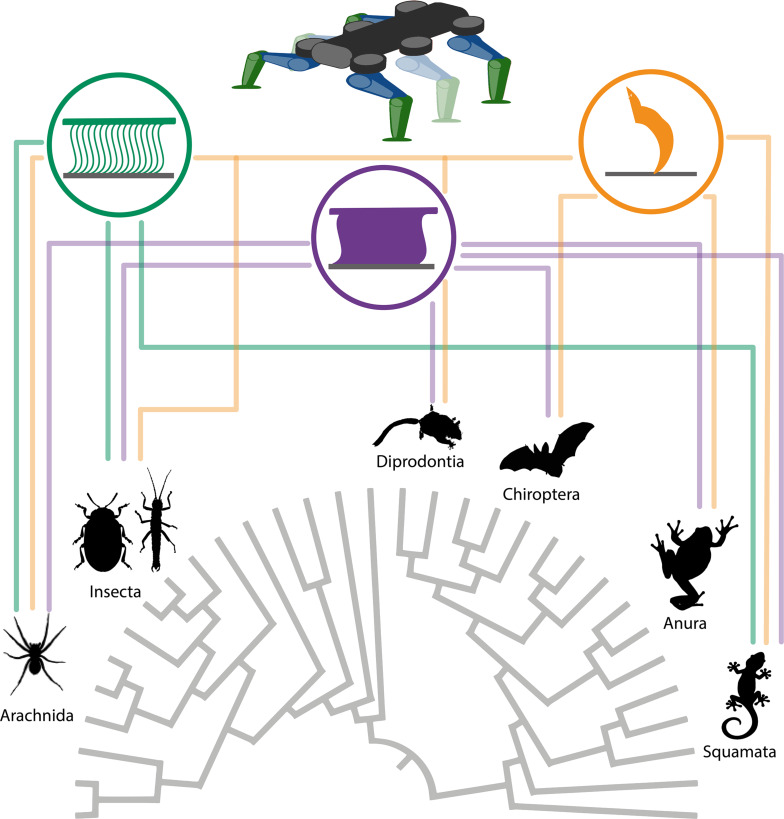
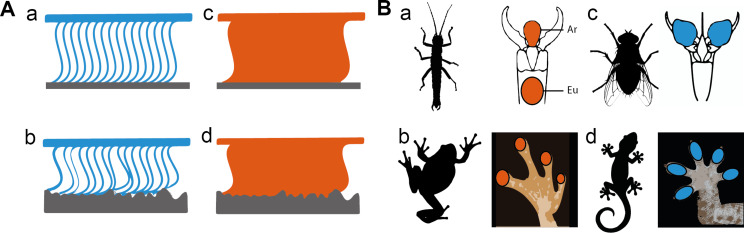
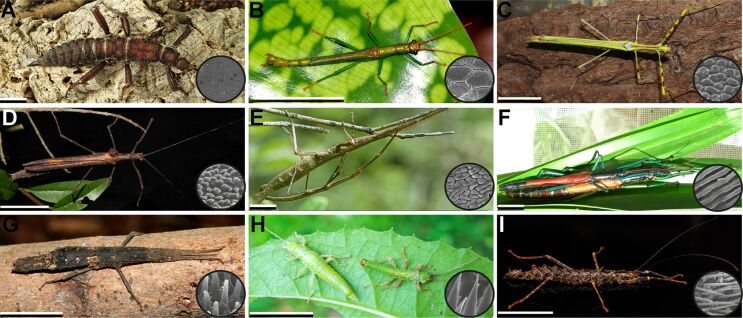
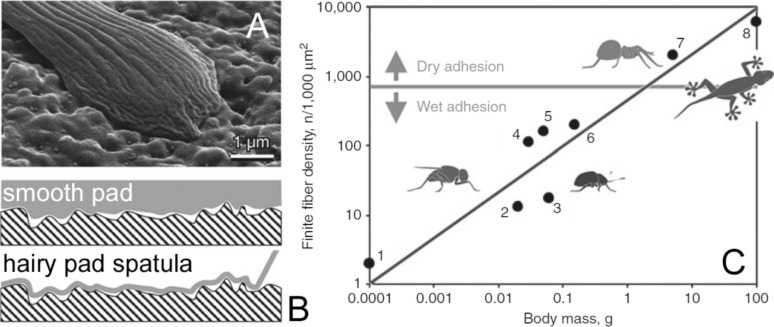
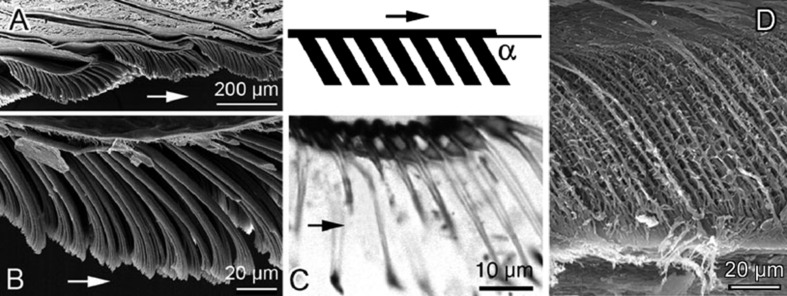
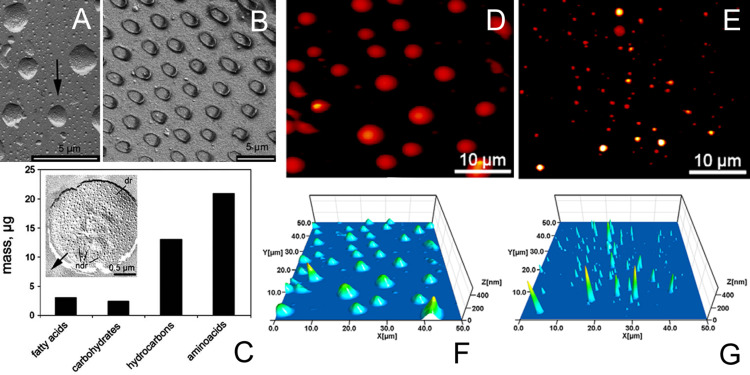
Adhesive pads are functional systems with specific micro- and nanostructures which evolved as a response to specific environmental conditions and therefore exhibit convergent traits. The functional constraints that shape systems for the attachment to a surface are general requirements. Different strategies to solve similar problems often follow similar physical principles, hence, the morphology of attachment devices is affected by physical constraints. This resulted in two main types of attachment devices in animals: hairy and smooth. They differ in morphology and ultrastructure but achieve mechanical adaptation to substrates with different roughness and maximise the actual contact area with them. Species-specific environmental surface conditions resulted in different solutions for the specific ecological surroundings of different animals. As the conditions are similar in discrete environments unrelated to the group of animals, the micro- and nanostructural adaptations of the attachment systems of different animal groups reveal similar mechanisms. Consequently, similar attachment organs evolved in a convergent manner and different attachment solutions can occur within closely related lineages. In this review, we present a summary of the literature on structural and functional principles of attachment pads with a special focus on insects, describe micro- and nanostructures, surface patterns, origin of different pads and their evolution, discuss the material properties (elasticity, viscoelasticity, adhesion, friction) and basic physical forces contributing to adhesion, show the influence of different factors, such as substrate roughness and pad stiffness, on contact forces, and review the chemical composition of pad fluids, which is an important component of an adhesive function. Attachment systems are omnipresent in animals. We show parallel evolution of attachment structures on micro- and nanoscales at different phylogenetic levels, focus on insects as the largest animal group on earth, and subsequently zoom into the attachment pads of the stick and leaf insects (Phasmatodea) to explore convergent evolution of attachment pads at even smaller scales. Since convergent events might be potentially interesting for engineers as a kind of optimal solution by nature, the biomimetic implications of the discussed results are briefly presented.

摘要

粘附垫是具有特定微观和纳米结构的功能系统,它们是对特定环境条件的一种进化响应,因此呈现出趋同特征。形成附着于表面的系统的功能限制是普遍要求。解决类似问题的不同策略通常遵循相似的物理原理,因此,附着装置的形态受到物理限制的影响。这导致动物中主要有两种附着装置类型:有毛的和光滑的。它们在形态和超微结构上有所不同,但都能实现对不同粗糙度底物的机械适应,并使其与底物的实际接触面积最大化。特定物种的环境表面条件导致了针对不同动物特定生态环境的不同解决方案。由于在与动物群体无关的离散环境中条件相似,不同动物群体附着系统的微观和纳米结构适应性揭示了相似的机制。因此,相似的附着器官以趋同的方式进化,并且在密切相关的谱系中可能出现不同的附着解决方案。在这篇综述中,我们总结了关于附着垫结构和功能原理的文献,特别关注昆虫,描述微观和纳米结构、表面图案、不同垫的起源及其进化,讨论有助于粘附的材料特性(弹性、粘弹性、粘附力、摩擦力)和基本物理力,展示不同因素(如底物粗糙度和垫的刚度)对接触力的影响,并综述垫液的化学成分,这是粘附功能的一个重要组成部分。附着系统在动物中无处不在。我们展示了在不同系统发育水平上微观和纳米尺度附着结构的平行进化,将重点放在地球上最大的动物群体昆虫上,随后深入研究竹节虫和叶虫(竹节虫目)的附着垫,以探索更小尺度上附着垫的趋同进化。由于趋同事件作为一种自然的最优解决方案可能对工程师有潜在的吸引力,我们简要介绍了所讨论结果的仿生意义。
https://cdn.ncbi.nlm.nih.gov/pmc/blobs/93d2/8290099/2e0776354cb1/Beilstein_J_Nanotechnol-12-725-g011.jpg
https://cdn.ncbi.nlm.nih.gov/pmc/blobs/93d2/8290099/c33e0a1083c5/Beilstein_J_Nanotechnol-12-725-g002.jpg
https://cdn.ncbi.nlm.nih.gov/pmc/blobs/93d2/8290099/cfa9e90aa283/Beilstein_J_Nanotechnol-12-725-g003.jpg
https://cdn.ncbi.nlm.nih.gov/pmc/blobs/93d2/8290099/5dfd8f51707c/Beilstein_J_Nanotechnol-12-725-g004.jpg
https://cdn.ncbi.nlm.nih.gov/pmc/blobs/93d2/8290099/3ebf3d2a6628/Beilstein_J_Nanotechnol-12-725-g005.jpg
https://cdn.ncbi.nlm.nih.gov/pmc/blobs/93d2/8290099/27c9defe3370/Beilstein_J_Nanotechnol-12-725-g006.jpg
https://cdn.ncbi.nlm.nih.gov/pmc/blobs/93d2/8290099/62d24b6849f4/Beilstein_J_Nanotechnol-12-725-g007.jpg
https://cdn.ncbi.nlm.nih.gov/pmc/blobs/93d2/8290099/889e54968dbb/Beilstein_J_Nanotechnol-12-725-g008.jpg
https://cdn.ncbi.nlm.nih.gov/pmc/blobs/93d2/8290099/3f7ed02afa51/Beilstein_J_Nanotechnol-12-725-g009.jpg
https://cdn.ncbi.nlm.nih.gov/pmc/blobs/93d2/8290099/a9a57b96e3f0/Beilstein_J_Nanotechnol-12-725-g010.jpg
https://cdn.ncbi.nlm.nih.gov/pmc/blobs/93d2/8290099/2e0776354cb1/Beilstein_J_Nanotechnol-12-725-g011.jpg
https://cdn.ncbi.nlm.nih.gov/pmc/blobs/93d2/8290099/c33e0a1083c5/Beilstein_J_Nanotechnol-12-725-g002.jpg
https://cdn.ncbi.nlm.nih.gov/pmc/blobs/93d2/8290099/cfa9e90aa283/Beilstein_J_Nanotechnol-12-725-g003.jpg
https://cdn.ncbi.nlm.nih.gov/pmc/blobs/93d2/8290099/5dfd8f51707c/Beilstein_J_Nanotechnol-12-725-g004.jpg
https://cdn.ncbi.nlm.nih.gov/pmc/blobs/93d2/8290099/3ebf3d2a6628/Beilstein_J_Nanotechnol-12-725-g005.jpg
https://cdn.ncbi.nlm.nih.gov/pmc/blobs/93d2/8290099/27c9defe3370/Beilstein_J_Nanotechnol-12-725-g006.jpg
https://cdn.ncbi.nlm.nih.gov/pmc/blobs/93d2/8290099/62d24b6849f4/Beilstein_J_Nanotechnol-12-725-g007.jpg
https://cdn.ncbi.nlm.nih.gov/pmc/blobs/93d2/8290099/889e54968dbb/Beilstein_J_Nanotechnol-12-725-g008.jpg
https://cdn.ncbi.nlm.nih.gov/pmc/blobs/93d2/8290099/3f7ed02afa51/Beilstein_J_Nanotechnol-12-725-g009.jpg
https://cdn.ncbi.nlm.nih.gov/pmc/blobs/93d2/8290099/a9a57b96e3f0/Beilstein_J_Nanotechnol-12-725-g010.jpg
https://cdn.ncbi.nlm.nih.gov/pmc/blobs/93d2/8290099/2e0776354cb1/Beilstein_J_Nanotechnol-12-725-g011.jpg

相似文献

1
Physical constraints lead to parallel evolution of micro- and nanostructures of animal adhesive pads: a review.物理限制导致动物黏附垫的微观和纳米结构平行进化:综述
Beilstein J Nanotechnol. 2021 Jul 15;12:725-743. doi: 10.3762/bjnano.12.57. eCollection 2021.
2
Comparative analysis of the ultrastructure and adhesive secretion pathways of different smooth attachment pads of the stick insect (Phasmatodea).竹节虫(竹节虫目)不同光滑附着垫的超微结构和黏附分泌途径的比较分析
Beilstein J Nanotechnol. 2024 May 29;15:612-630. doi: 10.3762/bjnano.15.52. eCollection 2024.
3
Complementary effect of attachment devices in stick insects (Phasmatodea).附肢器在竹节虫(直翅目)中的互补作用。
J Exp Biol. 2019 Nov 29;222(Pt 23):jeb209833. doi: 10.1242/jeb.209833.
4
Adhesive and frictional properties of tarsal attachment pads in two species of stick insects (Phasmatodea) with smooth and nubby euplantulae.两种具光滑和粒状表皮附肢的竹节虫跗节附肢垫的粘着和摩擦特性。
Zoology (Jena). 2012 Jun;115(3):135-41. doi: 10.1016/j.zool.2011.11.002. Epub 2012 May 9.
5
The effect of age on the attachment ability of stick insects (Phasmatodea).年龄对竹节虫(竹节虫目)附着能力的影响。
Beilstein J Nanotechnol. 2024 Jul 15;15:867-883. doi: 10.3762/bjnano.15.72. eCollection 2024.
6
Functionally different pads on the same foot allow control of attachment: stick insects have load-sensitive "heel" pads for friction and shear-sensitive "toe" pads for adhesion.同一只脚上功能不同的脚垫有助于控制附着:竹节虫有对负载敏感的“脚跟”脚垫用于摩擦,还有对剪切力敏感的“脚趾”脚垫用于黏附。
PLoS One. 2013 Dec 11;8(12):e81943. doi: 10.1371/journal.pone.0081943. eCollection 2013.
7
Comparison of smooth and hairy attachment pads in insects: friction, adhesion and mechanisms for direction-dependence.昆虫光滑与多毛附着垫的比较:摩擦力、附着力及方向依赖性机制
J Exp Biol. 2008 Oct;211(Pt 20):3333-43. doi: 10.1242/jeb.020941.
8
Why are so many adhesive pads hairy?为什么这么多粘性垫是有毛的?
J Exp Biol. 2006 Jul;209(Pt 14):2611-21. doi: 10.1242/jeb.02323.
9
Physical principles of fluid-mediated insect attachment - Shouldn't insects slip?流体介导昆虫附着的物理原理 - 昆虫不应该打滑吗?
Beilstein J Nanotechnol. 2014 Jul 28;5:1160-6. doi: 10.3762/bjnano.5.127. eCollection 2014.
10
Structure and properties of the glandular surface in the digestive zone of the pitcher in the carnivorous plant Nepenthes ventrata and its role in insect trapping and retention.食肉植物猪笼草消化区腺体表面的结构与特性及其在捕获和留住昆虫中的作用。
J Exp Biol. 2004 Aug;207(Pt 17):2947-63. doi: 10.1242/jeb.01128.

引用本文的文献

1
Biological Attachment Systems and Biomimetics-In Memory of William Jon P. Barnes.生物附着系统与仿生学——纪念威廉·乔恩·P·巴恩斯
Biomimetics (Basel). 2025 Apr 2;10(4):220. doi: 10.3390/biomimetics10040220.
2
Controlled Dry Adhesion of Bio-Inspired Fibrillar Polymers: Mechanics, Strategies, and Recent Advances.仿生纤维状聚合物的可控干粘附:力学、策略及最新进展
Materials (Basel). 2025 Apr 2;18(7):1620. doi: 10.3390/ma18071620.
3
Double-spiral as a bio-inspired functional element in engineering design.双螺旋作为工程设计中受生物启发的功能元件。

本文引用的文献

1
Evolution of attachment structures in the highly diverse Acercaria (Hexapoda).高度多样化的无翅亚纲(六足亚门)中附着结构的演化。
Cladistics. 2014 Apr;30(2):170-201. doi: 10.1111/cla.12030. Epub 2013 Jun 6.
2
Early specializations for mimicry and defense in a Jurassic stick insect.侏罗纪竹节虫在拟态和防御方面的早期特化
Natl Sci Rev. 2020 Apr 2;8(1):nwaa056. doi: 10.1093/nsr/nwaa056. eCollection 2021 Jan.
3
In the soft grip of nature.在大自然的温柔怀抱中。
Sci Rep. 2024 Nov 25;14(1):29225. doi: 10.1038/s41598-024-79630-6.
4
Diversity of attachment systems in heelwalkers (Mantophasmatodea) - highly specialized, but uniform.跟脚步行虫(直翅目)的附着系统多样性 - 高度特化,但统一。
BMC Ecol Evol. 2024 Oct 25;24(1):130. doi: 10.1186/s12862-024-02319-x.
5
Interaction of a non-axisymmetric artificial single spatula with rough surfaces.非轴对称人工单刮刀与粗糙表面的相互作用。
Interface Focus. 2024 Jun 7;14(3):20230081. doi: 10.1098/rsfs.2023.0081. eCollection 2024 Jun.
6
The effect of age on the attachment ability of stick insects (Phasmatodea).年龄对竹节虫(竹节虫目)附着能力的影响。
Beilstein J Nanotechnol. 2024 Jul 15;15:867-883. doi: 10.3762/bjnano.15.72. eCollection 2024.
7
Comparative analysis of the ultrastructure and adhesive secretion pathways of different smooth attachment pads of the stick insect (Phasmatodea).竹节虫(竹节虫目)不同光滑附着垫的超微结构和黏附分泌途径的比较分析
Beilstein J Nanotechnol. 2024 May 29;15:612-630. doi: 10.3762/bjnano.15.52. eCollection 2024.
8
TriTrap: A Robotic Gripper Inspired by Insect Tarsal Chains.TriTrap:一种受昆虫跗骨链启发的机器人夹具。
Biomimetics (Basel). 2024 Feb 26;9(3):142. doi: 10.3390/biomimetics9030142.
9
Mechanoecology: biomechanical aspects of insect-plant interactions.机械生态学:昆虫-植物相互作用的生物力学方面。
J Comp Physiol A Neuroethol Sens Neural Behav Physiol. 2024 Mar;210(2):249-265. doi: 10.1007/s00359-024-01698-2. Epub 2024 Mar 14.
10
Holding in the stream: convergent evolution of suckermouth structures in Loricariidae (Siluriformes).水流中的保留:吸甲鲶科(鲇形目)吸盘口结构的趋同进化
Front Zool. 2023 Dec 1;20(1):37. doi: 10.1186/s12983-023-00516-w.
Sci Robot. 2020 Dec 16;5(49). doi: 10.1126/scirobotics.abd9120.
4
Multifunctional Adhesives on the Eggs of the Leaf Insect (Phasmatodea: Phylliidae): Solvent Influence and Biomimetic Implications.叶昆虫(竹节虫目:叶䗛科)卵上的多功能粘合剂:溶剂影响及仿生意义
Biomimetics (Basel). 2020 Nov 27;5(4):66. doi: 10.3390/biomimetics5040066.
5
Lost lovers linked at long last: elusive female mystery solved after a century of being placed in a different genus (Phasmatodea, Phylliidae).失散已久的恋人终于重聚:在被归入不同属(竹节虫目,叶竹节虫科)一个世纪后,难以捉摸的雌性谜团终于解开。
Zookeys. 2020 Sep 17;969:43-84. doi: 10.3897/zookeys.969.56214. eCollection 2020.
6
Attachment performance of stick insects (Phasmatodea) on convex substrates.竹节虫(直翅目)在凸面基质上的附着性能。
J Exp Biol. 2020 Sep 11;223(Pt 17):jeb226514. doi: 10.1242/jeb.226514.
7
Adhesion Performance in the Eggs of the Philippine Leaf Insect (Phasmatodea: Phylliidae).菲律宾叶螽(直翅目:叶螽科)卵的黏附性能
Insects. 2020 Jun 28;11(7):400. doi: 10.3390/insects11070400.
8
Role of Fruit Epicuticular Waxes in Preventing (Diptera: Tephritidae) Attachment in Different Cultivars of .果实表皮蜡质在防止[某种实蝇科(双翅目:实蝇科)]附着于[某种植物]不同品种上的作用
Insects. 2020 Mar 17;11(3):189. doi: 10.3390/insects11030189.
9
Pressure-induced silk spinning mechanism in webspinners (Insecta: Embioptera).压力诱导的纺丝机制在缨尾目昆虫(Insecta: Embioptera)中。
Soft Matter. 2019 Dec 4;15(47):9742-9750. doi: 10.1039/c9sm01782h.
10
Complementary effect of attachment devices in stick insects (Phasmatodea).附肢器在竹节虫(直翅目)中的互补作用。
J Exp Biol. 2019 Nov 29;222(Pt 23):jeb209833. doi: 10.1242/jeb.209833.