Leventhal Adam M, Cho Junhan, Keyes Katherine M, Zink Jennifer, Riehm Kira E, Zhang Yi, Ketema Elizabeth
Department of Preventive Medicine, University of Southern California Keck School of Medicine, 2001 N Soto Street, Los Angeles, CA 90089, USA.
Department of Psychology, University of Southern California, 3620 South McClintock Avenue, Los Angeles, CA 90089, USA.
Prev Med Rep. 2021 Jul 15;23:101497. doi: 10.1016/j.pmedr.2021.101497. eCollection 2021 Sep.
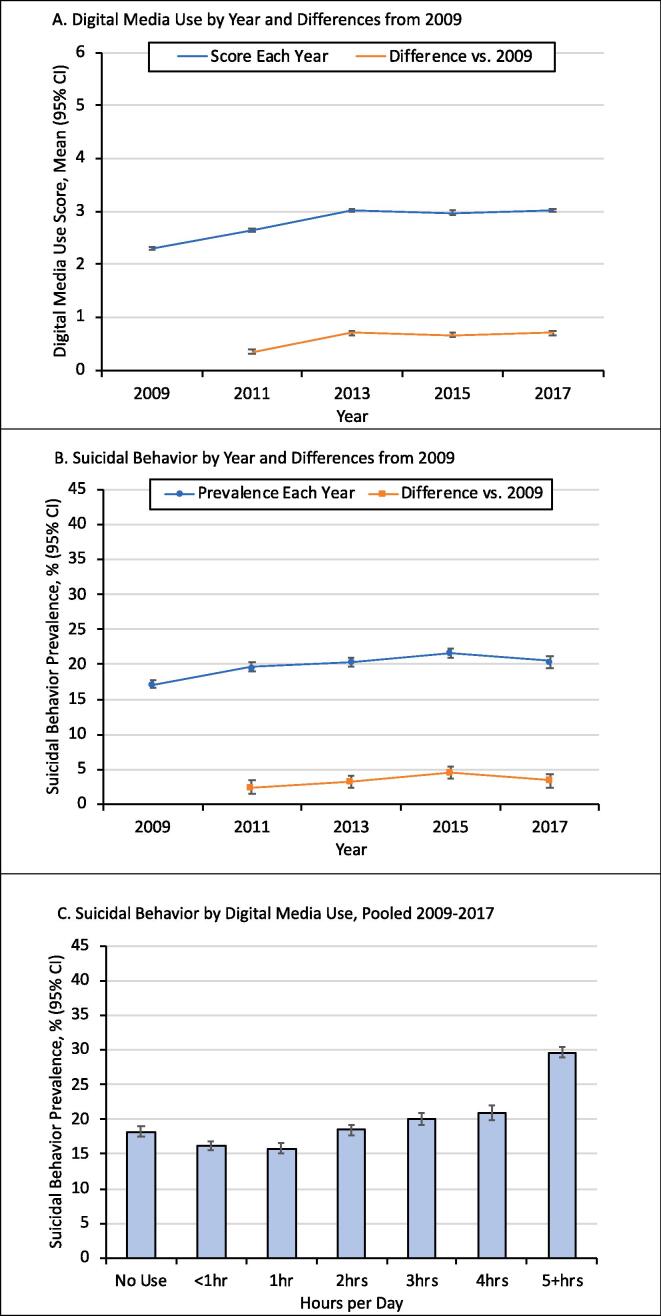
U.S. adolescent suicidal behavior and digital media use prevalence have contemporaneously increased this decade in population-level ecological analyses. The purpose of this study was to determine whether these two trends are directly associated by using multi-year person-level data to test whether the association of year with suicidal behavior was mediated by digital media use. Data were from the Youth Risk Behavior Surveillance System (2009-2017), a nationally-representative biennial cross-sectional self-report survey of U.S. students (N = 72,942). Mediation analysis was used to estimate the proportion of cross-year changes in suicidal behavior that were mediated by concurrent changes in leisure-time digital media use. Past-year suicidal behavior in 2011 (19.6%), 2013 (20.4%), 2015 (21.7%), and 2017 (20.5%) increased relative to 2009 (17.1%). Hours of daily digital media use in 2011 (mean[SD] = 2.65[1.86]), 2013 (mean[SD] = 3.02[2.08]), 2015 (mean[SD] = 2.97[2.12]), and 2017 (mean[SD] = 3.01[2.18) increased vs. 2009 (mean[SD] = 2.31[1.81]). The association of survey year with suicidal behavior was mediated by digital media use-20.5%(95%CI = 16.2, 24.8), 34.3%(95%CI = 24.5, 44.1), 22.8%(95%CI = 17.3, 28.0), and 41.4%(95%CI = 33.9, 49.5) of cross-year suicidal behavior prevalence increases (vs. 2009) for 2011, 2013, 2015, and 2017, respectively, were mediated by concurrent digital media use increases. Therefore, small proportions of the 2009-2017 increases in U.S. adolescent suicidal behavior are associated with concurrent increasing digital media use trends. Further exploration of these trends is warranted.
在人口水平的生态分析中,美国青少年自杀行为和数字媒体使用的普及率在这十年间同时上升。本研究的目的是通过使用多年个人层面的数据来检验年份与自杀行为之间的关联是否由数字媒体使用介导,以确定这两种趋势是否直接相关。数据来自青少年风险行为监测系统(2009 - 2017年),这是一项对美国学生进行的具有全国代表性的两年一次横断面自我报告调查(N = 72,942)。中介分析用于估计自杀行为跨年度变化中由休闲时间数字媒体使用的同期变化所介导的比例。2011年(19.6%)、2013年(20.4%)、2015年(21.7%)和2017年(20.5%)过去一年的自杀行为相对于2009年(17.1%)有所增加。2011年(均值[标准差]=2.65[1.86])、2013年(均值[标准差]=3.02[2.08])、2015年(均值[标准差]=2.97[2.12])和2017年(均值[标准差]=3.01[2.18])的每日数字媒体使用时长相较于2009年(均值[标准差]=2.31[1.81])有所增加。调查年份与自杀行为之间的关联由数字媒体使用介导——2011年、2013年、2015年和2017年相对于2009年跨年度自杀行为患病率增加的20.5%(95%置信区间 = 16.2, 24.8)、34.3%(95%置信区间 = 24.5, 44.1)、22.8%(95%置信区间 = 17.3, 28.0)和41.4%(95%置信区间 = 33.9, 49.5)分别由同期数字媒体使用的增加所介导。因此,2009 - 2017年美国青少年自杀行为增加的小部分比例与同期数字媒体使用增加的趋势相关。有必要对这些趋势进行进一步探索。