Abdullahi Aliyu Dantani, Kodchasee Pratthana, Unban Kridsada, Pattananandecha Thanawat, Saenjum Chalermpong, Kanpiengjai Apinun, Shetty Kalidas, Khanongnuch Chartchai
Interdisciplinary Program in Biotechnology, The Graduate School, Chiang Mai University, Mueang, Chiang Mai 50200, Thailand.
Division of Biotechnology, School of Agro-Industry, Faculty of Agro-Industry, Chiang Mai University, Mueang, Chiang Mai 50100, Thailand.
Antioxidants (Basel). 2021 Jul 19;10(7):1144. doi: 10.3390/antiox10071144.
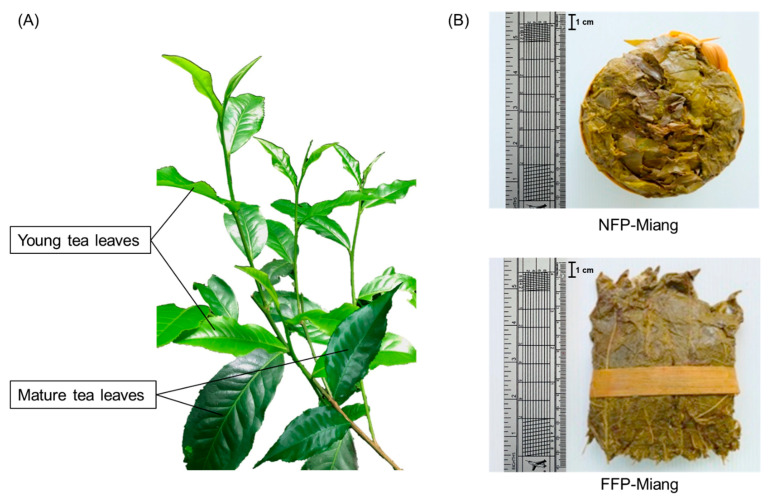
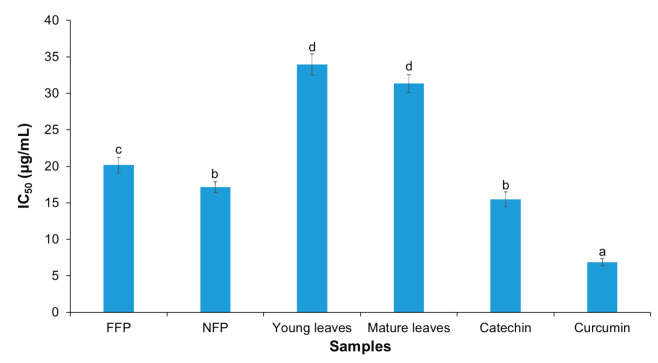
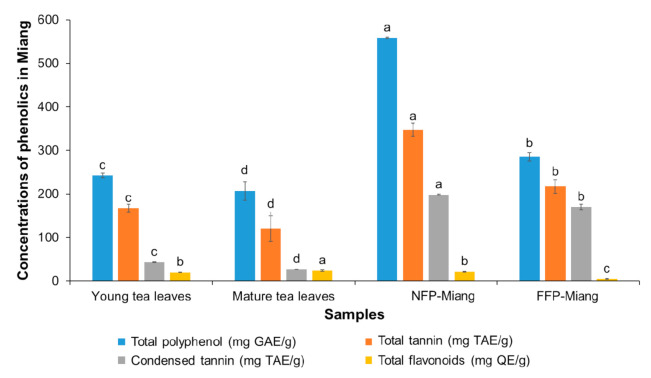
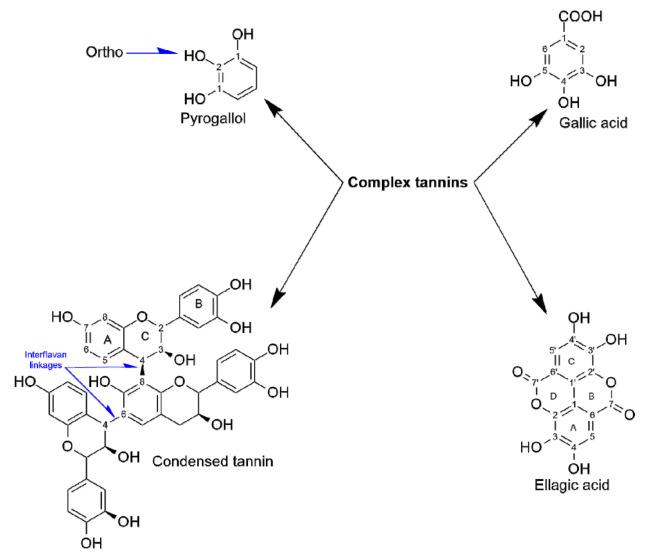
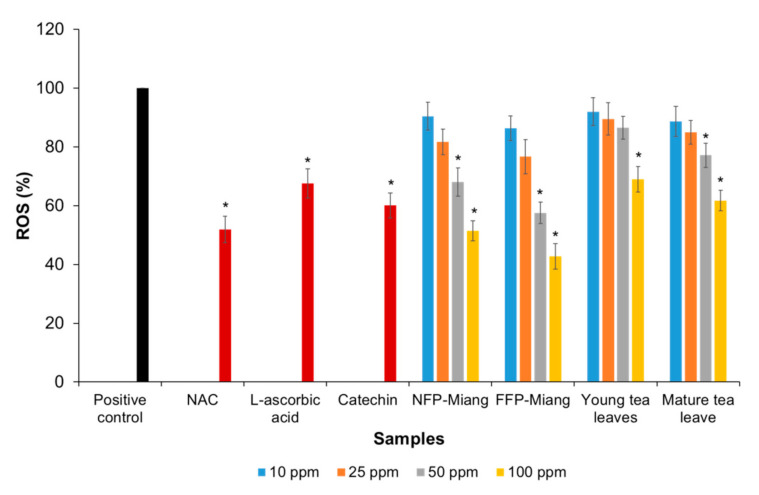
The study investigated the impact of the fermentation process on the phenolic contents and antioxidant and anti-inflammatory activities in extracts of Miang, an ethnic fermented tea product of northern Thailand. The acetone (80%) extraction of Miang samples fermented by a non-filamentous fungi-based process (NFP) and filamentous fungi-based process (FFP) had elevated levels of total polyphenols, total tannins, and condensed tannins compared to young and mature tea leaves. The antioxidant studies also showed better the half-maximal inhibitory concentration (IC) values for fermented leaves in both 1,1-diphenyl-2-picrylhydrazyl (DPPH) and 2,2'-azino-bis (3-ethylbenzothiazoline-6-sulfonic acid) (ABTS) radical scavenging activity assays as well as improved ferric reducing antioxidant power (FRAP) compared to young and mature tea leaves. Extracts of NFP and FFP samples at concentrations of 50 and 100 ppm showed better protective effects against hydrogen peroxide (HO)-induced intracellular reactive oxygen species (ROS) production in HT-29 colorectal cells without exerting cytotoxicity. Additionally, lipopolysaccharide (LPS)-induced production of nitric oxide (a proinflammatory mediator as well as a reactive nitrogen species) was also inhibited by these fermented Miang extracts with an IC values of 17.15 μg/mL (NFP), 20.17 μg/mL (FFP), 33.96 μg/mL (young tea leaves), and 31.33 μg/mL (mature tea leaves). Therefore, both NFP-Miang and FFP-Miang showed the potential to be targeted as natural bioactive functional ingredients with preventive properties against free radical and inflammatory-mediated diseases.
该研究调查了发酵过程对泰国北部民族发酵茶产品“Miang”提取物中酚类成分、抗氧化和抗炎活性的影响。与幼嫩和成熟茶叶相比,通过非丝状真菌发酵工艺(NFP)和丝状真菌发酵工艺(FFP)发酵的Miang样品的丙酮(80%)提取物中总多酚、总单宁和缩合单宁的含量有所提高。抗氧化研究还表明,在1,1-二苯基-2-苦基肼(DPPH)和2,2'-联氮-双-(3-乙基苯并噻唑啉-6-磺酸)(ABTS)自由基清除活性测定中,发酵茶叶的半数抑制浓度(IC)值更好,并且与幼嫩和成熟茶叶相比,其铁还原抗氧化能力(FRAP)有所提高。浓度为50和100 ppm的NFP和FFP样品提取物对过氧化氢(HO)诱导的HT-29结肠癌细胞内活性氧(ROS)生成具有更好的保护作用,且不具有细胞毒性。此外,这些发酵的Miang提取物还抑制了脂多糖(LPS)诱导的一氧化氮(一种促炎介质以及活性氮物质)的生成,其IC值分别为17.15 μg/mL(NFP)、20.17 μg/mL(FFP)、33.96 μg/mL(幼嫩茶叶)和31.33 μg/mL(成熟茶叶)。因此,NFP-Miang和FFP-Miang都有潜力作为天然生物活性功能成分,用于预防自由基和炎症介导的疾病。