Kennedy Ivan R, Hodzic Migdat
School of Life and Environmental Sciences, Sydney Institute of Agriculture, University of Sydney, Sydney, NSW 2006, Australia.
Faculty of Information Technologies (FIT), University of Mostar, 88000 Mostar, Bosnia and Herzegovina.
Entropy (Basel). 2021 Jul 5;23(7):860. doi: 10.3390/e23070860.
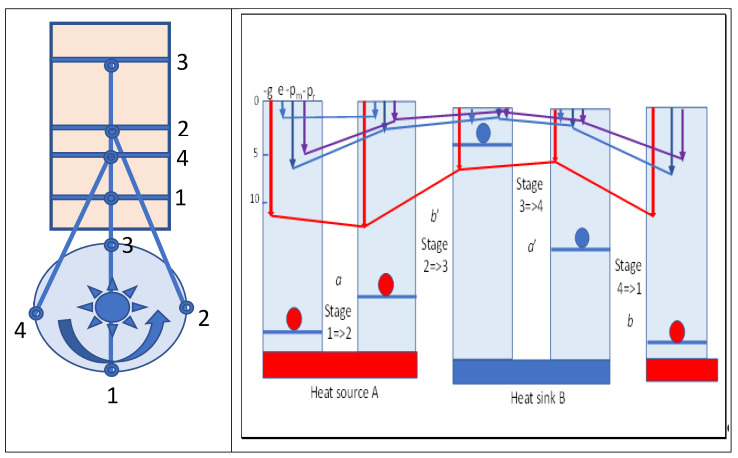
Despite the remarkable success of Carnot's heat engine cycle in founding the discipline of thermodynamics two centuries ago, false viewpoints of his use of the caloric theory in the cycle linger, limiting his legacy. An action revision of the Carnot cycle can correct this, showing that the heat flow powering external mechanical work is compensated internally with configurational changes in the thermodynamic or Gibbs potential of the working fluid, differing in each stage of the cycle quantified by Carnot as caloric. Action (@) is a property of state having the same physical dimensions as angular momentum ( = ). However, this property is scalar rather than vectorial, including a dimensionless phase angle (@ = ). We have recently confirmed with atmospheric gases that their entropy is a logarithmic function of the relative vibrational, rotational, and translational action ratios with Planck's quantum of action . The Carnot principle shows that the maximum rate of work () possible from the reversible cycle is controlled by the difference in temperature of the hot source and the cold sink: the colder the better. This temperature difference between the source and the sink also controls the isothermal variations of the Gibbs potential of the working fluid, which Carnot identified as reversible temperature-dependent but unequal caloric exchanges. Importantly, the engine's inertia ensures that heat from work performed adiabatically in the expansion phase is all restored to the working fluid during the adiabatic recompression, less the net work performed. This allows both the energy and the thermodynamic potential to return to the same values at the beginning of each cycle, which is a point strongly emphasized by Carnot. Our action revision equates Carnot's or the non-sensible heat later described by Clausius as 'work-heat', exclusively to negative Gibbs energy (-) or quantum field energy. This action field complements the sensible energy or vis-viva heat as molecular kinetic motion, and its recognition should have significance for designing more efficient heat engines or better understanding of the heat engine powering the Earth's climates.
尽管卡诺热机循环在两个世纪前创立热力学学科方面取得了显著成功,但关于他在该循环中使用热质理论的错误观点依然存在,这限制了他的遗产影响力。对卡诺循环进行基于作用量的修正可以纠正这一点,表明驱动外部机械功的热流在内部由工作流体的热力学或吉布斯势的构型变化来补偿,在卡诺所定义的热质的循环每个阶段都有所不同。作用量(@)是一种状态属性,其物理维度与角动量相同(= )。然而,这个属性是标量而非矢量,包括一个无量纲的相位角(@ = )。我们最近用大气气体证实,它们的熵是相对于普朗克作用量子的相对振动、转动和平动作用量比的对数函数。卡诺原理表明,可逆循环可能产生的最大功速率()由热源和冷源的温度差控制:冷源温度越低越好。热源和冷源之间的这个温度差也控制着工作流体吉布斯势的等温变化,卡诺将其视为与温度相关的可逆但不相等的热质交换。重要的是,发动机的惯性确保了在膨胀阶段绝热做功产生的热量在绝热再压缩过程中全部恢复到工作流体中,但减去净功。这使得能量和热力学势在每个循环开始时都回到相同的值,这是卡诺强烈强调的一点。我们基于作用量的修正将卡诺的 或后来克劳修斯描述为“功 - 热”的非显热完全等同于负吉布斯能量(- )或量子场能量。这个作用量场作为分子动能运动补充了显能或活力热,对其的认识对于设计更高效的热机或更好地理解驱动地球气候的热机应该具有重要意义。