Park Robin, Coveler Andrew L, Cavalcante Ludimila, Saeed Anwaar
Department of Medicine, MetroWest Medical Center, Tufts University School of Medicine, Framingham, MA 01702, USA.
Department of Medicine, Division of Oncology, University of Washington, Seattle, WA 98109-1024, USA.
Biology (Basel). 2021 Jul 1;10(7):610. doi: 10.3390/biology10070610.
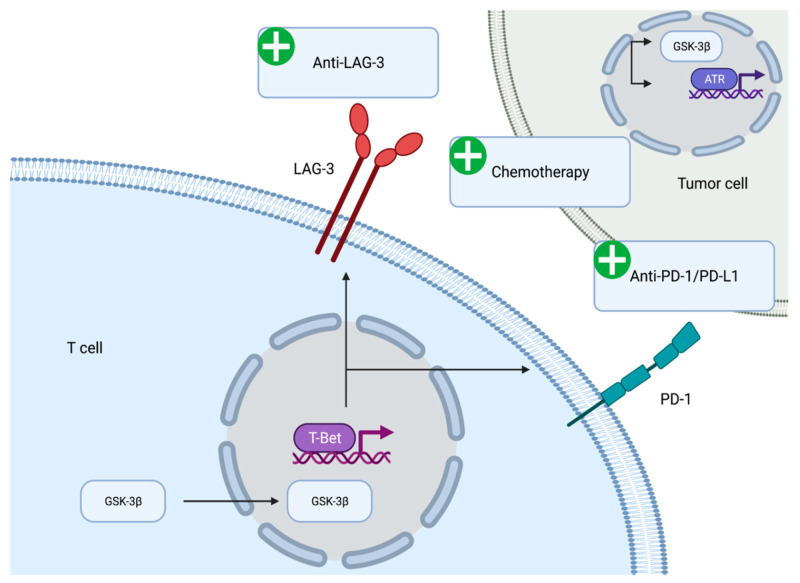
Glycogen synthase kinase-3 beta is a ubiquitously and constitutively expressed molecule with pleiotropic function. It acts as a protooncogene in the development of several solid tumors including pancreatic cancer through its involvement in various cellular processes including cell proliferation, survival, invasion and metastasis, as well as autophagy. Furthermore, the level of aberrant glycogen synthase kinase-3 beta expression in the nucleus is inversely correlated with tumor differentiation and survival in both in vitro and in vivo models of pancreatic cancer. Small molecule inhibitors of glycogen synthase kinase-3 beta have demonstrated therapeutic potential in pre-clinical models and are currently being evaluated in early phase clinical trials involving pancreatic cancer patients with interim results showing favorable results. Moreover, recent studies support a rationale for the combination of glycogen synthase kinase-3 beta inhibitors with chemotherapy and immunotherapy, warranting the evaluation of novel combination regimens in the future.
糖原合酶激酶-3β是一种广泛且组成性表达的分子,具有多效性功能。它在包括胰腺癌在内的多种实体瘤的发生发展中作为原癌基因发挥作用,通过参与包括细胞增殖、存活、侵袭和转移以及自噬等各种细胞过程。此外,在胰腺癌的体外和体内模型中,细胞核中异常糖原合酶激酶-3β表达水平与肿瘤分化和生存呈负相关。糖原合酶激酶-3β的小分子抑制剂在临床前模型中已显示出治疗潜力,目前正在涉及胰腺癌患者的早期临床试验中进行评估,中期结果显示出良好效果。此外,最近的研究支持将糖原合酶激酶-3β抑制剂与化疗和免疫疗法联合使用的理论依据,这使得未来对新型联合治疗方案的评估成为必要。