Minja Caroline A, Shirima Gabriel, Mshana Stephen E
School of Life Sciences, Department of Global Health and Biomedical Sciences, Nelson Mandela African Institution of Science and Technology, Arusha 23306, Tanzania.
Department of Microbiology and Immunology, Catholic University of Health and Allied Sciences, Mwanza 33109, Tanzania.
Antibiotics (Basel). 2021 Jul 9;10(7):836. doi: 10.3390/antibiotics10070836.
Globally, beta-lactamases are the most popular extended spectrum beta-lactamase alleles that are widely distributed due its mobilisation by mobile genetic elements in several compartments. We aimed to determine the conjugation frequencies and replicon types associated with plasmids carrying gene from Extended Spectrum Beta-lactamase producing isolates in order to understand the dissemination of resistance genes in different compartments.
A total of 51 archived isolates carrying beta-lactamases were used as donors in this study. Antibiotic susceptibility tests were performed as previously described for both donors and transconjugants. Conjugation experiment was performed by a modified protocol of the plate mating experiment, and plasmid replicon types were screened among donor and transconjugant isolates by multiplex Polymerase Chain Reaction in a set of three primer panels.
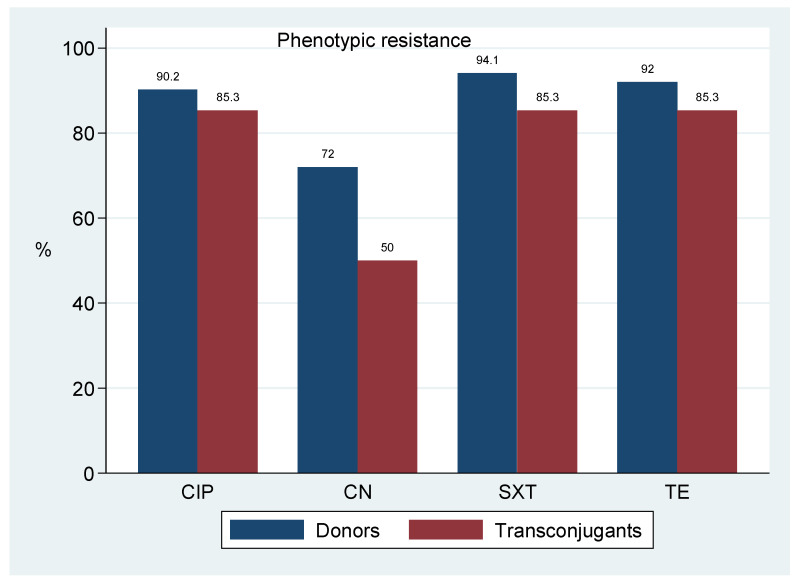
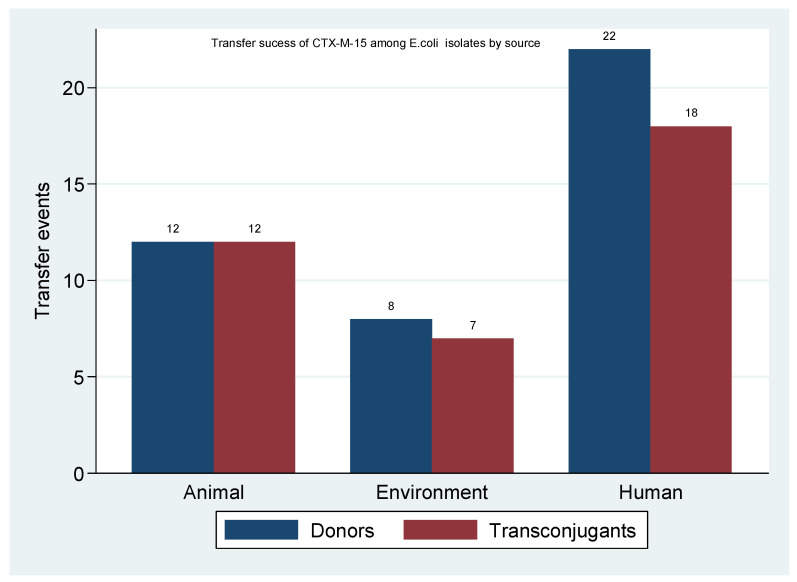
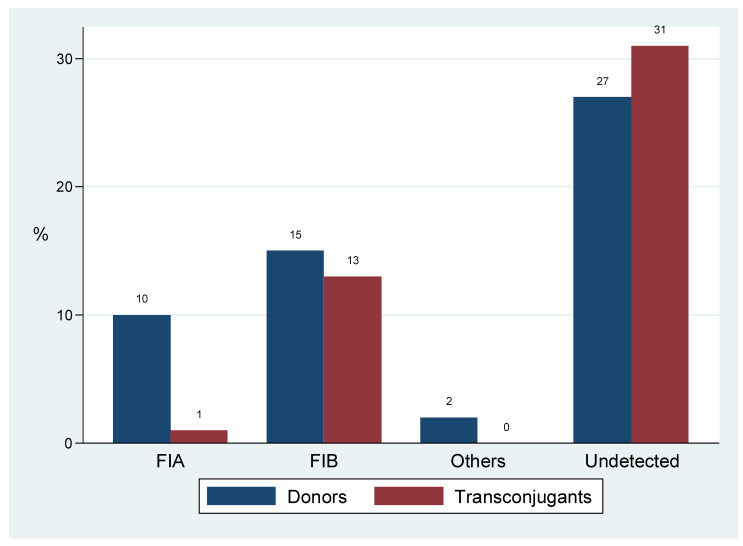
The conjugation efficiency of plasmids carrying was 88.2% (45/51) with conjugation frequencies in the order of 10 to 10 and a 100% transfer efficiency observed among of animal origin. Majority of donors ( 21) and transconjugants ( = 14) plasmids were typed as either Inc FIA or Inc FIB. Resistance to non-beta-lactam antibiotics was transferrable in 34/45 (75.6%) of events. Ciprofloxacin, tetracycline and sulphamethoxazole-trimethoprim resistance was co-transferred in 29/34 (85.3%) such events. Gentamicin resistance was transferred in 17/34 (50%) of events.
Majority of plasmids carrying were conjugatively transferred by IncF plasmids along with non-beta lactam resistance. There is a need for more research on plasmids to understand how plasmids especially multi replicon plasmids interact and the effect of such interaction on conjugation. One Health approach is to be intensified to address antimicrobial resistance which is a public health threat.
在全球范围内,β-内酰胺酶是最常见的超广谱β-内酰胺酶等位基因,由于其在多个区域被移动遗传元件转移,因而广泛分布。我们旨在确定携带超广谱β-内酰胺酶产生菌基因的质粒的接合频率和复制子类型,以便了解耐药基因在不同区域的传播情况。
本研究共使用51株携带β-内酰胺酶的存档菌株作为供体。按照之前描述的方法对供体和接合子进行抗生素敏感性试验。采用改良的平板交配实验方案进行接合实验,并通过一组三个引物板的多重聚合酶链反应在供体和接合子菌株中筛选质粒复制子类型。
携带质粒的接合效率为88.2%(45/51),接合频率在10 至10 之间,在动物源菌株中观察到转移效率为100%。大多数供体( = 21)和接合子( = 14)的质粒被分类为Inc FIA或Inc FIB。在34/45(75.6%)的事件中,对非β-内酰胺抗生素的耐药性是可转移的。在29/34(85.3%)的此类事件中,环丙沙星、四环素和磺胺甲恶唑-甲氧苄啶耐药性是共同转移的。在17/34(50%)的事件中转移了庆大霉素耐药性。
大多数携带质粒通过IncF质粒进行接合转移,并伴有非β-内酰胺耐药性。需要对质粒进行更多研究,以了解质粒尤其是多复制子质粒如何相互作用以及这种相互作用对接合的影响。应加强“同一健康”方法以应对作为公共卫生威胁的抗菌药物耐药性。