Pérez-Lago Laura, Aldámiz-Echevarría Teresa, García-Martínez Rita, Pérez-Latorre Leire, Herranz Marta, Sola-Campoy Pedro J, Suárez-González Julia, Martínez-Laperche Carolina, Comas Iñaki, González-Candelas Fernando, Catalán Pilar, Muñoz Patricia, García de Viedma Darío
Clinical Microbiology and Infectious Diseases Department, Gregorio Marañón General University Hospital, 28007 Madrid, Spain.
Gregorio Marañón Health Research Institute (IiSGM), 28007 Madrid, Spain.
Biomedicines. 2021 Jul 13;9(7):808. doi: 10.3390/biomedicines9070808.
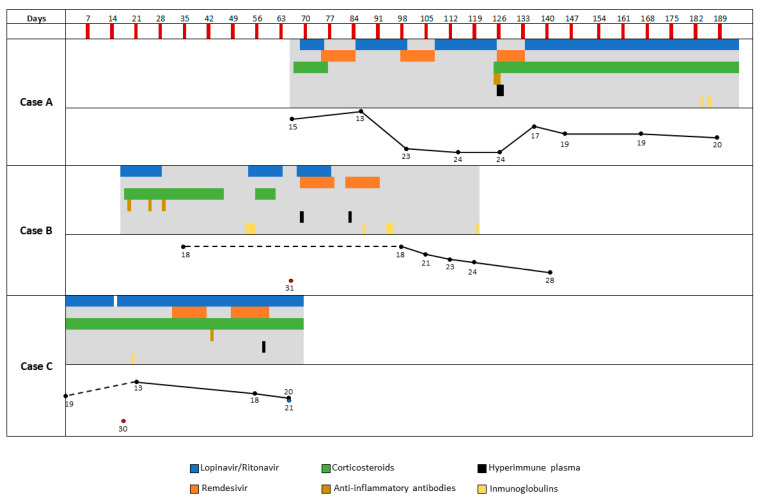
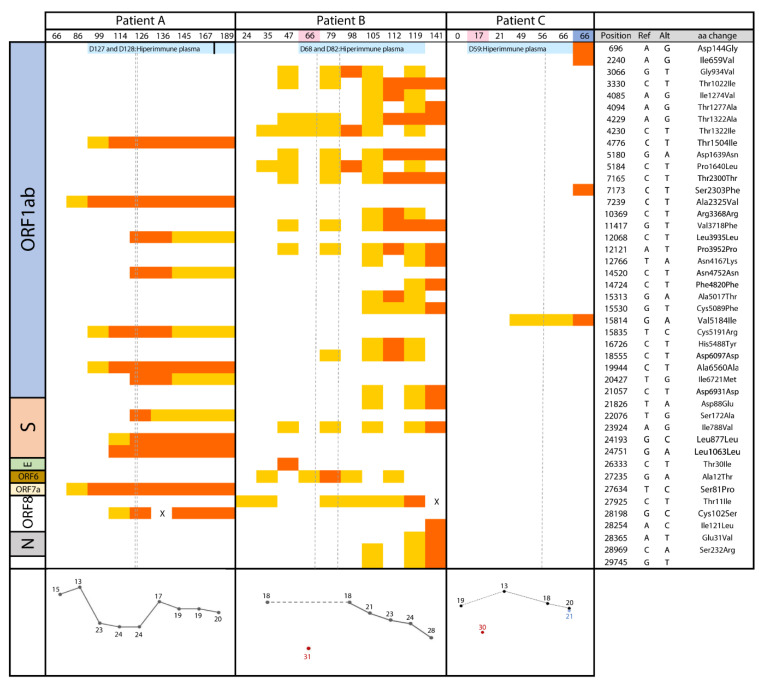
A successful Severe Acute Respiratory Syndrome Coronavirus 2 (SARS-CoV-2) variant, B.1.1.7, has recently been reported in the UK, causing global alarm. Most likely, the new variant emerged in a persistently infected patient, justifying a special focus on these cases. Our aim in this study was to explore certain clinical profiles involving severe immunosuppression that may help explain the prolonged persistence of viable viruses. We present three severely immunosuppressed cases (A, B, and C) with a history of lymphoma and prolonged SARS-CoV-2 shedding (2, 4, and 6 months), two of whom finally died. Whole-genome sequencing of 9 and 10 specimens from Cases A and B revealed extensive within-patient acquisition of diversity, 12 and 28 new single nucleotide polymorphisms, respectively, which suggests ongoing SARS-CoV-2 replication. This diversity was not observed for Case C after analysing 5 sequential nasopharyngeal specimens and one plasma specimen, and was only observed in one bronchoaspirate specimen, although viral viability was still considered based on constant low Ct values throughout the disease and recovery of the virus in cell cultures. The acquired viral diversity in Cases A and B followed different dynamics. For Case A, new single nucleotide polymorphisms were quickly fixed (13-15 days) after emerging as minority variants, while for Case B, higher diversity was observed at a slower emergence: fixation pace (1-2 months). Slower SARS-CoV-2 evolutionary pace was observed for Case A following the administration of hyperimmune plasma. This work adds knowledge on SARS-CoV-2 prolonged shedding in severely immunocompromised patients and demonstrates viral viability, noteworthy acquired intra-patient diversity, and different SARS-CoV-2 evolutionary dynamics in persistent cases.
最近在英国报告了一种成功的严重急性呼吸综合征冠状病毒2(SARS-CoV-2)变体B.1.1.7,引起了全球恐慌。这种新变体很可能出现在一名持续感染的患者身上,这使得对这些病例的特别关注变得合理。我们在这项研究中的目的是探索某些涉及严重免疫抑制的临床特征,这些特征可能有助于解释活病毒的长期持续存在。我们报告了三例严重免疫抑制病例(A、B和C),他们都有淋巴瘤病史且SARS-CoV-2脱落时间延长(分别为2、4和6个月),其中两人最终死亡。对病例A和B的9份和10份样本进行全基因组测序,结果显示患者体内广泛获得了多样性,分别有12个和28个新的单核苷酸多态性,这表明SARS-CoV-2正在进行复制。在分析了病例C的5份连续鼻咽样本和1份血浆样本后,未观察到这种多样性,仅在一份支气管吸出物样本中观察到,尽管基于整个疾病过程中持续的低Ct值以及病毒在细胞培养中的复苏情况,仍认为病毒具有活力。病例A和B中获得的病毒多样性遵循不同的动态变化。对于病例A,新的单核苷酸多态性在作为少数变体出现后很快就被固定(13 - 15天),而对于病例B,多样性出现较慢:固定速度(1 - 2个月)。在给予超免疫血浆后,病例A的SARS-CoV-2进化速度较慢。这项工作增加了对严重免疫受损患者中SARS-CoV-2长期脱落的认识,并证明了病毒的活力、值得注意的患者体内获得的多样性以及持续性病例中不同的SARS-CoV-2进化动态。