Nutrition and Metabolism, NOVA Medical School, Universidade Nova de Lisboa, Lisboa, Portugal.
EPIUnit - Institute of Public Health, Universidade do Porto, Porto, Portugal.
Obes Surg. 2021 Oct;31(10):4452-4460. doi: 10.1007/s11695-021-05608-2. Epub 2021 Aug 6.
To estimate the association of emotional distress with both consumption of energy-dense micronutrient-poor foods (EDF) and body mass index (BMI) and the association between EDF consumption and change in BMI, during COVID-19 pandemic in patients with prior bariatric surgery.
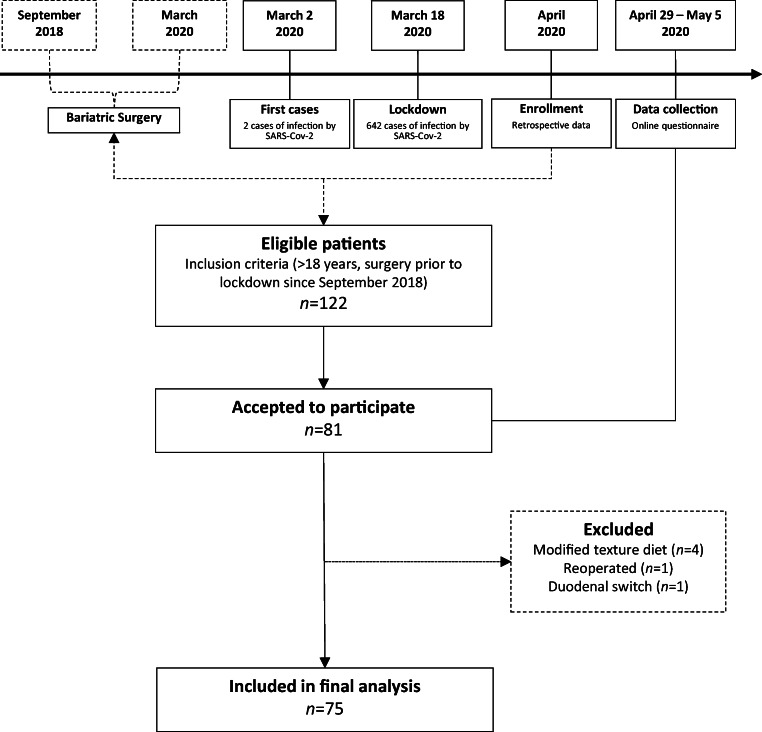
This cross-sectional study applied an online structured questionnaire to 75 postoperative bariatric patients during the first Portuguese lockdown. Emotional distress was assessed trough the Hospital Anxiety and Depression Scale (HADS) and dietary intake was evaluated by Food Frequency Questionnaire (FFQ). Self-reported BMI prior to and at the end of confinement was used to compute BMI change. Pre-surgery BMI was computed from measured height and weight from clinical records.
After adjustment for education, sex, time since surgery, pre-surgery BMI, and exercise practice, moderate/severe scores in HADS were significantly positively associated with consumption of EDF (ẞ = 0.799; 95% CI: 0.051, 1.546), but not with BMI. Daily EDF consumption significantly increased the odds of maintaining/increasing BMI (OR = 3.34; 95% CI: 1.18, 9.45), instead of decreasing it (reference). Sweets consumption was the only subcategory of EDF significantly positively associated with the odds of a worse outcome in BMI change (OR = 4.01; 95% CI: 1.13, 14.22).
Among postoperative bariatric patients, higher reported levels of emotional distress during confinement are associated with increased EDF consumption. Increased EDF consumption during confinement, particularly sweets, is associated with higher odds of bariatric patients not decreasing their BMI. Additional effort is needed to address inadequate lifestyle behaviors among these patients in the context of the COVID-19 pandemic.
评估在新冠肺炎大流行期间,情绪困扰与能量密集型、微量营养素缺乏型食物(EDF)的消耗以及 BMI 的变化与 EDF 消耗之间的关联,在既往接受过减重手术的患者中。
本横断面研究应用在线结构化问卷对首次葡萄牙封锁期间的 75 例术后肥胖患者进行调查。采用医院焦虑抑郁量表(HADS)评估情绪困扰,通过食物频率问卷(FFQ)评估饮食摄入。采用自我报告的隔离前和隔离结束时的 BMI 来计算 BMI 的变化。术前 BMI 由临床记录中的测量身高和体重计算得出。
在校正教育、性别、手术时间、术前 BMI 和运动实践后,HADS 中中度/重度评分与 EDF 消耗显著正相关(ß=0.799;95%CI:0.051,1.546),但与 BMI 无关。EDF 的每日摄入量显著增加了维持/增加 BMI 的可能性(OR=3.34;95%CI:1.18,9.45),而不是降低 BMI(参考)。甜食消费是唯一与 BMI 变化结果显著正相关的 EDF 亚类(OR=4.01;95%CI:1.13,14.22)。
在术后肥胖患者中,隔离期间报告的情绪困扰水平较高与 EDF 消耗增加有关。隔离期间 EDF 消耗增加,特别是甜食,与肥胖患者 BMI 不下降的几率增加相关。在 COVID-19 大流行背景下,需要进一步努力解决这些患者生活方式不良行为的问题。