Department of Medicine Huddinge, Karolinska Institutet, Stockholm, Sweden.
Division of Hepatology, Department of Upper GI Disease, C1:77 Karolinska University Hospital, Huddinge, 141 86, Stockholm, Sweden.
Hepatol Int. 2021 Oct;15(5):1174-1182. doi: 10.1007/s12072-021-10214-6. Epub 2021 Aug 6.
Primary sclerosing cholangitis (PSC) is associated with an increased risk of hepatobiliary and colorectal cancer, but the risks of other cancer forms have not been explored. The aim of this study was to evaluate the risk of intestinal and extraintestinal cancers in a large, well-defined cohort of PSC patients.
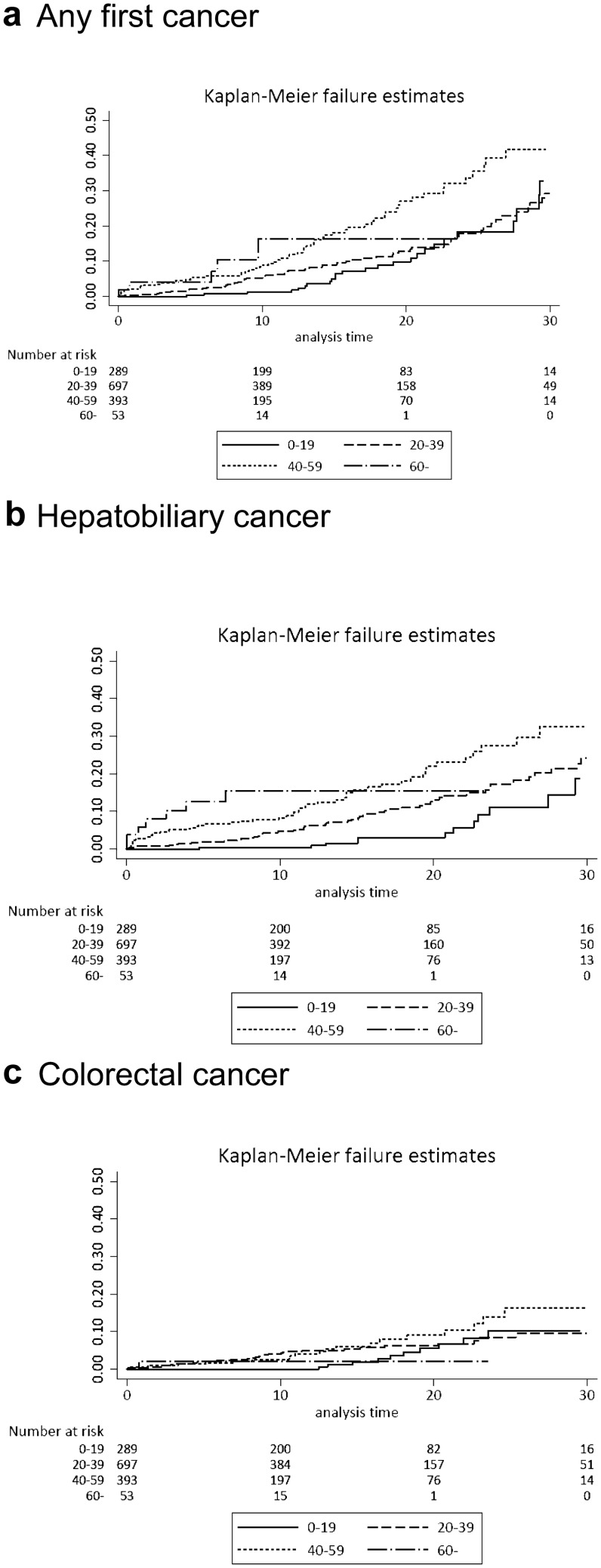
A matched cohort study of Swedish PSC patients was performed with up to ten comparators for each patient, matched for sex, age, and residency. The data were retrieved from national registers. Patients were followed from PSC diagnosis until cancer diagnosis, liver transplantation, first emigration date, death, or December 31, 2016. The risk of cancer was estimated using the Kaplan-Meier method and Cox regression models.
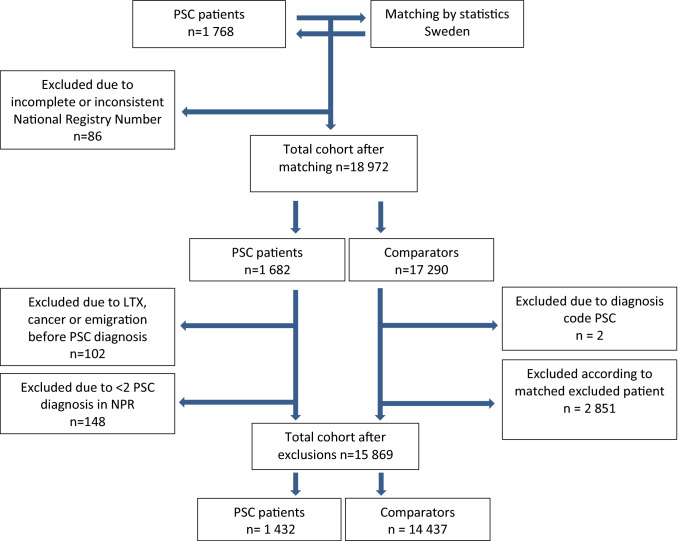
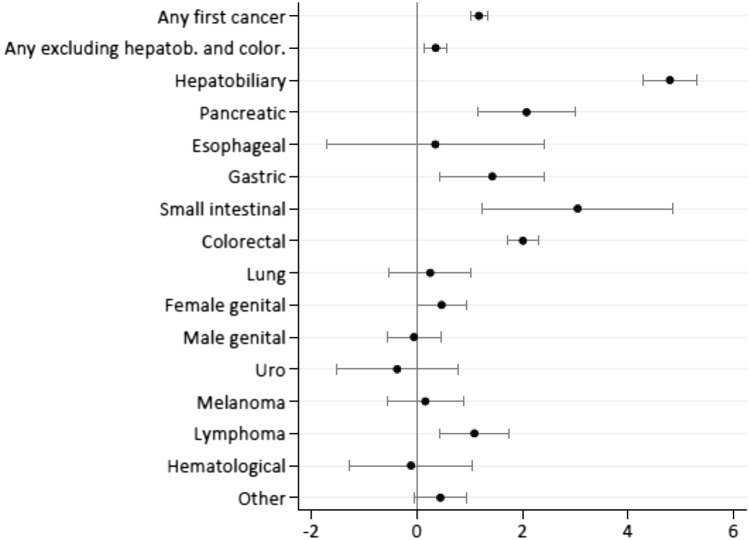
In total, 1432 PSC patients with a verified diagnosis and 14,437 comparators were studied. The mean follow-up time was 15.9 years. Eighty-eight percent of the PSC patients had concomitant inflammatory bowel disease. PSC patients ran significantly increased risks of developing any cancer [HR 3.8, 95% confidence interval (CI) 3.3-4.3], hepatobiliary cancer (HR 120.9, 95% CI 72.0-203.1), colorectal cancer (HR 7.5, 95% CI 5.6-10.0), pancreatic cancer (HR 8.0, 95% CI 3.2-20.2), gastric cancer (HR 4.2, 95% CI 1.5-11.3), small bowel cancer (HR 21.1, 95% CI 3.5-128.2), and lymphoma (HR 3.0, 95% CI 1.6-5.7). PSC was not associated with a lower risk of any cancer form.
PSC patients have a four times overall increased risk of developing cancer compared to the general population, with increased risk of developing hepatobiliary, colorectal, and pancreatic cancer, as well as lymphoma.
原发性硬化性胆管炎(PSC)与肝胆癌和结直肠癌风险增加相关,但其他癌症形式的风险尚未得到探索。本研究的目的是在一个大型、明确界定的 PSC 患者队列中评估肠内和肠外癌症的风险。
对瑞典 PSC 患者进行了匹配队列研究,每位患者最多有 10 个对照者,按性别、年龄和居住地匹配。数据来自国家登记处。患者从 PSC 诊断开始随访,直至癌症诊断、肝移植、首次移民日期、死亡或 2016 年 12 月 31 日。使用 Kaplan-Meier 方法和 Cox 回归模型估计癌症风险。
共研究了 1432 例经证实诊断的 PSC 患者和 14437 名对照者。平均随访时间为 15.9 年。88%的 PSC 患者伴有炎症性肠病。PSC 患者发生任何癌症的风险显著增加[HR 3.8,95%置信区间(CI)3.3-4.3]、肝胆癌(HR 120.9,95%CI 72.0-203.1)、结直肠癌(HR 7.5,95%CI 5.6-10.0)、胰腺癌(HR 8.0,95%CI 3.2-20.2)、胃癌(HR 4.2,95%CI 1.5-11.3)、小肠癌(HR 21.1,95%CI 3.5-128.2)和淋巴瘤(HR 3.0,95%CI 1.6-5.7)。PSC 与任何癌症形式的风险降低无关。
与普通人群相比,PSC 患者患癌症的总体风险增加了四倍,肝胆癌、结直肠癌和胰腺癌以及淋巴瘤的风险增加。