Miranda Mafalda N S, Pingarilho Marta, Pimentel Victor, Martins Maria do Rosário O, Vandamme Anne-Mieke, Bobkova Marina, Böhm Michael, Seguin-Devaux Carole, Paredes Roger, Rubio Rafael, Zazzi Maurizio, Incardona Francesca, Abecasis Ana
Global Health and Tropical Medicine (GHTM), Institute of Hygiene and Tropical Medicine, New University of Lisbon (IHMT/UNL), 1349-008 Lisbon, Portugal.
Laboratory Clinical and Epidemiological Virology, Department of Microbiology and Immunology, KU Leuven, Rega Institute for Medical Research, 3000 Leuven, Belgium.
Pathogens. 2021 Jul 2;10(7):835. doi: 10.3390/pathogens10070835.
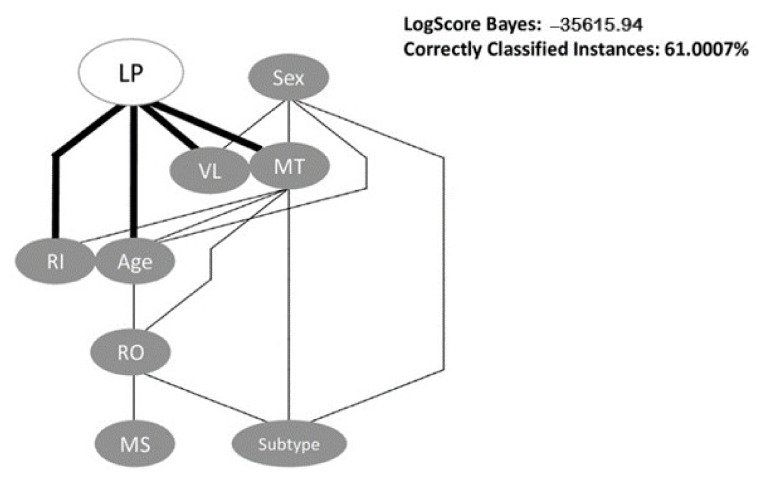
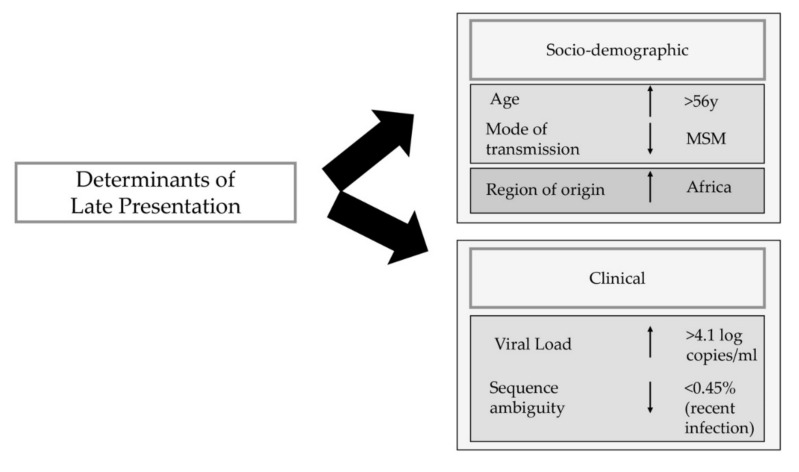
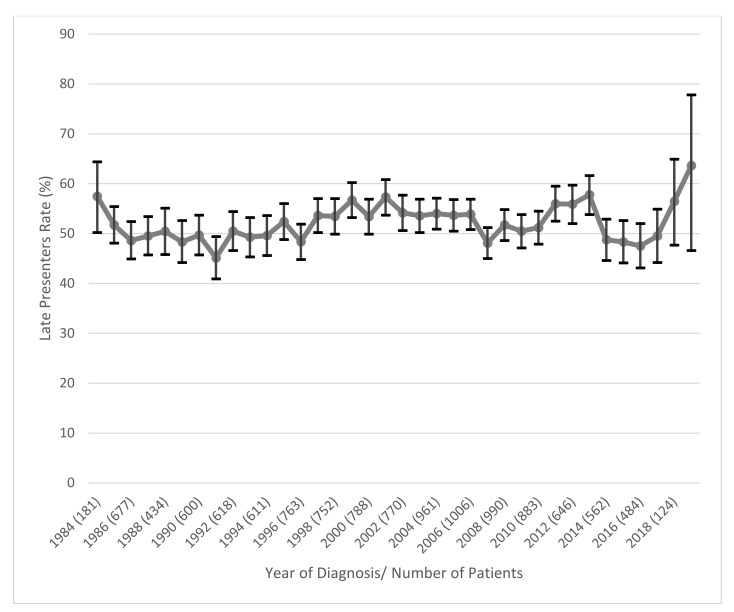
To control the Human Immunodeficiency Virus (HIV) pandemic, the World Health Organization (WHO) set the 90-90-90 target to be reached by 2020. One major threat to those goals is late presentation, which is defined as an individual presenting a TCD4+ count lower than 350 cells/mm or an AIDS-defining event. The present study aims to identify determinants of late presentation in Europe based on the EuResist database with HIV-1 infected patients followed-up between 1981 and 2019. Our study includes clinical and socio-demographic information from 89851 HIV-1 infected patients. Statistical analysis was performed using RStudio and SPSS and a Bayesian network was constructed with the WEKA software to analyze the association between all variables. Among 89,851 HIV-1 infected patients included in the analysis, the median age was 33 (IQR: 27.0-41.0) years and 74.4% were males. Of those, 28,889 patients (50.4%) were late presenters. Older patients (>56), heterosexuals, patients originated from Africa and patients presenting with log VL >4.1 had a higher probability of being late presenters ( < 0.001). Bayesian networks indicated VL, mode of transmission, age and recentness of infection as variables that were directly associated with LP. This study highlights the major determinants associated with late presentation in Europe. This study helps to direct prevention measures for this population.
为控制人类免疫缺陷病毒(HIV)大流行,世界卫生组织(WHO)设定了到2020年要实现的90-90-90目标。这些目标面临的一个主要威胁是就诊延迟,就诊延迟定义为个体的TCD4 +细胞计数低于350个细胞/立方毫米或出现艾滋病定义事件。本研究旨在基于EuResist数据库,对1981年至2019年期间接受随访的HIV-1感染患者进行分析,以确定欧洲就诊延迟的决定因素。我们的研究纳入了89851名HIV-1感染患者的临床和社会人口统计学信息。使用RStudio和SPSS进行统计分析,并使用WEKA软件构建贝叶斯网络,以分析所有变量之间的关联。在纳入分析的89851名HIV-1感染患者中,年龄中位数为33岁(四分位间距:27.0-41.0),男性占74.4%。其中,28889名患者(50.4%)为就诊延迟者。年龄较大的患者(>56岁)、异性恋者、来自非洲的患者以及log VL>4.1的患者成为就诊延迟者的可能性更高(<0.001)。贝叶斯网络表明病毒载量、传播方式、年龄和感染近期情况是与就诊延迟直接相关的变量。本研究突出了欧洲与就诊延迟相关的主要决定因素。这项研究有助于指导针对该人群的预防措施。