Gómez-López Iván, Lobo-Rodrigo Gloria, Portillo María P, Cano M Pilar
Laboratory of Phytochemistry and Plant Food Functionality, Biotechnology and Food Microbiology Department, Institute of Food Science Research (CIAL) (CSIC-UAM), Nicolás Cabrera 9, 28049 Madrid, Spain.
Nutrition and Obesity Group, Department of Nutrition and Food Science, Faculty of Pharmacy, University of the Basque Country (UPV/EHU), Lucio Lascaray Research Center, 01006 Vitoria-Gasteiz, Spain.
Foods. 2021 Jul 9;10(7):1593. doi: 10.3390/foods10071593.
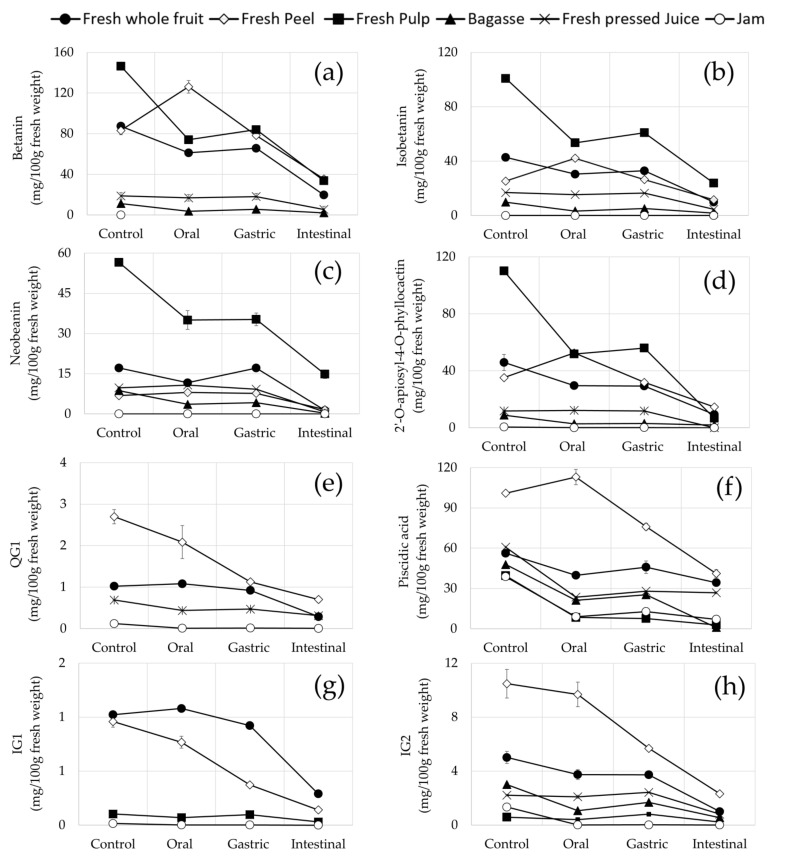
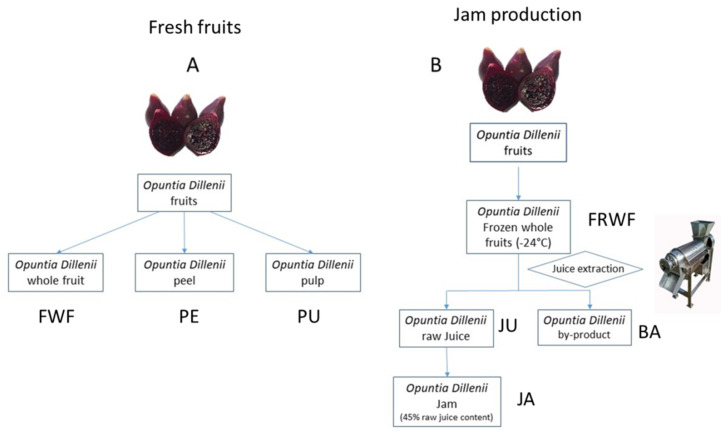
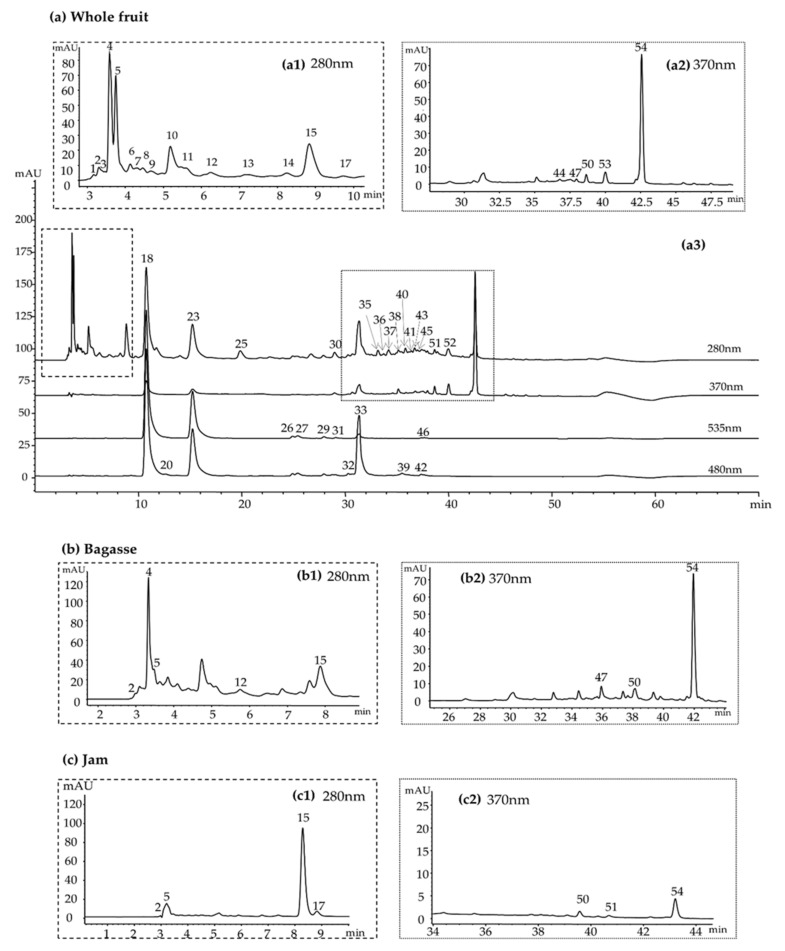
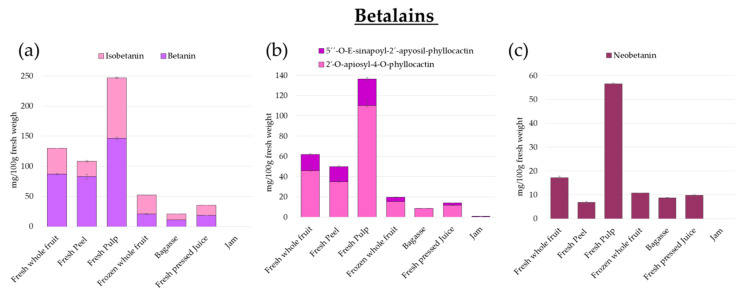
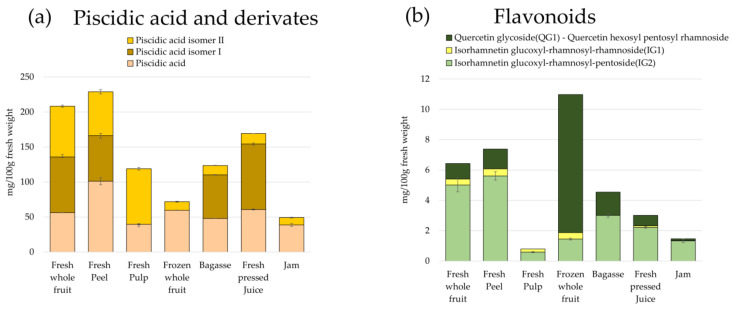
The aim of the present study was the full characterization, quantification, and determination of the digestive stability and bioaccessibility of individual betalain and phenolic compounds of fresh fruits (peel, pulp, and whole fruit) and of the products of the industrialization to obtain jam (raw pressed juice (product used for jam formulation), by-product (bagasse), and frozen whole fruit (starting material for jam production)). fruits and products profile showed 60 betalain and phenolic compounds that were identified and quantified by HPLC-DAD-ESI/MS and HPLC-DAD-MS/QTOF, being 25 phenolic acids (including isomers and derivatives), 12 flavonoids (including glycosides), 3 ellagic acids (including glycosides and derivative), and 20 betanins (including degradation compounds). In vitro gastrointestinal digestion was performed by INFOGEST protocol. Fruit pulp showed the greater content of total betalains (444.77 mg/100 g f.w.), and jam only showed very low amounts of two betanin degradation compounds, Cyclo-dopa-5-O-β-glucoside (and its isomer) (0.63 mg/100 f.w.), and two Phyllocactin derivatives (1.04 mg/100 g f.w.). Meanwhile, fruit peel was the richer tissue in total phenolic acids (273.42 mg/100 g f.w.), mainly in piscidic acid content and total flavonoids (7.39 mg/100 g f.w.), isorhamnetin glucoxyl-rhamnosyl-pentoside (IG2) being the most abundant of these compounds. The stability of betalains and phenolic compounds during gastrointestinal digestion is reported in the present study. In pulp (the edible fraction of the fresh fruit), the betanin bioaccessibility was only 22.9%, and the flavonoid bioaccessibility ranged from 53.7% to 30.6%, depending on the compound. In non-edible samples, such as peel sample (PE), the betanin bioaccessibility was 42.5% and the greater bioaccessibility in flavonoids was observed for quercetin glycoside (QG1) 53.7%, the fruit peel being the most interesting material to obtain antioxidant extracts, attending to its composition on antioxidant compounds and their bioaccessibilities.
本研究的目的是全面表征、定量并测定新鲜水果(果皮、果肉和整个果实)以及工业化产品果酱(用于果酱配方的生榨果汁、副产品蔗渣和冷冻整个果实)中各甜菜碱和酚类化合物的消化稳定性及生物可及性。水果和产品分析表明,通过HPLC-DAD-ESI/MS和HPLC-DAD-MS/QTOF鉴定并定量了60种甜菜碱和酚类化合物,其中包括25种酚酸(包括异构体和衍生物)、12种黄酮类化合物(包括糖苷)、3种鞣花酸(包括糖苷和衍生物)以及20种甜菜红素(包括降解化合物)。采用INFOGEST方案进行体外胃肠道消化实验。果肉中总甜菜红素含量最高(444.77毫克/100克鲜重),而果酱中仅含有极少量的两种甜菜红素降解化合物,环多巴-5-O-β-葡萄糖苷(及其异构体)(0.63毫克/100克鲜重)和两种仙人掌果素衍生物(1.04毫克/100克鲜重)。同时,果皮中总酚酸含量最高(273.42毫克/100克鲜重),主要是鱼藤酮酸含量,总黄酮含量为(7.39毫克/100克鲜重),其中异鼠李素葡萄糖基-鼠李糖基-戊糖苷(IG2)含量最为丰富。本研究报告了甜菜碱和酚类化合物在胃肠道消化过程中的稳定性。在果肉(新鲜水果的可食用部分)中,甜菜红素的生物可及性仅为22.9%,黄酮类化合物的生物可及性在53.7%至30.6%之间,具体取决于化合物种类。在非可食用样品中,如果皮样品(PE),甜菜红素的生物可及性为42.5%,槲皮素糖苷(QG1)的黄酮类化合物生物可及性最高,为53.7%,从其抗氧化化合物组成及其生物可及性来看,果皮是获取抗氧化提取物最具吸引力的材料。