Theakstone Ashton G, Brennan Paul M, Jenkinson Michael D, Mills Samantha J, Syed Khaja, Rinaldi Christopher, Xu Yun, Goodacre Royston, Butler Holly J, Palmer David S, Smith Benjamin R, Baker Matthew J
Technology and Innovation Centre, Department of Pure and Applied Chemistry, University of Strathclyde, Glasgow G1 1RD, UK.
Translational Neurosurgery, Centre for Clinical Brain Sciences, University of Edinburgh, Edinburgh EH16 4SB, UK.
Cancers (Basel). 2021 Jul 30;13(15):3851. doi: 10.3390/cancers13153851.
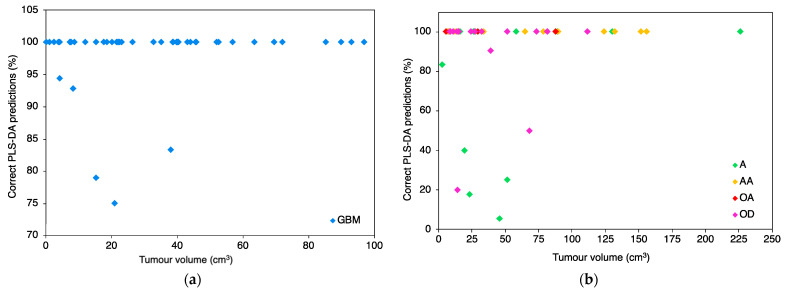
To support the early detection and diagnosis of brain tumours we have developed a rapid, cost-effective and easy to use spectroscopic liquid biopsy based on the absorbance of infrared radiation. We have previously reported highly sensitive results of our approach which can discriminate patients with a recent brain tumour diagnosis and asymptomatic controls. Other liquid biopsy approaches (e.g., based on tumour genetic material) report a lower classification accuracy for early-stage tumours. In this manuscript we present an investigation into the link between brain tumour volume and liquid biopsy test performance.
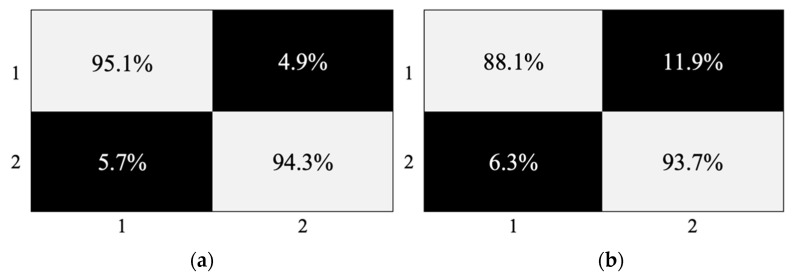
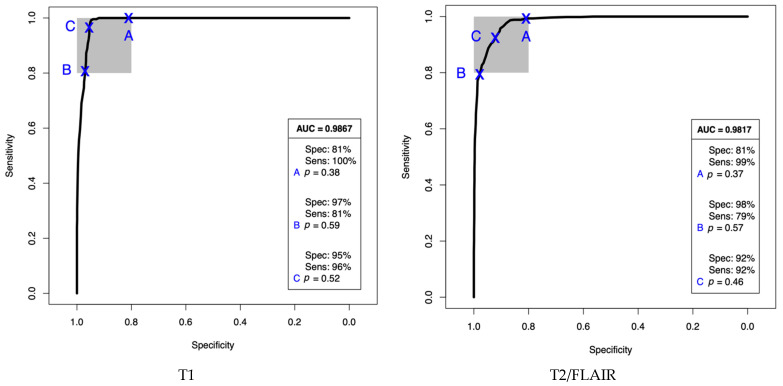
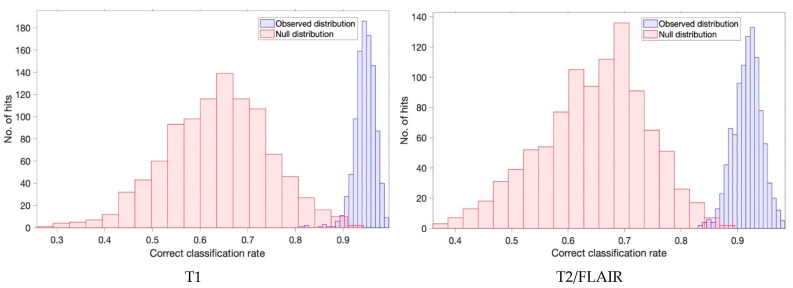
In a cohort of 177 patients (90 patients with high-grade glioma (glioblastoma (GBM) or anaplastic astrocytoma), or low-grade glioma (astrocytoma, oligoastrocytoma and oligodendroglioma)) tumour volumes were calculated from magnetic resonance imaging (MRI) investigations and patients were split into two groups depending on MRI parameters (T1 with contrast enhancement or T2/FLAIR (fluid-attenuated inversion recovery)). Using attenuated total reflection (ATR)-Fourier transform infrared (FTIR) spectroscopy coupled with supervised learning methods and machine learning algorithms, 90 tumour patients were stratified against 87 control patients who displayed no symptomatic indications of cancer, and were classified as either glioma or non-glioma.
Sensitivities, specificities and balanced accuracies were all greater than 88%, the area under the curve (AUC) was 0.98, and cancer patients with tumour volumes as small as 0.2 cm were correctly identified.
Our spectroscopic liquid biopsy approach can identify gliomas that are both small and low-grade showing great promise for deployment of this technique for early detection and diagnosis.
为支持脑肿瘤的早期检测和诊断,我们开发了一种基于红外辐射吸收的快速、经济高效且易于使用的光谱液体活检技术。我们之前报道了该方法的高灵敏度结果,其能够区分近期被诊断为脑肿瘤的患者和无症状对照者。其他液体活检方法(例如基于肿瘤遗传物质的方法)对早期肿瘤的分类准确率较低。在本手稿中,我们对脑肿瘤体积与液体活检测试性能之间的联系进行了研究。
在一个由177名患者组成的队列中(90名患有高级别胶质瘤(胶质母细胞瘤(GBM)或间变性星形细胞瘤)或低级别胶质瘤(星形细胞瘤、少突星形细胞瘤和少突胶质细胞瘤)),根据磁共振成像(MRI)检查计算肿瘤体积,并根据MRI参数(有对比增强的T1或T2/液体衰减反转恢复序列(FLAIR))将患者分为两组。使用衰减全反射(ATR)-傅里叶变换红外(FTIR)光谱结合监督学习方法和机器学习算法,将90名肿瘤患者与87名无癌症症状体征的对照患者进行分层,并分类为胶质瘤或非胶质瘤。
灵敏度、特异性和平衡准确率均大于88%,曲线下面积(AUC)为0.98,并且能够正确识别肿瘤体积小至0.2 cm的癌症患者。
我们的光谱液体活检方法能够识别小体积和低级别胶质瘤,这表明该技术在早期检测和诊断方面具有很大的应用前景。