Geboers Bart, Timmer Florentine E F, Ruarus Alette H, Pouw Johanna E E, Schouten Evelien A C, Bakker Joyce, Puijk Robbert S, Nieuwenhuizen Sanne, Dijkstra Madelon, van den Tol M Petrousjka, de Vries Jan J J, Oprea-Lager Daniela E, Menke-van der Houven van Oordt C Willemien, van der Vliet Hans J, Wilmink Johanna W, Scheffer Hester J, de Gruijl Tanja D, Meijerink Martijn R
Department of Radiology and Nuclear Medicine, Cancer Center Amsterdam, Amsterdam University Medical Centers, de Boelelaan 1117, 1081 HV Amsterdam, The Netherlands.
Department of Medical Oncology, Cancer Center Amsterdam, Amsterdam University Medical Centers, de Boelelaan 1117, 1081 HV Amsterdam, The Netherlands.
Cancers (Basel). 2021 Aug 2;13(15):3902. doi: 10.3390/cancers13153902.
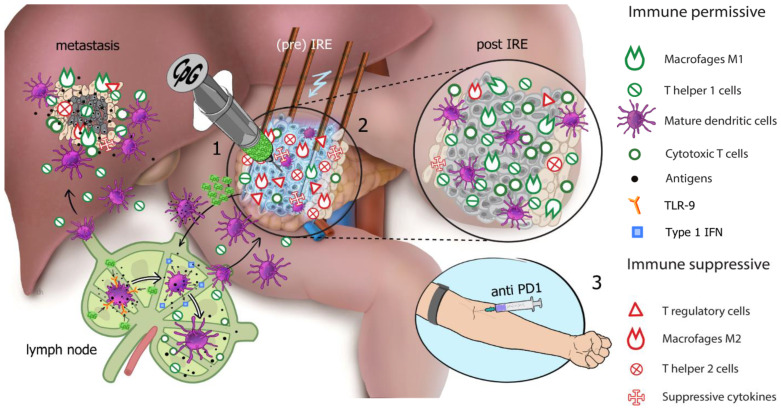
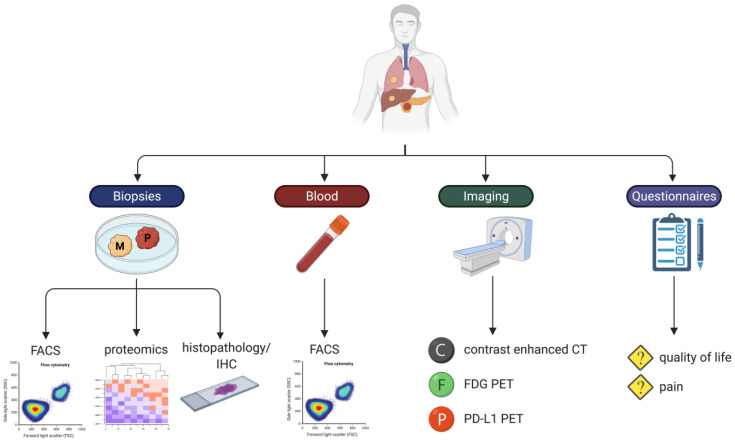
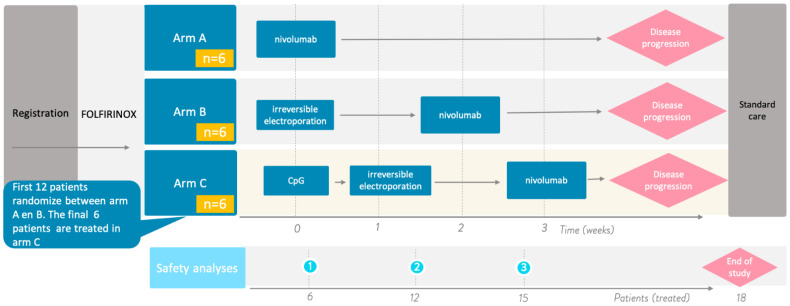
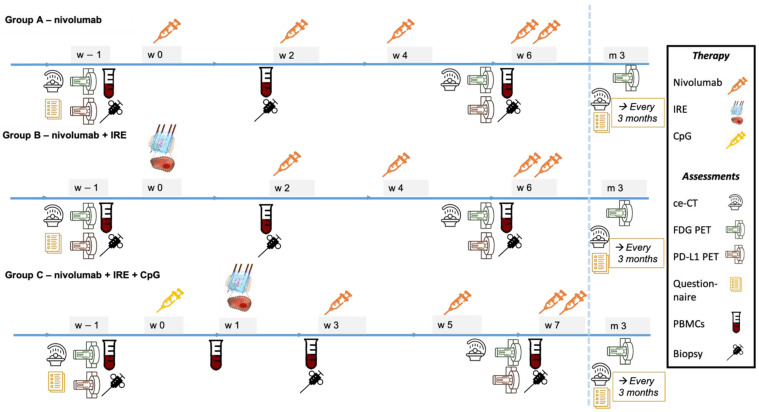
Irreversible electroporation (IRE) is a novel image-guided tumor ablation technique with the ability to generate a window for the establishment of systemic antitumor immunity. IRE transiently alters the tumor's immunosuppressive microenvironment while simultaneously generating antigen release, thereby instigating an adaptive immune response. Combining IRE with immunotherapeutic drugs, i.e., electroimmunotherapy, has synergistic potential and might induce a durable antitumor response. The primary objective of this study is to assess the safety of the combination of IRE with IMO-2125 (a toll-like receptor 9 ligand) and/or nivolumab in patients with metastatic pancreatic ductal adenocarcinoma (mPDAC). In this randomized controlled phase I clinical trial, 18 patients with mPDAC pretreated with chemotherapy will be enrolled in one of three study arms: A (control): nivolumab monotherapy; B: percutaneous IRE of the primary tumor followed by nivolumab; or C: intratumoral injection of IMO-2125 followed by percutaneous IRE of the primary tumor and nivolumab. Assessments include contrast enhanced computed tomography (ceCT), F-FDG and F-BMS-986192 (PD-L1) positron emission tomography (PET)-CT, biopsies of the primary tumor and metastases, peripheral blood samples, and quality of life and pain questionnaires. There is no curative treatment option for patients with mPDAC, and palliative chemotherapy regimens only moderately improve survival. Consequently, there is an urgent need for innovative and radically different treatment approaches. Should electroimmunotherapy establish an effective and durable anti-tumor response, it may ultimately improve PDAC's dismal prognosis.
不可逆电穿孔(IRE)是一种新型的图像引导肿瘤消融技术,能够为建立全身抗肿瘤免疫创造条件。IRE可短暂改变肿瘤的免疫抑制微环境,同时促使抗原释放,从而激发适应性免疫反应。将IRE与免疫治疗药物联合使用,即电免疫疗法,具有协同潜力,可能诱导持久的抗肿瘤反应。本研究的主要目的是评估IRE与IMO-2125(一种Toll样受体9配体)和/或纳武单抗联合应用于转移性胰腺导管腺癌(mPDAC)患者的安全性。在这项随机对照I期临床试验中,18例接受过化疗的mPDAC患者将被纳入三个研究组之一:A组(对照组):纳武单抗单药治疗;B组:对原发肿瘤进行经皮IRE,随后使用纳武单抗;或C组:瘤内注射IMO-2125,随后对原发肿瘤进行经皮IRE并使用纳武单抗。评估包括对比增强计算机断层扫描(ceCT)、F-FDG和F-BMS-986192(PD-L1)正电子发射断层扫描(PET)-CT、原发肿瘤和转移灶活检、外周血样本以及生活质量和疼痛问卷。对于mPDAC患者,目前尚无治愈性治疗方案,姑息化疗方案仅能适度改善生存期。因此,迫切需要创新且截然不同的治疗方法。如果电免疫疗法能建立有效且持久的抗肿瘤反应,最终可能改善PDAC令人沮丧的预后。