Radiotherapy & OncoImmunology Laboratory, Department of Radiation Oncology, Radboud University Medical Center, Nijmegen, Netherlands.
Department of Medical Imaging, Radboud University Medical Center, Nijmegen, Netherlands.
Front Immunol. 2021 Apr 14;12:617365. doi: 10.3389/fimmu.2021.617365. eCollection 2021.
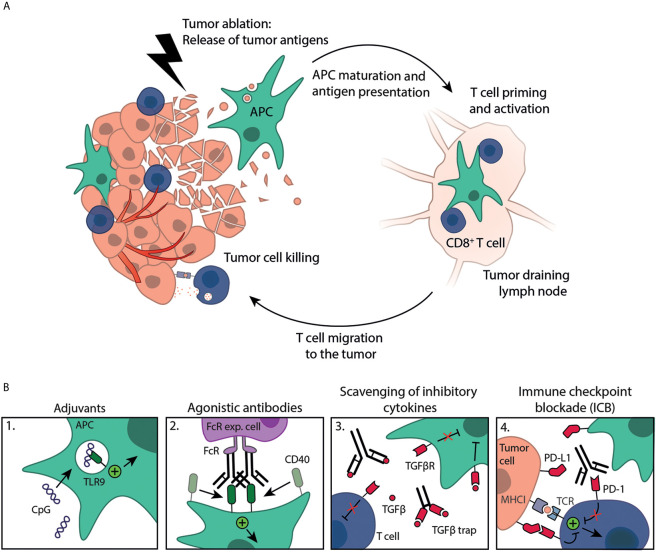
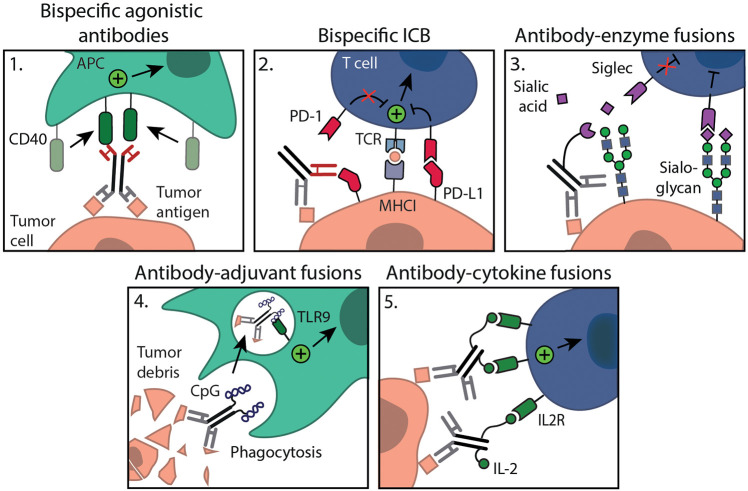
tumor ablation techniques, like radiotherapy, cryo- and heat-based thermal ablation are successfully applied in oncology for local destruction of tumor masses. Although diverse in technology and mechanism of inducing cell death, ablative techniques share one key feature: they generate tumor debris which remains . This tumor debris functions as an unbiased source of tumor antigens available to the immune system and has led to the concept of cancer vaccination. Most studies, however, report generally modest tumor-directed immune responses following local tumor ablation as stand-alone treatment. Tumors have evolved mechanisms to create an immunosuppressive tumor microenvironment (TME), parts of which may admix with the antigen depot. Provision of immune stimuli, as well as approaches that counteract the immunosuppressive TME, have shown to be key to boost ablation-induced anti-tumor immunity. Recent advances in protein engineering have yielded novel multifunctional antibody formats. These multifunctional antibodies can provide a combination of distinct effector functions or allow for delivery of immunomodulators specifically to the relevant locations, thereby mitigating potential toxic side effects. This review provides an update on immune activation strategies that have been tested to act in concert with tumor debris to achieve cancer vaccination. We further provide a rationale for multifunctional antibody formats to be applied together with ablation to boost anti-tumor immunity for local and systemic tumor control.
肿瘤消融技术,如放疗、冷冻和热消融,已成功应用于肿瘤学领域,用于局部破坏肿瘤。尽管消融技术在技术和诱导细胞死亡的机制上有所不同,但它们都有一个关键特征:产生肿瘤碎片,这些碎片仍然存在。这些肿瘤碎片作为免疫系统可用的肿瘤抗原的无偏来源,导致了癌症疫苗接种的概念。然而,大多数研究报告称,局部肿瘤消融作为单一治疗方法,通常只会引起适度的肿瘤定向免疫反应。肿瘤已经进化出创造免疫抑制肿瘤微环境(TME)的机制,其中一部分可能与抗原库混合。提供免疫刺激物以及对抗免疫抑制 TME 的方法已被证明是增强消融诱导的抗肿瘤免疫的关键。蛋白质工程的最新进展产生了新型多功能抗体格式。这些多功能抗体可以提供多种不同的效应功能组合,或允许免疫调节剂特异性递送到相关位置,从而减轻潜在的毒性副作用。本综述提供了免疫激活策略的最新进展,这些策略已被测试用于与肿瘤碎片协同作用,以实现癌症疫苗接种。我们进一步提供了一个理由,即多功能抗体格式与消融一起应用,以增强局部和全身肿瘤控制的抗肿瘤免疫。