
样品制备对 LC-MS/MS 检测和定量选定坚果过敏原蛋白的影响。
Effect of Sample Preparation on the Detection and Quantification of Selected Nuts Allergenic Proteins by LC-MS/MS.
机构信息
Institute of Nutritional Science, University of Potsdam, Arthur-Scheunert-Allee 114-116, 14558 Nuthetal, Germany.
GV-Institut für Getreideverarbeitung GmbH, Arthur-Scheunert-Allee 40/41, 14558 Nuthetal, Germany.
出版信息
Molecules. 2021 Aug 3;26(15):4698. doi: 10.3390/molecules26154698.
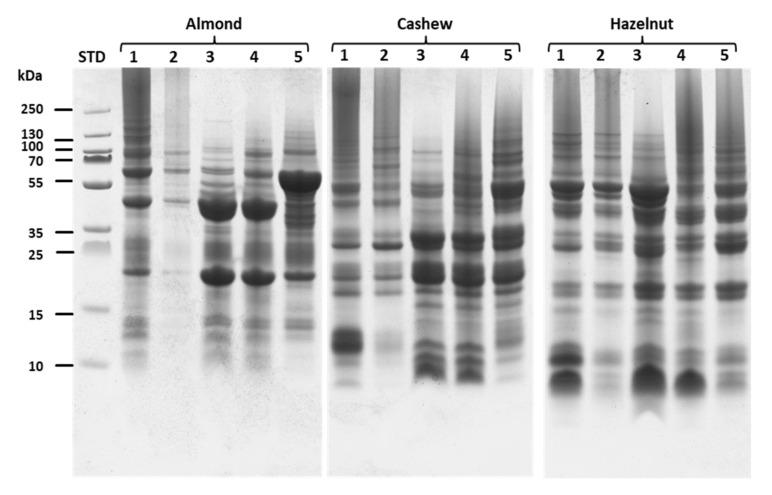
The detection and quantification of nut allergens remains a major challenge. The liquid chroma-tography tandem mass spectrometry (LC-MS/MS) is emerging as one of the most widely used methods, but sample preparation prior to the analysis is still a key issue. The objective of this work was to establish optimized protocols for extraction, tryptic digestion and LC-MS analysis of almond, cashew, hazelnut, peanut, pistachio and walnut samples. Ammonium bicar-bonate/urea extraction (Ambi/urea), SDS buffer extraction (SDS), polyvinylpolypyrroli-done (PVPP) extraction, trichloroacetic acid/acetone extraction (TCA/acetone) and chloro-form/methanol/sodium chloride precipitation (CM/NaCl) as well as the performances of con-ventional tryptic digestion and microwave-assisted breakdown were investigated. Overall, the protein extraction yields ranged from 14.9 ± 0.5 (almond extract from CM/NaCl) to 76.5 ± 1.3% (hazelnut extract from Ambi/urea). Electrophoretic profiling showed that the SDS extraction method clearly presented a high amount of extracted proteins in the range of 0-15 kDa, 15-35 kDa, 35-70 kDa and 70-250 kDa compared to the other methods. The linearity of the LC-MS methods in the range of 0 to 0.4 µg equivalent defatted nut flour was assessed and recovery of internal standards GWGG and DPLNV(d8)LKPR ranged from 80 to 120%. The identified bi-omarkers peptides were used to relatively quantifier selected allergenic protein form the inves-tigated nut samples. Considering the overall results, it can be concluded that SDS buffer allows a better protein extraction from almond, peanut and walnut samples while PVPP buffer is more appropriate for cashew, pistachio and hazelnut samples. It was also found that conventional overnight digestion is indicated for cashew, pistachio and hazelnut samples, while microwave assisted tryptic digestion is recommended for almond, hazelnut and peanut extracts.
坚果过敏原的检测和定量仍然是一个主要挑战。液相色谱-串联质谱(LC-MS/MS)正成为最广泛使用的方法之一,但分析前的样品制备仍然是一个关键问题。本工作的目的是建立优化的杏仁、腰果、榛子、花生、开心果和核桃样品提取、胰蛋白酶消化和 LC-MS 分析的方案。研究了碳酸铵/尿素提取(Ambi/urea)、十二烷基硫酸钠缓冲液提取(SDS)、聚乙烯吡咯烷酮(PVPP)提取、三氯乙酸/丙酮提取(TCA/acetone)和氯仿/甲醇/氯化钠沉淀(CM/NaCl)以及常规胰蛋白酶消化和微波辅助破碎的性能。总体而言,蛋白质提取率范围为 14.9±0.5%(CM/NaCl 法提取的杏仁提取物)至 76.5±1.3%(Ambi/urea 法提取的榛子提取物)。电泳分析表明,与其他方法相比,SDS 提取方法在 0-15 kDa、15-35 kDa、35-70 kDa 和 70-250 kDa 范围内明显呈现出大量提取的蛋白质。在 0 至 0.4 µg 当量脱脂坚果粉范围内评估了 LC-MS 方法的线性度,GWGG 和 DPLNV(d8)LKPR 内标物的回收率在 80%至 120%之间。所鉴定的生物标志物肽被用于相对定量研究中所涉及的坚果样品中的特定过敏原蛋白。综合考虑所有结果,可以得出结论,SDS 缓冲液可以更好地从杏仁、花生和核桃样品中提取蛋白质,而 PVPP 缓冲液更适合腰果、开心果和榛子样品。还发现,常规过夜消化适用于腰果、开心果和榛子样品,而微波辅助胰蛋白酶消化则适用于杏仁、榛子和花生提取物。



 Zotero 插件