Nijs Jo, Lahousse Astrid, Kapreli Eleni, Bilika Paraskevi, Saraçoğlu İsmail, Malfliet Anneleen, Coppieters Iris, De Baets Liesbet, Leysen Laurence, Roose Eva, Clark Jacqui, Voogt Lennard, Huysmans Eva
Pain in Motion Research Group (PAIN), Department of Physiotherapy, Human Physiology and Anatomy, Faculty of Physical Education & Physiotherapy, Vrije Universiteit Brussel, 1050 Brussels, Belgium.
Chronic Pain Rehabilitation, Department of Physical Medicine and Physiotherapy, University Hospital Brussels, 1050 Brussels, Belgium.
J Clin Med. 2021 Jul 21;10(15):3203. doi: 10.3390/jcm10153203.
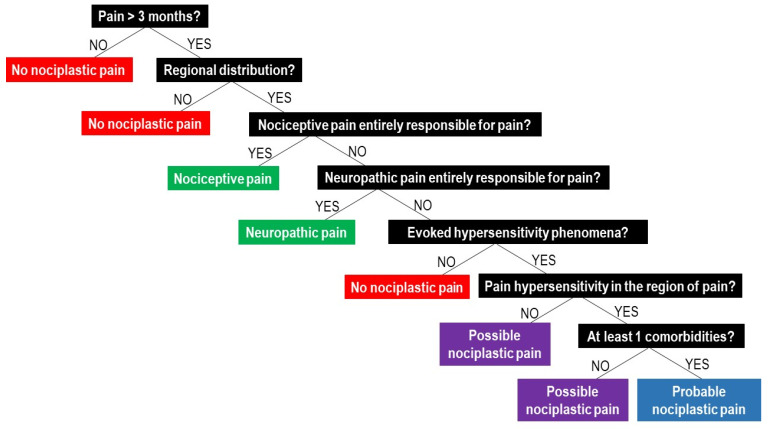
Recently, the International Association for the Study of Pain (IASP) released clinical criteria and a grading system for nociplastic pain affecting the musculoskeletal system. These criteria replaced the 2014 clinical criteria for predominant central sensitization (CS) pain and accounted for clinicians' need to identify (early) and correctly classify patients having chronic pain according to the pain phenotype. Still, clinicians and researchers can become confused by the multitude of terms and the variety of clinical criteria available. Therefore, this paper aims at (1) providing an overview of what preceded the IASP criteria for nociplastic pain ('the past'); (2) explaining the new IASP criteria for nociplastic pain in comparison with the 2014 clinical criteria for predominant CS pain ('the present'); and (3) highlighting key areas for future implementation and research work in this area ('the future'). It is explained that the 2021 IASP clinical criteria for nociplastic pain are in line with the 2014 clinical criteria for predominant CS pain but are more robust, comprehensive, better developed and hold more potential. Therefore, the 2021 IASP clinical criteria for nociplastic pain are important steps towards precision pain medicine, yet studies examining the clinimetric and psychometric properties of the criteria are urgently needed.
最近,国际疼痛研究协会(IASP)发布了影响肌肉骨骼系统的伤害感受性疼痛的临床标准和分级系统。这些标准取代了2014年主要中枢敏化(CS)疼痛的临床标准,并考虑到临床医生需要根据疼痛表型(早期)识别并正确分类患有慢性疼痛的患者。尽管如此,临床医生和研究人员仍可能被众多术语和可用的各种临床标准弄得一头雾水。因此,本文旨在:(1)概述IASP伤害感受性疼痛标准之前的情况(“过去”);(2)将IASP新的伤害感受性疼痛标准与2014年主要CS疼痛的临床标准进行比较并解释(“现在”);(3)强调该领域未来实施和研究工作的关键领域(“未来”)。文中解释说,2021年IASP伤害感受性疼痛临床标准与2014年主要CS疼痛临床标准一致,但更稳健、全面、更完善且更具潜力。因此,2021年IASP伤害感受性疼痛临床标准是迈向精准疼痛医学的重要一步,但迫切需要对这些标准的临床测量和心理测量特性进行研究。