Department of Gastroenterology and Hepatology, Kindai University Faculty of Medicine, Osaka-Sayama, Japan.
Front Immunol. 2021 Jul 23;12:713779. doi: 10.3389/fimmu.2021.713779. eCollection 2021.
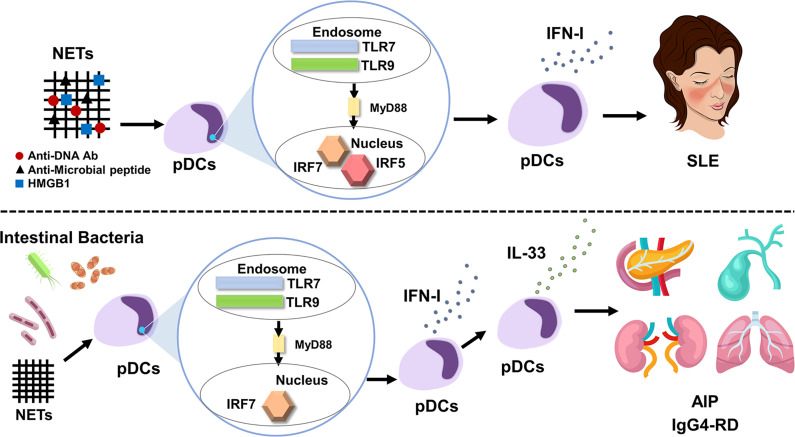
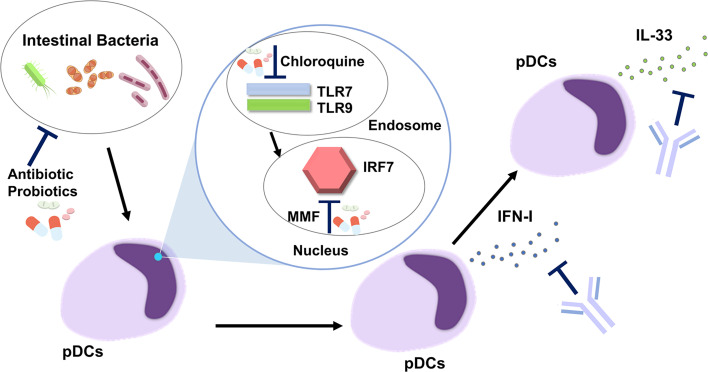
Although plasmacytoid dendritic cells (pDCs) able to produce large amounts of type 1 interferons (IFN-I) play beneficial roles in host defense against viral infections, excessive activation of pDCs, followed by robust production of IFN-I, causes autoimmune disorders including systemic lupus erythematosus (SLE) and psoriasis. Autoimmune pancreatitis (AIP), which is recognized as a pancreatic manifestation of systemic immunoglobulin G4-related disease (IgG4-RD), is a chronic fibroinflammatory disorder driven by autoimmunity. IgG4-RD is a multi-organ autoimmune disorder characterized by elevated serum concentrations of IgG4 antibody and infiltration of IgG4-expressing plasmacytes in the affected organs. Although the immunopathogenesis of IgG4-RD and AIP has been poorly elucidated, recently, we found that activation of pDCs mediates the development of murine experimental AIP and human AIP/IgG4-RD the production of IFN-I and interleukin-33 (IL-33). Depletion of pDCs or neutralization of signaling pathways mediated by IFN-I and IL-33 efficiently inhibited the development of experimental AIP. Furthermore, enhanced expression of IFN-I and IL-33 was observed in the pancreas and serum of human AIP/IgG4-RD. Thus, AIP and IgG4-RD share their immunopathogenesis with SLE and psoriasis because in all these conditions, IFN-I production by pDCs contributes to the pathogenesis. Because the enhanced production of IFN-I and IL-33 by pDCs promotes chronic inflammation and fibrosis characteristic for AIP and IgG4-RD, neutralization of IFN-I and IL-33 could be a new therapeutic option for these disorders. In this Mini Review, we discuss the pathogenic roles played by the pDC-IFN-I-IL-33 axis and the development of a new treatment targeting this axis in AIP and IgG4-RD.
虽然能够大量产生 I 型干扰素 (IFN-I) 的浆细胞样树突状细胞 (pDC) 在宿主抵抗病毒感染方面发挥有益作用,但 pDC 的过度激活会导致 IFN-I 的大量产生,从而引发自身免疫性疾病,包括系统性红斑狼疮 (SLE) 和银屑病。自身免疫性胰腺炎 (AIP) 被认为是系统性 IgG4 相关疾病 (IgG4-RD) 的胰腺表现,是一种由自身免疫驱动的慢性纤维炎症性疾病。IgG4-RD 是一种多器官自身免疫性疾病,其特征是血清 IgG4 抗体浓度升高,受影响器官中浸润 IgG4 表达浆细胞。尽管 IgG4-RD 和 AIP 的免疫发病机制尚未得到充分阐明,但最近我们发现,pDC 的激活介导了实验性 AIP 和人类 AIP/IgG4-RD 的发展,其机制是 IFN-I 和白细胞介素-33 (IL-33) 的产生。pDC 耗竭或 IFN-I 和 IL-33 介导的信号通路的中和有效地抑制了实验性 AIP 的发展。此外,在人类 AIP/IgG4-RD 的胰腺和血清中观察到 IFN-I 和 IL-33 的表达增强。因此,AIP 和 IgG4-RD 与 SLE 和银屑病具有共同的免疫发病机制,因为在所有这些情况下,pDC 产生的 IFN-I 有助于发病机制。由于 pDC 产生的 IFN-I 和 IL-33 的增强促进了 AIP 和 IgG4-RD 的慢性炎症和纤维化,因此 IFN-I 和 IL-33 的中和可能成为这些疾病的新治疗选择。在这篇综述中,我们讨论了 pDC-IFN-I-IL-33 轴的致病作用以及针对该轴的新治疗方法在 AIP 和 IgG4-RD 中的发展。