Systems Medicine, Deutsches Zentrum für Neurodegenerative Erkrankungen (DZNE), Bonn, Germany.
Genomics & Immunoregulation, Life & Medical Sciences (LIMES) Institute, University of Bonn, Bonn, Germany.
Front Immunol. 2021 Jul 21;12:720109. doi: 10.3389/fimmu.2021.720109. eCollection 2021.
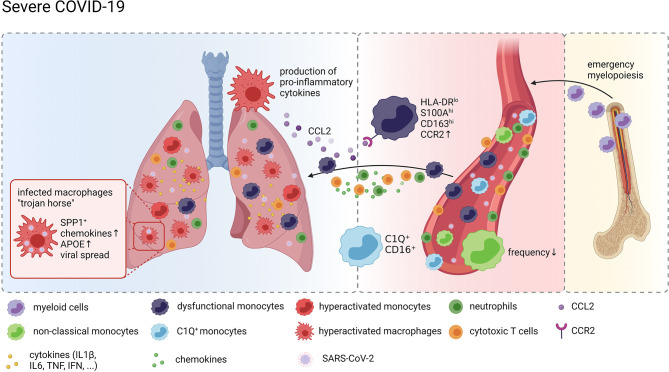
COVID-19 is a contagious viral disease caused by SARS-CoV-2 that led to an ongoing pandemic with massive global health and socioeconomic consequences. The disease is characterized primarily, but not exclusively, by respiratory clinical manifestations ranging from mild common cold symptoms, including cough and fever, to severe respiratory distress and multi-organ failure. Macrophages, a heterogeneous group of yolk-sac derived, tissue-resident mononuclear phagocytes of complex ontogeny present in all mammalian organs, play critical roles in developmental, homeostatic and host defense processes with tissue-dependent plasticity. In case of infection, they are responsible for early pathogen recognition, initiation and resolution of inflammation, as well as repair of tissue damage. Monocytes, bone-marrow derived blood-resident phagocytes, are recruited under pathological conditions such as viral infections to the affected tissue to defend the organism against invading pathogens and to aid in efficient resolution of inflammation. Given their pivotal function in host defense and the potential danger posed by their dysregulated hyperinflammation, understanding monocyte and macrophage phenotypes in COVID-19 is key for tackling the disease's pathological mechanisms. Here, we outline current knowledge on monocytes and macrophages in homeostasis and viral infections and summarize concepts and key findings on their role in COVID-19. While monocytes in the blood of patients with moderate COVID-19 present with an inflammatory, interferon-stimulated gene (ISG)-driven phenotype, cellular dysfunction epitomized by loss of HLA-DR expression and induction of S100 alarmin expression is their dominant feature in severe disease. Pulmonary macrophages in COVID-19 derived from infiltrating inflammatory monocytes are in a hyperactivated state resulting in a detrimental loop of pro-inflammatory cytokine release and recruitment of cytotoxic effector cells thereby exacerbating tissue damage at the site of infection.
COVID-19 是一种由 SARS-CoV-2 引起的传染性病毒性疾病,导致了一场持续的大流行,对全球健康和社会经济造成了巨大影响。这种疾病的主要特征,但其并不完全局限于呼吸道临床表现,包括咳嗽和发热等轻度普通感冒症状,以及严重的呼吸窘迫和多器官衰竭等。
巨噬细胞是一组异质的卵黄囊衍生的组织驻留单核吞噬细胞,具有复杂的个体发生,存在于所有哺乳动物器官中,在发育、稳态和宿主防御过程中发挥关键作用,具有组织依赖性的可塑性。在感染的情况下,它们负责早期病原体识别、炎症的启动和解决,以及组织损伤的修复。单核细胞是骨髓来源的血液驻留吞噬细胞,在病毒感染等病理条件下被招募到受影响的组织中,以保护机体免受入侵病原体的侵害,并有助于有效解决炎症。鉴于它们在宿主防御中的关键作用,以及其失调性过度炎症所带来的潜在危险,了解 COVID-19 中的单核细胞和巨噬细胞表型是解决该疾病病理机制的关键。
在这里,我们概述了单核细胞和巨噬细胞在稳态和病毒感染中的现有知识,并总结了它们在 COVID-19 中的作用的概念和关键发现。虽然中度 COVID-19 患者血液中的单核细胞表现出炎症性、干扰素刺激基因(ISG)驱动的表型,但以 HLA-DR 表达丧失和 S100 警报素表达诱导为特征的细胞功能障碍是其严重疾病的主要特征。COVID-19 中的肺巨噬细胞来源于浸润性炎症单核细胞,处于超激活状态,导致促炎细胞因子释放和细胞毒性效应细胞募集的有害循环,从而加重感染部位的组织损伤。