van der Bijl Wouter, Mank Judith E
Department of Zoology University of British Columbia Vancouver BC V6T 1Z4 Canada.
Biodiversity Research Centre University of British Columbia Vancouver BC V6T 1Z4 Canada.
Evol Lett. 2021 Jul 3;5(4):359-369. doi: 10.1002/evl3.245. eCollection 2021 Aug.
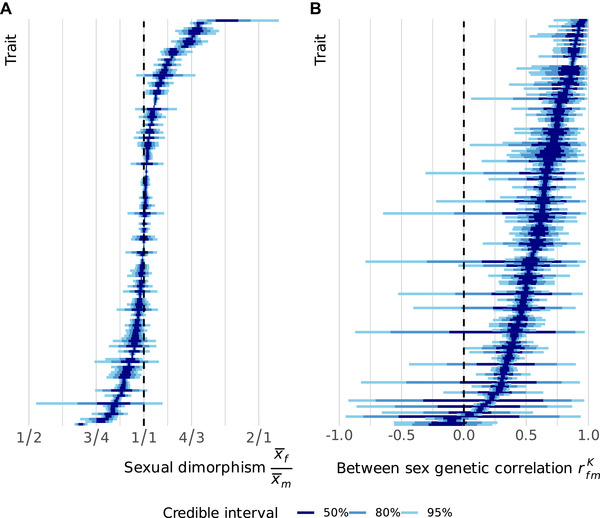
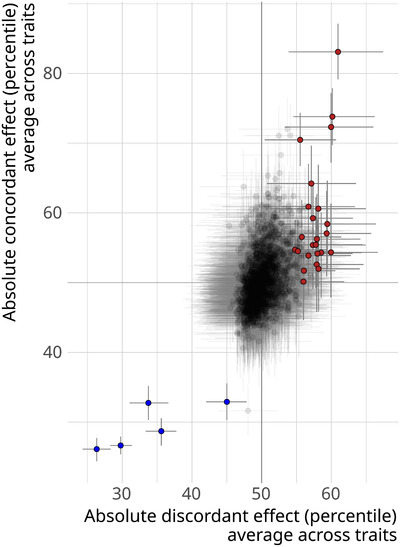
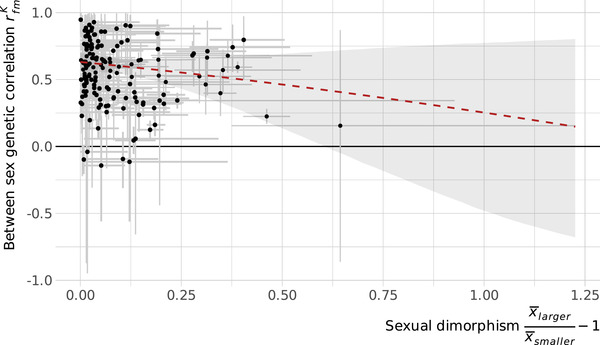
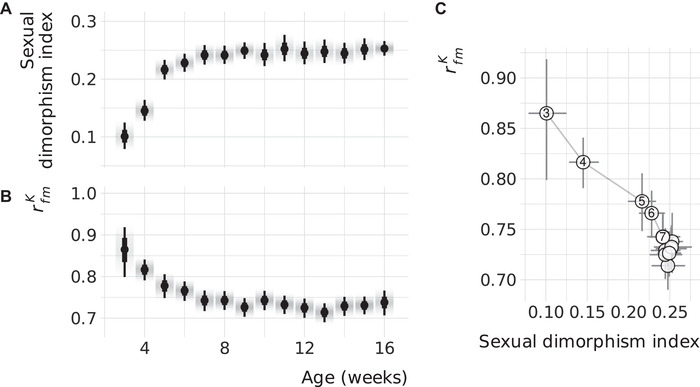
The majority of the genome is shared between the sexes, and it is expected that the genetic architecture of most traits is shared as well. This common architecture has been viewed as a major source of constraint on the evolution of sexual dimorphism (SD). SD is nonetheless common in nature, leading to assumptions that it results from differential regulation of shared genetic architecture. Here, we study the effect of thousands of gene knockout mutations on 202 mouse phenotypes to explore how regulatory variation affects SD. We show that many traits are dimorphic to some extent, and that a surprising proportion of knockouts have sex-specific phenotypic effects. Many traits, regardless whether they are monomorphic or dimorphic, harbor cryptic differences in genetic architecture between the sexes, resulting in sexually discordant phenotypic effects from sexually concordant regulatory changes. This provides an alternative route to dimorphism through sex-specific genetic architecture, rather than differential regulation of shared architecture.
大多数基因组在两性之间是共享的,并且预计大多数性状的遗传结构也是共享的。这种共同的结构被视为对性二态性(SD)进化的主要限制来源。然而,SD在自然界中很常见,这导致人们认为它是由共享遗传结构的差异调节引起的。在这里,我们研究了数千个基因敲除突变对202种小鼠表型的影响,以探索调控变异如何影响SD。我们表明,许多性状在某种程度上是二态的,并且令人惊讶的是,有相当比例的基因敲除具有性别特异性的表型效应。许多性状,无论它们是单态的还是二态的,在两性之间的遗传结构中都存在隐秘的差异,导致来自性别一致的调控变化的性别不一致的表型效应。这为通过性别特异性遗传结构而不是共享结构的差异调节来实现二态性提供了一条替代途径。