Berg Carla J, Duan Xuejing, Getachew Betelihem, Pulvers Kim, Crawford Natalie D, Sussman Steve, Ma Yan, Jones-Harrell Carla, Henriksen Lisa
Department of Prevention and Community Health, Milken Institute School of Public Health, George Washington University, Washington, DC, United States.
Biostatistics and Epidemiology Consulting Service, Milken Institute School of Public Health, George Washington University, Washington, DC, United States.
Tob Regul Sci. 2021 Jan;7(1):59-75. doi: 10.18001/trs.7.1.5.
Given the need to understand e-cigarette retail and its impact, we examined sociodemographic, tobacco and marijuana use, and e-cigarette retail experiences as correlates of (1) past 30-day e-cigarette use, (2) past 30-day advertising/media exposure, and (3) point-of-sale age verification among young adults.
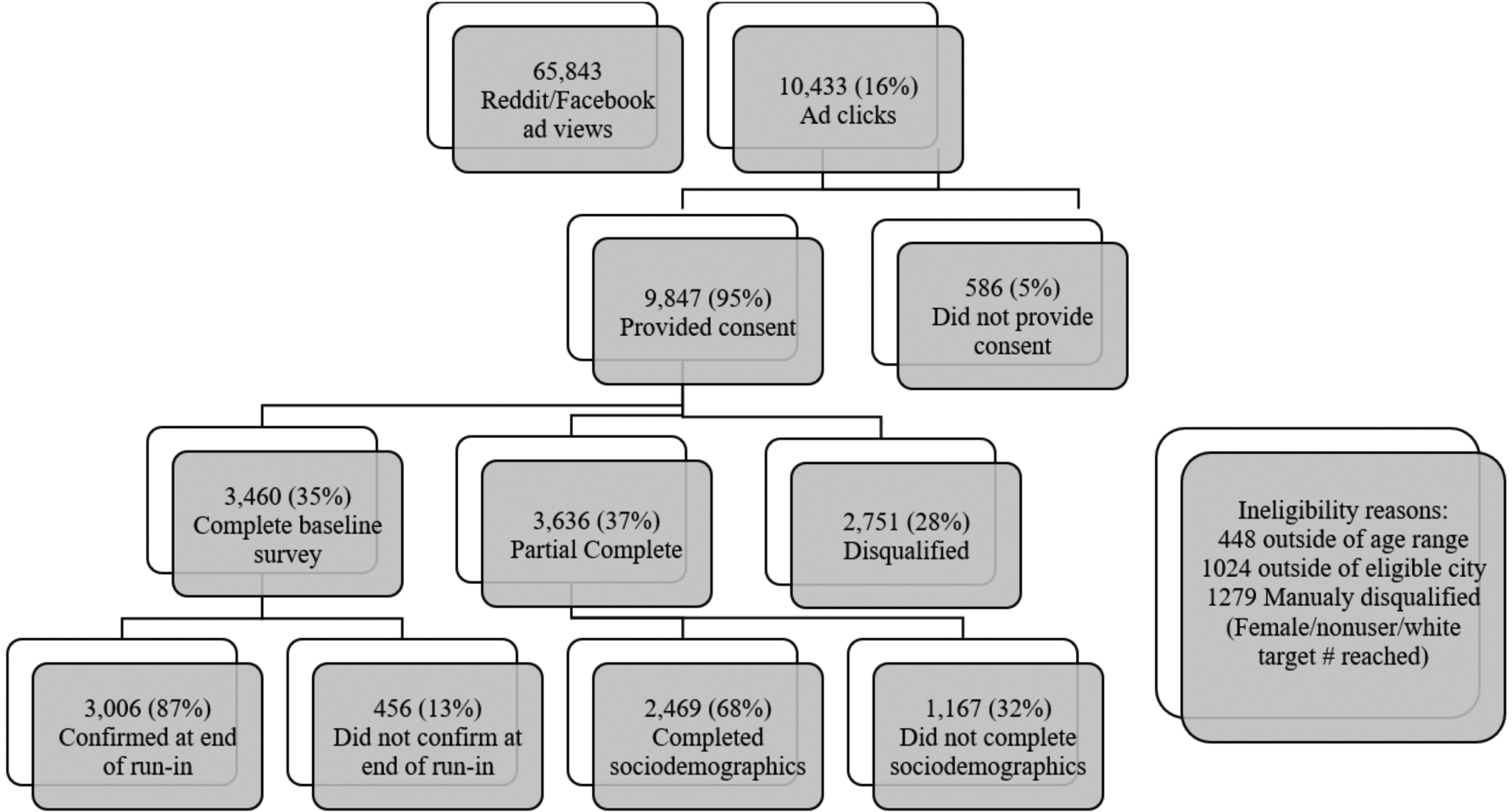
We analyzed baseline survey data (September-December, 2018) among 3006 young adults (ages 18-34) in 6 metropolitan areas (Atlanta, Boston, Minneapolis, Oklahoma City, San Diego, Seattle) in a 2-year longitudinal study.
In this sample (M = 24.6, 42.3% male, 71.6% white, 11.4% Hispanic), 37.7% (N = 1133) were past 30-day e-cigarette users; 68.6% (N = 2062; non-users: 66.0%, users: 72.9%) reported past 30-day e-cigarette-related advertising/media exposure. Among e-cigarette users, vape shops were the most common source of e-cigarettes (44.7%) followed by online (18.2%). Among users, 34.2% were "almost always" asked for age verification. In multilevel logistic regression, e-cigarette use and advertising/media exposure were correlated (and both correlated with being younger). E-cigarette use also correlated with other tobacco product and marijuana use (and being male and white). Infrequent age verification correlated with commonly purchasing e-cigarettes online (and being older and black).
Increased efforts are needed to reduce young adult advertising/media exposure and increase retailer compliance among retailers, particularly online and vape shops.
鉴于有必要了解电子烟零售及其影响,我们研究了社会人口统计学、烟草和大麻使用情况,以及电子烟零售体验与(1)过去30天内电子烟使用、(2)过去30天内广告/媒体曝光,以及(3)年轻人销售点年龄验证之间的相关性。
在一项为期两年的纵向研究中,我们分析了2018年9月至12月期间6个大都市地区(亚特兰大、波士顿、明尼阿波利斯、俄克拉荷马城、圣地亚哥、西雅图)3006名年轻人(18 - 34岁)的基线调查数据。
在这个样本中(平均年龄M = 24.6岁,男性占42.3%,白人占71.6%,西班牙裔占11.4%),37.7%(N = 1133)在过去30天内使用过电子烟;68.6%(N = 2062;非使用者:66.0%,使用者:72.9%)报告在过去30天内接触过与电子烟相关的广告/媒体。在电子烟使用者中,电子烟商店是最常见获得电子烟的来源(44.7%),其次是网络(18.2%)。在使用者中,34.2%“几乎总是”被要求进行年龄验证。在多水平逻辑回归分析中,电子烟使用与广告/媒体曝光相关(且两者均与年龄较小相关)。电子烟使用还与其他烟草制品和大麻使用相关(以及与男性和白人相关)。不经常进行年龄验证与通常在网上购买电子烟相关(以及与年龄较大和黑人相关)。
需要加大力度减少年轻人的广告/媒体曝光,并提高零售商(尤其是在线零售商和电子烟商店)的合规性。