Gani Linsey, Anthony Natasha, Dacay Lily, Tan Pei, Chong Le Roy, King Thomas Fj
Department of Endocrinology Department of Medicine Changi General Hospital 2 Simei Street 3 529889 Singapore Singapore.
Centre of Trial Research Unit Changi General Hospital Singapore Singapore.
JBMR Plus. 2021 Jun 19;5(8):e10515. doi: 10.1002/jbm4.10515. eCollection 2021 Aug.
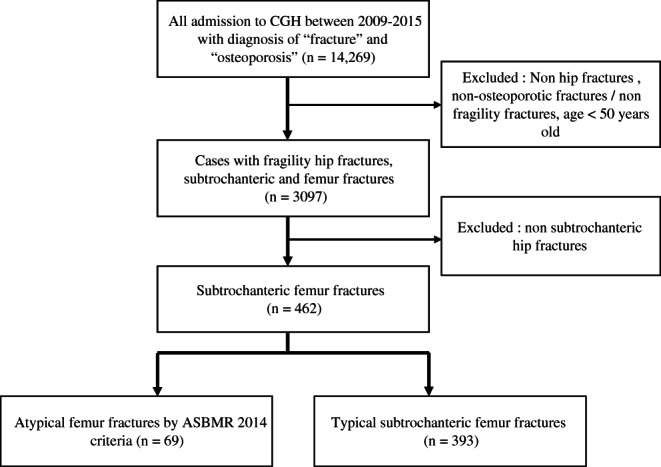
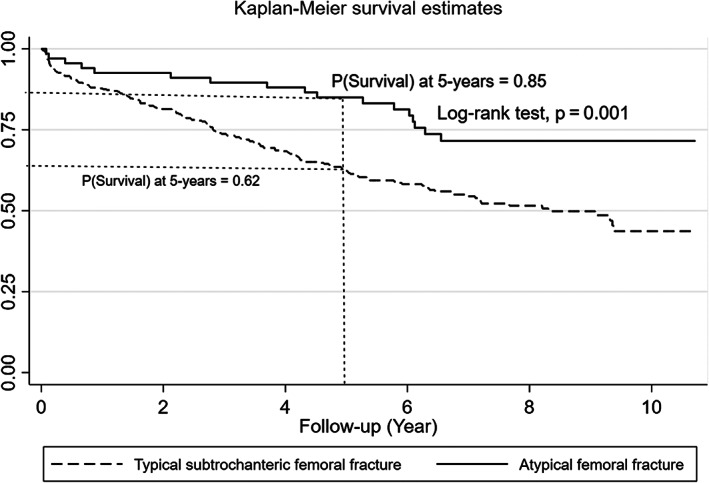
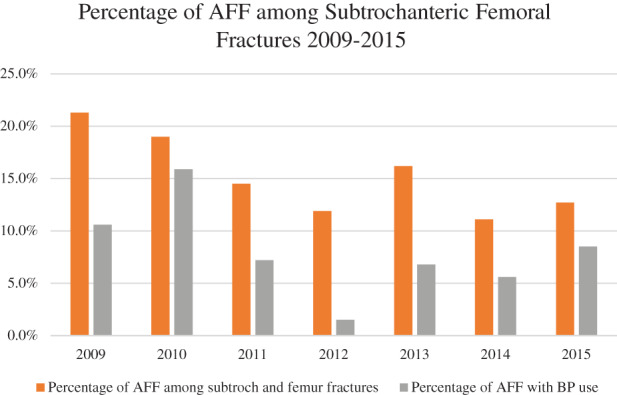
Bisphosphonates (BP) are the most commonly prescribed effective form of osteoporosis treatment with adverse effects associated with prolonged use such as atypical femoral fractures (AFF). Asians have an elevated risk of AFF at 5 to 6 times those of whites and Hispanics. In this study, we characterize factors associated with AFF and its mortality in a single center in Singapore. We conducted a cohort study of subjects older than 50 years admitted to Changi General Hospital (CGH), Singapore, with fragility subtrochanteric femoral fractures from 2009 to 2015. Using the ASBMR 2014 criteria, fractures are classified into atypical and typical subtrochanteric femoral fractures. CGH uses a nationalized electronic health record that allows review of information on patients' demographics, clinical history and previous investigations. Mortality was assessed as of December 31, 2019. Between 2009 and 2015, there were 3097 hip fractures, of which 393 were subtrochanteric femoral fractures and 69 were classified as AFF by ASBMR 2014 criteria. A total of 52.2% of AFF occurred with BP exposure of median duration 56.5 (28 to 66) months. Multivariate regression showed that BP exposure was associated with the highest risk of AFF (odds ratio [OR] = 6.65 [2.35-18.9]). AFF patients had higher 5-year survival (0.85 versus 0.62, = 0.001) compared with typical subtrochanteric fracture patients. However, after adjusting for variables, the type of subtrochanteric femoral fractures were no longer significantly associated with progression to death, whereas older age, higher mean Charlson comorbidity score, and Malay ethnicity were the strongest predictors of death. AFF constitutes a small proportion of hip and femoral fractures with prolonged BP use being the highest risk factor for its development. There is no evidence of increased mortality or morbidity in patients with AFF compared with the typical subtrochanteric fracture. The fear of AFF should not impede treatment of typical osteoporotic fractures in this population. © 2021 The Authors. published by Wiley Periodicals LLC on behalf of American Society for Bone and Mineral Research.
双膦酸盐(BP)是最常用的骨质疏松症治疗有效药物,但长期使用会产生不良反应,如非典型股骨骨折(AFF)。亚洲人发生AFF的风险比白人和西班牙裔高5至6倍。在本研究中,我们对新加坡单一中心与AFF及其死亡率相关的因素进行了特征分析。我们对2009年至2015年入住新加坡樟宜综合医院(CGH)、年龄超过50岁且因脆性股骨转子下骨折入院的患者进行了队列研究。根据2014年美国骨与矿物质研究学会(ASBMR)的标准,将骨折分为非典型和典型股骨转子下骨折。CGH使用全国性电子健康记录,可查阅患者的人口统计学信息、临床病史和既往检查资料。截至2019年12月31日评估死亡率。2009年至2015年期间,共发生3097例髋部骨折,其中393例为股骨转子下骨折,根据2014年ASBMR标准,69例被归类为AFF。共有52.2%的AFF发生在BP暴露中位数为56.5(28至66)个月的情况下。多变量回归显示,BP暴露与AFF的最高风险相关(比值比[OR]=6.65[2.35 - 18.9])。与典型股骨转子下骨折患者相比,AFF患者的5年生存率更高(0.85对0.62,P = 0.001)。然而,在对变量进行调整后,股骨转子下骨折的类型与死亡进展不再显著相关,而年龄较大、平均查尔森合并症评分较高和马来族裔是死亡的最强预测因素。AFF在髋部和股骨骨折中占比小,长期使用BP是其发生的最高风险因素。与典型股骨转子下骨折患者相比,没有证据表明AFF患者的死亡率或发病率增加。对AFF的担忧不应妨碍该人群中典型骨质疏松性骨折的治疗。© 2021作者。由Wiley Periodicals LLC代表美国骨与矿物质研究学会出版。