Chin Jacinta, Green Sarah B, McKamey Lacie J, Gooch Michael D, Chapin Ryan W, Gould Alyssa P, Milliken Stephanie F, Blanchette Lisa M
Novant Health, Department of Pharmacy, USA.
Infect Prev Pract. 2019 Aug 15;1(2):100019. doi: 10.1016/j.infpip.2019.100019. eCollection 2019 Jun.
Fluoroquinolone (FQ) antibiotics have become a target of many antimicrobial stewardship programmes. Multiple post-marketing warnings from the Food and Drug Administration caution against use of this drug class for certain infections due to risk of harmful adverse effects outweighing benefit. Commonly employed strategies to affect antibiotic prescribing can be restrictive and without improvement in overall antibiotic appropriateness or decrease in collateral damage.
To develop a strategy for sustainable optimization of FQ antibiotics.
Multi-state health-system of 14 hospitals and medical centers.
The health-system antimicrobial stewardship program identified the opportunity to improve FQ utilization. In collaboration with our data and analytics team, specific targets of FQ use in pneumonia and chronic obstructive pulmonary disease were established. Face-to-face provider education and prospective audit and feedback were the mainstays of the campaign. Enhancements to the electronic medical record to support the initiative were also implemented.
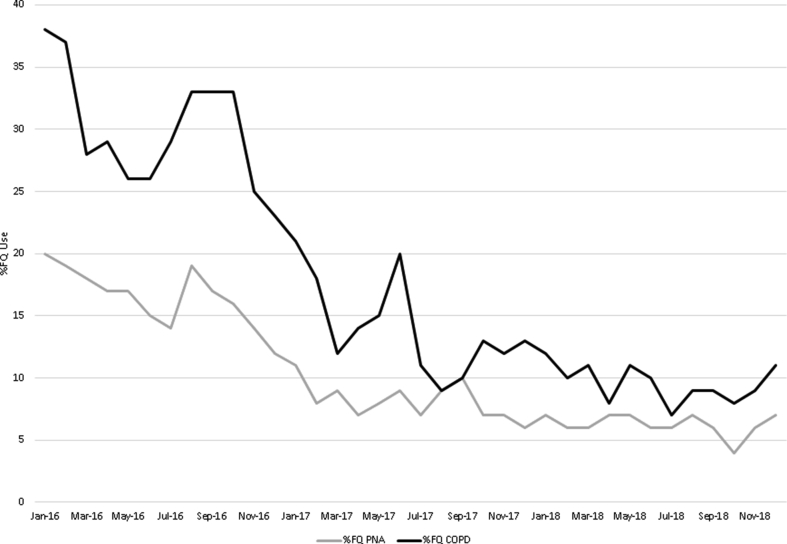
There was an overall decrease in FQ utilization by 56.9%. For pneumonia use of FQs decreased from 16.4% to 8.1% and in COPD changed from 29.6% to 9.7% over the same time period.
A non-restrictive FQ optimization initiative based on education and feedback decreased both FQ consumption and total antibiotic use across a large multi-hospital health-system.
氟喹诺酮(FQ)类抗生素已成为许多抗菌药物管理计划的目标。美国食品药品监督管理局发布的多项上市后警告提醒,由于有害副作用的风险超过益处,应避免将此类药物用于某些感染。常用的影响抗生素处方的策略可能具有限制性,且无法提高整体抗生素使用的合理性或减少附带损害。
制定一项可持续优化FQ类抗生素使用的策略。
由14家医院和医疗中心组成的多州医疗系统。
该医疗系统的抗菌药物管理计划发现了改善FQ使用情况的机会。与数据和分析团队合作,确定了肺炎和慢性阻塞性肺疾病中FQ使用的具体目标。面对面的医生教育以及前瞻性审核和反馈是该活动的主要内容。还对电子病历进行了改进以支持该倡议。
FQ的总体使用量下降了56.9%。在同一时期,肺炎患者中FQ的使用从16.4%降至8.1%,慢性阻塞性肺疾病患者中FQ的使用从29.6%降至9.7%。
一项基于教育和反馈的非限制性FQ优化倡议降低了大型多医院医疗系统中FQ的消耗量和抗生素的总体使用量。